












Single-chain crosslinked polymers via the transesterification of folded polymers: from efficient synthesis to crystallinity control
Literature Information
Publication Date
2020-07-07
DOI
10.1039/D0PY00758G
Impact Factor
5.582
Authors
Daiki Ito, Yoshihiko Kimura, Makoto Ouchi, Takaya Terashima
View Original
Abstract
Herein we report efficient synthetic systems of single-chain crosslinked polymers via the intramolecular transesterification of folded random copolymers in organic media and the unique crystallization behavior of their crosslinked polymers. For this purpose, we designed random terpolymers comprising octadecyl methacrylate (ODMA), 2-hydroxyethyl methacrylate, and methyl acrylate (MA). The copolymers self-folded in octane via the association of the hydroxyl groups to form reverse micelles; the micelles were intramolecularly crosslinked by scandium-mediated transesterification of the MA units with the hydroxyl groups to give polymer nanoparticles bearing multiple octadecyl groups. This system affords efficient synthesis of various single-chain crosslinked polymers with controlled molecular weight at a relatively high concentration of up to 50 mg mL−1. Additionally, the crystallinity of these ODMA-based copolymers can be controlled by the crosslinking degree; the crystallinity and melting temperatures of the octadecyl groups gradually decreased as the intramolecular crosslinking of the copolymers proceeded. Thus, controlling the intramolecular crosslinking of polymers is one possibility to tune the crystallinity of polymer materials.
Related Literature
A novel paper-based colorimetry device for the determination of the albumin to creatinine ratio
Sudkate Chaiyo, Kurt Kalcher, Amara Apilux, Orawon Chailapakul, Weena Siangproh
2018-10-09
Paper
DOI: 10.1039/C8AN01122B
Correction: The mechanism and regularity of quenching the effect of bases on fluorophores: the base-quenched probe method
Huihui Mao, Guanghua Luo, Yuxia Zhan, Jun Zhang, Shuang Yao, Yang Yu
2018-10-01
Correction
DOI: 10.1039/C8AN90083C
Fully convolutional neural network for removing background in noisy images of uranium bearing particles
Jay G. Tarolli, Benjamin E. Naes, Lamar Butler, Keeyahna Foster, Caleb M. Gumbs, Andrea L. Howard, David Willingham
2017-03-31
Paper
DOI: 10.1039/C7AN00175D
Electrochemical aptasensors for zeatin detection based on MoS2 nanosheets and enzymatic signal amplification
Yunlei Zhou, Huanshun Yin, Yue Wang, Chengji Sui, Minghui Wang, Shiyun Ai
2018-09-07
Paper
DOI: 10.1039/C8AN01356J
Interaction study of cancer cells and fibroblasts on a spatially confined oxygen gradient microfluidic chip to investigate the tumor microenvironment
Wei Sun, Yuqing Chen, Yuerong Wang, Pei Luo, Min Zhang, Hongyang Zhang, Ping Hu
2018-10-01
Paper
DOI: 10.1039/C8AN01216D
Determination of the illegal adulteration of natural healthcare products with chemical drugs using surface-enhanced Raman scattering
Jiawei Wu, Lixia Zhang, Xiangfeng Bu, Peng Li, Bing Zhao, Yuan Tian
2018-09-18
Paper
DOI: 10.1039/C8AN01286E
Quantitative NMR of quadrupolar nucleus as a novel analytical method: hydrolysis behaviour analysis of aluminum ion
Genki Sakata, Minoru Mizuhata
2017-04-19
Paper
DOI: 10.1039/C7AN00067G
Effects and controls of capacitive hysteresis in ionic liquid electrochemical measurements
Anthony J. Lucio, Scott K. Shaw
2018-08-29
Paper
DOI: 10.1039/C8AN01085D
Infrared imaging of high density protein arrays
Joëlle De Meutter, Julie Vandenameele, André Matagne, Erik Goormaghtigh
2016-11-28
Paper
DOI: 10.1039/C6AN02048H
You might also like
Compound Q&A
What is the market or research trend for N-(4-Methoxybenzyl)-2-pyridinamine (CAS: 52818-63-0)?
N-(4-Methoxybenzyl)-2-pyridinamine (CAS: 52818-63-0) is increasingly being used ...
52818-63-0N-(4-Methoxybenzyl)-...
Compound Q&A
What precautions should be taken when handling Ethyl 4-(2-chlorophenyl)-1,3-thiazole-2-carboxylate (CAS: 1050507-06-6)?
When handling Ethyl 4-(2-chlorophenyl)-1,3-thiazole-2-carboxylate, appropriate p...
1050507-06-6Ethyl 4-(2-chlorophe...
Compound Q&A
What regulatory guidelines apply to diethyldiselane (CAS: 628-39-7)?
Diethyldiselane (CAS: 628-39-7) is classified under the Globally Harmonized Syst...
628-39-7Diethyldiselane
Compound Q&A
What is the market or research trend for oxocopper (CAS: 12053-18-8)?
The market for oxocopper (CAS: 12053-18-8) is primarily driven by its use in cat...
12053-18-8oxocopper; oxo-(oxoc...
Compound Q&A
What is the market or research trend for 5-{[(2-Methyl-2-propanyl)oxy]carbonyl}-5-azaspiro[2.4]heptane-7-carboxylic acid?
The market for 5-{[(2-Methyl-2-propanyl)oxy]carbonyl}-5-azaspiro[2.4]heptane-7-c...
1268519-54-55-{[(2-Methyl-2-prop...
Compound Q&A
What is 2-(1-Pyrrolidinyl)-4-pyridinamine (CAS: 35981-63-6)?
2-(1-Pyrrolidinyl)-4-pyridinamine is a chemical compound with the CAS number 359...
35981-63-62-(1-Pyrrolidinyl)-4...
Compound Q&A
What are the physical and chemical properties of 2-(3-Pyridinyl)-1-azabicyclo[2.2.2]octane (CAS: 91556-75-1)?
2-(3-Pyridinyl)-1-azabicyclo[2.2.2]octane (CAS: 91556-75-1) is a crystalline sol...
91556-75-12-(3-Pyridinyl)-1-az...
Compound Q&A
How is (S)-Alpha-allyl-proline hydrochloride (CAS: 129704-91-2) typically synthesized?
(S)-Alpha-allyl-proline hydrochloride is usually synthesized via a Wittig reacti...
129704-91-2(S)-Alpha-allyl-prol...
Compound Q&A
What is 3-Methyl-1,2-oxazole-5-carboxylic acid (CAS: 4857-42-5)?
3-Methyl-1,2-oxazole-5-carboxylic acid (CAS: 4857-42-5) is an organic compound w...
4857-42-53-Methyl-1,2-oxazole...
Compound Q&A
How is Lys-SMCC-DM1 (CAS: 1281816-04-3) typically synthesized?
Lys-SMCC-DM1 is synthesized via a multi-step process involving the coupling of S...
1281816-04-3Lys-SMCC-DM1
Source Journal
Polymer Chemistry

CiteScore:
8.6
Self-citation Rate:
7.3%
Articles per Year:
457
Polymer Chemistry welcomes submissions in all areas of polymer science that have a strong focus on macromolecular chemistry. Manuscripts may cover a broad range of fields, yet no direct application focus is required.
Recommended Compounds
![5'-Fluoro-[2,3'-biindolinylidene]-2',3-dione structure](https://static.chemtradehub.com/structs/251/251903-00-1-9cb1.webp "5'-Fluoro-[2,3'-biindolinylidene]-2',3-dione structure")
![1-[6-(1H-Imidazol-1-yl)-3-pyridinyl]methanamine structure](https://static.chemtradehub.com/structs/914/914637-08-4-8825.webp "1-[6-(1H-Imidazol-1-yl)-3-pyridinyl]methanamine structure")
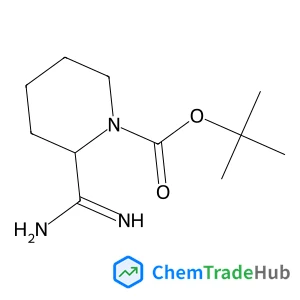
2-Methyl-2-propanyl 2-carbamimidoyl-1-piperidinecarboxylate
CAS Number:
1258640-98-0
Molecular Formula:
C11H21N3O2
Recommended Suppliers





Disclaimer
This page provides academic journal information for reference and research purposes only. We are not affiliated with any journal publishers and do not handle publication submissions. For publication-related inquiries, please contact the respective journal publishers directly.
If you notice any inaccuracies in the information displayed, please contact us at support@chemtradehub.com. We will promptly review and address your concerns.