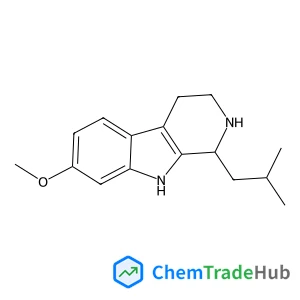
1-Isobutyl-7-methoxy-2,3,4,9-tetrahydro-1H-beta-carboline
CAS Number:
175975-76-5
Molecular Formula:
C16H22N2O
Sudkate Chaiyo, Kurt Kalcher, Amara Apilux, Orawon Chailapakul, Weena Siangproh
A novel paper-based analytical device (PAD) was fabricated and developed for the simple and rapid determination of the albumin to creatinine ratio (ACR) in urine samples. The detection was based on a colorimetric reaction using bromocresol green (BG) in a phosphate buffer (PB) at pH 4 for the determination of albumin (AL) and creatinine (CR). BG changes color from greenish-yellow to bluish-green in the presence of AL and/or CR. Picric acid (PA) in 0.25 M NaOH was used to detect CR, and PA changes color from yellow to orange. Under the optimal conditions, the working range was 10 to 350 mg dL−1 with a detection limit of 7.1 and 5.4 mg dL−1 for AL + CR and CR detection, respectively. The repeatability was evaluated, and the %RSD value was less than 8.23 (n = 10). The ACR was obtained by calculating the AL and CR colorimetric results. Finally, the proposed devices were applied to the determination of AL, CR, and ACR in urine samples. The results obtained by the developed PADs were in good agreement with the standard method and demonstrated the method could reliably measure AL, CR, and ACR. The proposed method provides a low-cost, simple, sensitive, and promising tool for diagnostic identification assay for chronic kidney disease (CKD).
Sunghyun Uhm
DOI: 10.1039/C3CP50885D
Xin Zeng, Stevin S. Pramana, Sudip K. Batabyal, Xiaodong Chen, K. B. Jinesh
DOI: 10.1039/C3CP43470B
Ruguang Ma, Mingjun Hu, Hua Cheng, Yang Yang Li
DOI: 10.1039/C3CP50588J
Ping Wu, Pan Du, Hui Zhang, Chenxin Cai
DOI: 10.1039/C3CP50900A
Qian Gou, Gang Feng, Luca Evangelisti, Alberto Lesarri, Emilio J. Cocinero, Walther Caminati
DOI: 10.1039/C3CP50306B
Kai Welke, Hiroshi C. Watanabe, Tino Wolter, Marcus Elstner
DOI: 10.1039/C3CP44181D
Magali Duvail, Jean-François Dufrêche, Lise Arleth, Thomas Zemb
DOI: 10.1039/C3CP43981J
Stephan Menzel, Stefan Tappertzhofen, Ilia Valov
DOI: 10.1039/C3CP50738F
ZhenHua Zeng, Mårten E. Björketun, Sune Ebbesen, Mogens B. Mogensen, Jan Rossmeisl
DOI: 10.1039/C3CP51099A
N-(4-Methoxybenzyl)-2-pyridinamine (CAS: 52818-63-0) is increasingly being used ...
When handling Ethyl 4-(2-chlorophenyl)-1,3-thiazole-2-carboxylate, appropriate p...
Diethyldiselane (CAS: 628-39-7) is classified under the Globally Harmonized Syst...
The market for oxocopper (CAS: 12053-18-8) is primarily driven by its use in cat...
The market for 5-{[(2-Methyl-2-propanyl)oxy]carbonyl}-5-azaspiro[2.4]heptane-7-c...
2-(1-Pyrrolidinyl)-4-pyridinamine is a chemical compound with the CAS number 359...
2-(3-Pyridinyl)-1-azabicyclo[2.2.2]octane (CAS: 91556-75-1) is a crystalline sol...
(S)-Alpha-allyl-proline hydrochloride is usually synthesized via a Wittig reacti...
3-Methyl-1,2-oxazole-5-carboxylic acid (CAS: 4857-42-5) is an organic compound w...
Lys-SMCC-DM1 is synthesized via a multi-step process involving the coupling of S...

Analyst publishes analytical and bioanalytical research that reports premier fundamental discoveries and inventions, and the applications of those discoveries, unconfined by traditional discipline barriers.
![1-{3-[4-Amino-3-(4-phenoxyphenyl)-1H-pyrazolo[3,4-d]pyrimidin-1-yl]-1-piperidinyl}-2,3-dihydroxy-1-propanone structure](https://static.chemtradehub.com/structs/122/1226872-27-0-e037.webp "1-{3-[4-Amino-3-(4-phenoxyphenyl)-1H-pyrazolo[3,4-d]pyrimidin-1-yl]-1-piperidinyl}-2,3-dihydroxy-1-propanone structure")