












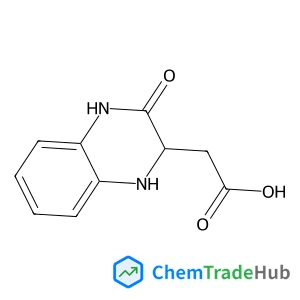
(3-Oxo-1,2,3,4-tetrahydro-2-quinoxalinyl)acetic acid
CAS Number:
136584-14-0
Molecular Formula:
C10H10N2O3
Ekaterina S. Sazanova, Iuliia A. Gracheva, Diane Allegro, Pascale Barbier, Elena V. Svirshchevskaya, Alexey Yu Fedorov
We describe an attempt to apply the concept of covalent binding towards the highly active allocolchicinoids selected on the basis of SAR analysis of previously synthesized molecules. To achieve the irreversible binding of the agent to the cysteine residues of the colchicine site of tubulin protein, we synthesized a number of new allocolchicinoids bearing the acceptor moiety. Some of the new derivatives possess cytotoxic activity against COLO-357, BxPC-3, HaCaT, and HEK293 cell lines in a low nanomolar range of concentrations. A substoichiometric mode of microtubule assembly inhibition was demonstrated. The most active compounds possess close to colchicine general toxicity on mice.
S. Mandal, R. Gopal, M. Shcherbinin, A. D’Elia, H. Srinivas, R. Richter, B. Bapat, S. R. Krishnan, V. Sharma
DOI: 10.1039/D0CP00689K
Mahendra Bhujel, David L. Marshall, Alan T. Maccarone, Benjamin I. McKinnon, Adam J. Trevitt, Gabriel da Silva, Stephen J. Blanksby, Berwyck L. J. Poad
DOI: 10.1039/D0CP01498B
Kwang-Hyon Kim
DOI: 10.1039/D0CP00150C
Jing Zhang, Chen Chen, Jianuan Pan, Li Zhang, Lijun Liang, Zhe Kong, Xinping Wang, Wei Zhang, Jia-Wei Shen
DOI: 10.1039/D0CP00071J
V. A. Eremin, M. V. Ananyev, H. J. M. Bouwmeester, E. Kh. Kurumchin, Ch.-Y. Yoo
DOI: 10.1039/C9CP06650K
Q. S. Fu, X. H. Chen, C. Chakrabarti, C. L. Li, J. Zheng, P. J. Wang, H. X. Yin, Y. Qiu, B. Meng, S. L. Yuan
DOI: 10.1039/C9CP06444C
Liu Hong
DOI: 10.1039/C9CP06083A
J. Samuel Arey
DOI: 10.1039/D0CP00582G
Miroslav Menšík, Petr Toman, Cheng-Han Chung, Chimed Ganzorig, Jiří Pfleger
DOI: 10.1039/C9CP06477J
Samuel Moxon, Adam R. Symington, Joshua S. Tse, James Dawson, Joseph M. Flitcroft, Stephen C. Parker, David J. Cooke, Robert M. Harker, Marco Molinari
DOI: 10.1039/D0CP00021C
This compound is mainly used as an intermediate in the synthesis of antipsychoti...
Waste containing 1-(D-Ribofuranosyl)-1,4-dihydro-3-pyridinecarboxamide (CAS: 191...
2-Methyl-2-propanyl 3-bromo-3-(hydroxymethyl)-1-azetidinecarboxylate (CAS: 20079...
N-(4-Chloro-2-pyridinyl)acetamide (CAS: 245056-66-0) is a chemical compound with...
5-Chloro-2-hydroxybenzoic acid, also known as 5-chlorosalicylic acid, is an arom...
When handling 1,1-Dichloro-1-fluoroethane (CAS: 1717-00-6), it is important to u...
Fmoc-(2S,3R)-3-phenylpyrrolidine-2-carboxylic acid is a white crystalline solid ...
4-Amino-5-bromo-2-pyridinecarboxylic acid is primarily used as a precursor in th...
Handling this compound should be done with personal protective equipment (PPE) i...
When handling 8-bromo-2,2-dimethyl-3,4-dihydro-2H-1,4-benzoxazin-3-one, use prop...
![2,6-Di(thiophen-2-yl)dithieno[3,2-b:2',3'-d]thiophene structure](https://static.chemtradehub.com/structs/910/910788-24-8-5b70.webp "2,6-Di(thiophen-2-yl)dithieno[3,2-b:2',3'-d]thiophene structure")
![Methyl 4-({[(2-methyl-2-propanyl)oxy]carbonyl}amino)bicyclo[2.2.2]octane-1-carboxylate structure](https://static.chemtradehub.com/structs/943/943845-74-7-b7e5.webp "Methyl 4-({[(2-methyl-2-propanyl)oxy]carbonyl}amino)bicyclo[2.2.2]octane-1-carboxylate structure")



