












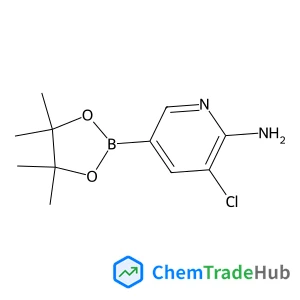
3-Chloro-5-(4,4,5,5-tetramethyl-1,3,2-dioxaborolan-2-yl)-2-pyridinamine
CAS Number:
1032758-99-8
Molecular Formula:
C11H16BClN2O2
Q. S. Fu, X. H. Chen, C. Chakrabarti, C. L. Li, J. Zheng, P. J. Wang, H. X. Yin, Y. Qiu, B. Meng, S. L. Yuan
Polycrystalline Co2Ti1−xCrxO4 (0 ≤ x ≤ 0.2) inverse spinel ceramics have been synthesized via a sol–gel technique. The dc magnetization measurement in the field-cooled mode shows that negative magnetization could be observed until x reaches 0.2. The exchange constants are calculated using the ferrimagnetic Curie–Weiss fitting and the mean-field theory. This reveals that the strength of the inter sublattice magnetic interaction presents a non-monotonic trend with the increase in Cr content and reaches the minimum at x = 0.1, giving rise to the highest compensation temperature in the x = 0.1 sample. The applicability of the x = 0.1 sample is investigated in light of two prominent magnetic effects: (i) the stable magnetic switching effect indicates the potential applications in magnetic switching and data storage and (ii) the coexistence of normal and inverse magnetocaloric effects suggests a potential application in a constant temperature bath at 54 K.
C. E. Clapp
DOI: 10.1039/C7CP08331A
Katharina Kohse-Höinghaus, Jürgen Troe, Jens-Uwe Grabow, Matthias Olzmann, Gernot Friedrichs, Klaus-Dieter Hungenberg
DOI: 10.1039/C8CP90054J
Nadia Ben Amor, Mathias Rapacioli, Jennifer A. Noble, Joëlle Mascetti, Céline Toubin, Aude Simon
DOI: 10.1039/C8CP01175C
TaeGi Lee, Kunio Shimura, DaeGwi Kim
DOI: 10.1039/C7CP07812A
DOI: 10.1039/C7CP08032H
Maria Wächtler
DOI: 10.1039/C8CP01007B
Jitendra Pal Singh, Baljeet Kaur, Aditya Sharma, So Hee Kim, Sanjeev Gautam, Ramesh Chandra Srivastava, Navdeep Goyal, Weol Cheol Lim, H.-J. Lin, J. M. Chen, K. Asokan, D. Kanjilal, Sung Ok Won, Ik-Jae Lee, Keun Hwa Chae
DOI: 10.1039/C8CP00368H
Lorenzo Angiolini, Boiko Cohen, Abderrazzak Douhal
DOI: 10.1039/C7CP08328A
F. B. Haffner, N. Canilho, B. Medronho, C. Gardiennet, A. Gansmüller, A. Pasc
DOI: 10.1039/C8CP00073E
Lesheng Li, Yosuke Kanai
DOI: 10.1039/C7CP07247C
This compound is mainly used as an intermediate in the synthesis of antipsychoti...
Waste containing 1-(D-Ribofuranosyl)-1,4-dihydro-3-pyridinecarboxamide (CAS: 191...
2-Methyl-2-propanyl 3-bromo-3-(hydroxymethyl)-1-azetidinecarboxylate (CAS: 20079...
N-(4-Chloro-2-pyridinyl)acetamide (CAS: 245056-66-0) is a chemical compound with...
5-Chloro-2-hydroxybenzoic acid, also known as 5-chlorosalicylic acid, is an arom...
When handling 1,1-Dichloro-1-fluoroethane (CAS: 1717-00-6), it is important to u...
Fmoc-(2S,3R)-3-phenylpyrrolidine-2-carboxylic acid is a white crystalline solid ...
4-Amino-5-bromo-2-pyridinecarboxylic acid is primarily used as a precursor in th...
Handling this compound should be done with personal protective equipment (PPE) i...
When handling 8-bromo-2,2-dimethyl-3,4-dihydro-2H-1,4-benzoxazin-3-one, use prop...

Physical Chemistry Chemical Physics (PCCP) is an international journal co-owned by 19 physical chemistry and physics societies from around the world. This journal publishes original, cutting-edge research in physical chemistry, chemical physics and biophysical chemistry. To be suitable for publication in PCCP, articles must include significant innovation and/or insight into physical chemistry; this is the most important criterion that reviewers and Editors will judge against when evaluating submissions. The journal has a broad scope and welcomes contributions spanning experiment, theory, computation and data science. Topical coverage includes spectroscopy, dynamics, kinetics, statistical mechanics, thermodynamics, electrochemistry, catalysis, surface science, quantum mechanics, quantum computing and machine learning. Interdisciplinary research areas such as polymers and soft matter, materials, nanoscience, energy, surfaces/interfaces, and biophysical chemistry are welcomed if they demonstrate significant innovation and/or insight into physical chemistry. Joined experimental/theoretical studies are particularly appreciated when complementary and based on up-to-date approaches.
![2,6-Bis({(2R)-2-[hydroxy(diphenyl)methyl]-1-pyrrolidinyl}methyl)-4-methylphenol structure](https://static.chemtradehub.com/structs/877/877395-58-9-70bf.webp "2,6-Bis({(2R)-2-[hydroxy(diphenyl)methyl]-1-pyrrolidinyl}methyl)-4-methylphenol structure")



