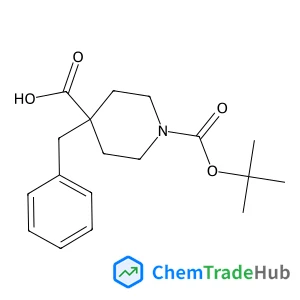
4-Benzyl-1-(tert-butoxycarbonyl)piperidine-4-carboxylic acid
CAS Number:
170838-87-6
Molecular Formula:
C18H25NO4
Kwang-Hyon Kim
Despite the great importance of high-index materials for dielectric nanophotonics, their optical functionalities are significantly limited for diverse photonic applications and thus, the usability of low-index materials should be explored. This work proposes the use of metallic substrates for low-index dielectric metasurfaces for significantly enhancing the local field and their optical responses. Plasmon-assisted dipole resonances mainly contribute to field enhancement in dielectric nanoparticles comprising the metasurfaces, where the intensity enhancement increases on decreasing the index of the nanoparticles when supported by metallic substrates. Another challenge with the current high-index materials is strong optical losses in the blue-ultraviolet range, which limit their practical applications such as harmonic generations in this spectral range. For a pump with a peak intensity of about 3.4 GW cm−2, a metasurface of lithium niobate nanodisk array supported by a gold substrate generates second harmonic at 400 nm with an efficiency of about 5 × 10⁻²%, which is one order of magnitude higher than the previously reported efficiency of harmonic generation in this range. The results presented in this work promise the significant extension of the current nonlinear nanophotonics, which is limited to high-index semiconducting materials.
Nadia Ben Amor, Mathias Rapacioli, Jennifer A. Noble, Joëlle Mascetti, Céline Toubin, Aude Simon
DOI: 10.1039/C8CP01175C
Lorenzo Angiolini, Boiko Cohen, Abderrazzak Douhal
DOI: 10.1039/C7CP08328A
Sepehr Ebadi
DOI: 10.1039/C7CP08481A
Naoto Todoroki, Ryutaro Kawamura, Masato Asano, Ren Sasakawa, Shuntaro Takahashi, Toshimasa Wadayama
DOI: 10.1039/C8CP01217B
Junyao Li, Narcisse T. Tsona, Lin Du
DOI: 10.1039/C7CP05008A
Wenhao Yuan, Tianyu Li, Wei Li, Jiuzhong Yang
DOI: 10.1039/C7CP08518D
Zhixiao Liu, Wangyu Hu, Shiguo Zhang, Perla B. Balbuena, Partha P. Mukherjee
DOI: 10.1039/C8CP01462K
Qing-Lu Liu, Zong-Yan Zhao, Jian-Hong Yi
DOI: 10.1039/C8CP00432C
Mohammad A. Halim, Christian Clavier, Xavier Dagany, Michel Kerleroux, Philippe Dugourd, Robert C. Dunbar, Rodolphe Antoine
DOI: 10.1039/C8CP00404H
Michael Eikerling
DOI: 10.1039/C8CP01315B
This compound is mainly used as an intermediate in the synthesis of antipsychoti...
Waste containing 1-(D-Ribofuranosyl)-1,4-dihydro-3-pyridinecarboxamide (CAS: 191...
2-Methyl-2-propanyl 3-bromo-3-(hydroxymethyl)-1-azetidinecarboxylate (CAS: 20079...
N-(4-Chloro-2-pyridinyl)acetamide (CAS: 245056-66-0) is a chemical compound with...
5-Chloro-2-hydroxybenzoic acid, also known as 5-chlorosalicylic acid, is an arom...
When handling 1,1-Dichloro-1-fluoroethane (CAS: 1717-00-6), it is important to u...
Fmoc-(2S,3R)-3-phenylpyrrolidine-2-carboxylic acid is a white crystalline solid ...
4-Amino-5-bromo-2-pyridinecarboxylic acid is primarily used as a precursor in th...
Handling this compound should be done with personal protective equipment (PPE) i...
When handling 8-bromo-2,2-dimethyl-3,4-dihydro-2H-1,4-benzoxazin-3-one, use prop...

Physical Chemistry Chemical Physics (PCCP) is an international journal co-owned by 19 physical chemistry and physics societies from around the world. This journal publishes original, cutting-edge research in physical chemistry, chemical physics and biophysical chemistry. To be suitable for publication in PCCP, articles must include significant innovation and/or insight into physical chemistry; this is the most important criterion that reviewers and Editors will judge against when evaluating submissions. The journal has a broad scope and welcomes contributions spanning experiment, theory, computation and data science. Topical coverage includes spectroscopy, dynamics, kinetics, statistical mechanics, thermodynamics, electrochemistry, catalysis, surface science, quantum mechanics, quantum computing and machine learning. Interdisciplinary research areas such as polymers and soft matter, materials, nanoscience, energy, surfaces/interfaces, and biophysical chemistry are welcomed if they demonstrate significant innovation and/or insight into physical chemistry. Joined experimental/theoretical studies are particularly appreciated when complementary and based on up-to-date approaches.
![Methyl 4-({[(2-methyl-2-propanyl)oxy]carbonyl}amino)bicyclo[2.2.2]octane-1-carboxylate structure](https://static.chemtradehub.com/structs/943/943845-74-7-b7e5.webp "Methyl 4-({[(2-methyl-2-propanyl)oxy]carbonyl}amino)bicyclo[2.2.2]octane-1-carboxylate structure")