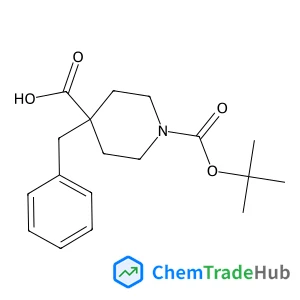
4-Benzyl-1-(tert-butoxycarbonyl)piperidine-4-carboxylic acid
CAS Number:
170838-87-6
Molecular Formula:
C18H25NO4
S. Mandal, R. Gopal, M. Shcherbinin, A. D’Elia, H. Srinivas, R. Richter, B. Bapat, S. R. Krishnan, V. Sharma
Embedded atoms or molecules in a photoexcited He nanodroplet are well-known to be ionized through inter-atomic relaxation in a Penning process. In this work, we investigate the Penning ionization of acetylene oligomers occurring from the photoexcitation bands of He nanodroplets. In close analogy to conventional Penning electron spectroscopy by thermal atomic collisions, the n = 2 photoexcitation band plays the role of the metastable atomic 1s2s 3,1S He*. This facilitates electron spectroscopy of acetylene aggregates in the sub-Kelvin He environment, providing the following insight into their structure: the molecules in the dopant cluster are loosely bound van der Waals complexes rather than forming covalent compounds. In addition, this work reveals a Penning process stemming from the n = 4 band where charge-transfer from autoionized He in the droplets is known to be the dominant relaxation channel. This allows for excited states of the remnant dopant oligomer Penning-ions to be studied. Hence, we demonstrate Penning ionization electron spectroscopy of doped droplets as an effective technique for investigating dopant oligomers which are easily formed by attachment to the host cluster.
M. Allan, M. Lacko, P. Papp, Š. Matejčík, M. Zlatar, I. I. Fabrikant, J. Kočišek, J. Fedor
DOI: 10.1039/C8CP01387J
Yu Gao, Haichao Liu, Shitong Zhang, Qiang Gu, Yue Shen, Yunpeng Ge, Bing Yang
DOI: 10.1039/C8CP00834E
Xiuting Li, Christopher Batchelor-McAuley, Javor K. Novev, Richard G. Compton
DOI: 10.1039/C8CP01360H
C. E. Clapp
DOI: 10.1039/C7CP08331A
José I. Martínez, Alex Laikhtman, Hoi Ri Moon, Alla Zak, Julio A. Alonso
DOI: 10.1039/C8CP01437J
Rafael Grande-Aztatzi, Jose M. Mercero, Jesus M. Ugalde
DOI: 10.1039/C8CP91727B
Dinesh Mishra, Vladislav Lobodin, Chengqi Zhang, Fadi Aldeek, Eric Lochner, Hedi Mattoussi
DOI: 10.1039/C7CP08682B
M. A. Peck, G. R. Hearne, C. Obuah, J. Darkwa
DOI: 10.1039/C8CP01135D
Zhixiao Liu, Wangyu Hu, Shiguo Zhang, Perla B. Balbuena, Partha P. Mukherjee
DOI: 10.1039/C8CP01462K
Y. R. Guo, F. Dong, C. Qiao, J. J. Wang, Ming Xu, Y. X. Zheng, R. J. Zhang, L. Y. Chen, C. Z. Wang, K. M. Ho
DOI: 10.1039/C8CP00142A
This compound is mainly used as an intermediate in the synthesis of antipsychoti...
Waste containing 1-(D-Ribofuranosyl)-1,4-dihydro-3-pyridinecarboxamide (CAS: 191...
2-Methyl-2-propanyl 3-bromo-3-(hydroxymethyl)-1-azetidinecarboxylate (CAS: 20079...
N-(4-Chloro-2-pyridinyl)acetamide (CAS: 245056-66-0) is a chemical compound with...
5-Chloro-2-hydroxybenzoic acid, also known as 5-chlorosalicylic acid, is an arom...
When handling 1,1-Dichloro-1-fluoroethane (CAS: 1717-00-6), it is important to u...
Fmoc-(2S,3R)-3-phenylpyrrolidine-2-carboxylic acid is a white crystalline solid ...
4-Amino-5-bromo-2-pyridinecarboxylic acid is primarily used as a precursor in th...
Handling this compound should be done with personal protective equipment (PPE) i...
When handling 8-bromo-2,2-dimethyl-3,4-dihydro-2H-1,4-benzoxazin-3-one, use prop...

Physical Chemistry Chemical Physics (PCCP) is an international journal co-owned by 19 physical chemistry and physics societies from around the world. This journal publishes original, cutting-edge research in physical chemistry, chemical physics and biophysical chemistry. To be suitable for publication in PCCP, articles must include significant innovation and/or insight into physical chemistry; this is the most important criterion that reviewers and Editors will judge against when evaluating submissions. The journal has a broad scope and welcomes contributions spanning experiment, theory, computation and data science. Topical coverage includes spectroscopy, dynamics, kinetics, statistical mechanics, thermodynamics, electrochemistry, catalysis, surface science, quantum mechanics, quantum computing and machine learning. Interdisciplinary research areas such as polymers and soft matter, materials, nanoscience, energy, surfaces/interfaces, and biophysical chemistry are welcomed if they demonstrate significant innovation and/or insight into physical chemistry. Joined experimental/theoretical studies are particularly appreciated when complementary and based on up-to-date approaches.