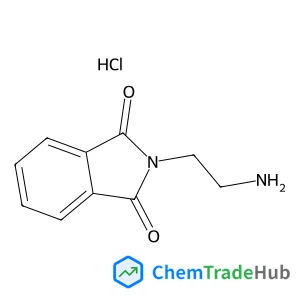
2-(2-Aminoethyl)-1H-isoindole-1,3(2H)-dione hydrochloride (1:1)
CAS Number:
30250-67-0
Molecular Formula:
C10H11ClN2O2
Karol Rytel, Kamil Kędzierski, Bolesław Barszcz, Małgorzata Widelicka, Alicja Stachowiak, Andrzej Biadasz, Łukasz Majchrzycki, Emerson Coy, Danuta Wróbel
Correction for ‘The influence of diameter of multiwalled carbon nanotubes on mechanical, optical and electrical properties of Langmuir–Schaefer films’ by Karol Rytel et al., Phys. Chem. Chem. Phys., 2020, DOI: 10.1039/d0cp03687k.
Qifeng Li, Chiung Wen Kuo, Zheng Yang, Peilin Chen, Keng C. Chou
DOI: 10.1039/B821045D
Kun-Mu Lee, Chih-Yu Hsu, Po-Yen Chen, Masashi Ikegami, Tsutomu Miyasaka, Kuo-Chuan Ho
DOI: 10.1039/B823011K
Alexey Shavel, Luis M. Liz-Marzán
DOI: 10.1039/B822733K
Mark Rozenberg, Aharon Loewenschuss, Claus Jørgen Nielsen
DOI: 10.1039/B922952C
Yann R. Chemla
DOI: 10.1039/B920234J
Holger Fricke, Kirsten Schwing, Andreas Gerlach, Claus Unterberg, Markus Gerhards
DOI: 10.1039/C000424C
Huan-Chang Tseng, Jiann-Shing Wu, Rong-Yeu Chang
DOI: 10.1039/B919672B
Ryo Akiyama, Yasuhito Karino, Hokuto Obama, Ayako Yoshifuku
DOI: 10.1039/B921314G
Waste containing 2-Ethyl-4-Methyl-1H-Imidazole-5-Carbaldehyde (CAS: 88634-80-4) ...
Triethoxy(octyl)silane (CAS: 1385031-14-0) is widely used in the pharmaceuticals...
Several alternatives to 3-iodo-7-nitro-1H-indazole (CAS: 864724-64-1) exist in t...
Yes, there are alternatives to Benzene, bis[(trimethoxysilyl)ethyl] (CAS: 266317...
Isothiazole-3-carbonitrile (CAS: 1452-17-1) is generally considered safe when us...
(3-Chlorophenyl)methanol (CAS: 873-63-2) is considered low to moderately toxic. ...
(2S,3S)-2-Hydroxy-3-({[(2-methyl-2-propanyl)oxy]carbonyl}amino)-3-(2-naphthyl)pr...
Proper handling of methyl 2-(bromomethyl)-5-methoxybenzoate requires the use of ...
6,8-Dibromoimidazo[1,2-a]pyridine-2-carboxylic acid (CAS: 904805-36-3) is an aro...
3-Amino-5-bromo-2-pyridinecarbonitrile is considered safe when handled under pro...

Physical Chemistry Chemical Physics (PCCP) is an international journal co-owned by 19 physical chemistry and physics societies from around the world. This journal publishes original, cutting-edge research in physical chemistry, chemical physics and biophysical chemistry. To be suitable for publication in PCCP, articles must include significant innovation and/or insight into physical chemistry; this is the most important criterion that reviewers and Editors will judge against when evaluating submissions. The journal has a broad scope and welcomes contributions spanning experiment, theory, computation and data science. Topical coverage includes spectroscopy, dynamics, kinetics, statistical mechanics, thermodynamics, electrochemistry, catalysis, surface science, quantum mechanics, quantum computing and machine learning. Interdisciplinary research areas such as polymers and soft matter, materials, nanoscience, energy, surfaces/interfaces, and biophysical chemistry are welcomed if they demonstrate significant innovation and/or insight into physical chemistry. Joined experimental/theoretical studies are particularly appreciated when complementary and based on up-to-date approaches.