


Adsorption of xenon on a protein arising from the translational motion of solvent molecules
Literature Information
Publication Date
2010-02-24
DOI
10.1039/B921314G
Impact Factor
3.676
Authors
Ryo Akiyama, Yasuhito Karino, Hokuto Obama, Ayako Yoshifuku
View Original
Abstract
A simple method was used to predict binding sites and to calculate the binding free energy for a xenon atom on a protein to determine the importance of the translational motion of water molecules in molecular recognition. We examined xenon bound on myoglobin and on a fragment of ammonium transporter. Despite the simplicity of our method, the predicted binding sites and the experimental results agree very well, and the estimated values of the free energy gain are also reasonable. We discuss the van der Waals picture of molecular recognition between a protein and a small hydrophobic molecule, such as an anesthetic molecule, which gives us a simple physical justification for the idea of a “lock and key” relationship used in conventional structure-based drug design programs.
Recommended Journals

Faraday Discussions

Current Pharmaceutical Biotechnology

European Journal of Organic Chemistry

Environmental Toxicology and Pharmacology

Journal of Enzyme inhibition and Medicinal Chemistry

Molecular Diversity

Contact Lens & Anterior Eye

Angewandte Chemie International Edition

CrystEngComm

Foundations of Chemistry
Related Literature
Understanding the affinity of bis-exTTF macrocyclic receptors towards fullerene recognition
Joaquín Calbo, Alberto de Juan, Juan Aragó, Julia Villalva, Emilio M. Pérez, Enrique Ortí
2019-05-20
Paper
DOI: 10.1039/C9CP01735F
Mixtures of LiTFSI and urea: ideal thermodynamic behavior as key to the formation of deep eutectic solvents?
2019-05-23
Paper
DOI: 10.1039/C9CP01440C
On-surface synthesis of 2D COFs on Cu(111) via the formation of thermodynamically stable organometallic networks as the template
Cheng-Xin Wang, Jian-Le Chen, Chen-Hui Shu, Ke-Ji Shi, Pei-Nian Liu
2019-05-31
Paper
DOI: 10.1039/C9CP01843C
Interface-tuned selective reductive coupling of nitroarenes to aromatic azo and azoxy: a first-principles-based microkinetics study
Lidong Zhang, Zheng-Jiang Shao, Xiao-Ming Cao
2019-05-20
Paper
DOI: 10.1039/C9CP01795J
Equations of the state of hard sphere fluids based on recent accurate virial coefficients B5–B12
Hua Jiang, A. Mulero
2019-05-20
Paper
DOI: 10.1039/C9CP02116G
New equations of state for the hard polyhedron fluids
Hua Jiang, A. Mulero
2019-05-23
Paper
DOI: 10.1039/C9CP02033K
Pretransitional behavior of viscoelastic parameters at the nematic to twist-bend nematic phase transition in flexible n-mers
Zeinab Parsouzi, Mojtaba Rajabi, Rony Saha, Prabesh Gyawali, Alan R. Baldwin, Chris Welch, Georg H. Mehl, J. T. Gleeson, Samuel Sprunt
2019-05-20
Paper
DOI: 10.1039/C9CP00984A
Causes of ferroelectricity in HfO2-based thin films: an ab initio perspective
2019-05-15
Paper
DOI: 10.1039/C9CP01880H
You might also like
Compound Q&A
How should waste containing 2-Ethyl-4-Methyl-1H-Imidazole-5-Carbaldehyde (CAS: 88634-80-4) be handled?
Waste containing 2-Ethyl-4-Methyl-1H-Imidazole-5-Carbaldehyde (CAS: 88634-80-4) ...
88634-80-42-Ethyl-4-Methyl-1H-...
Compound Q&A
What industries use Triethoxy(octyl)silane (CAS: 1385031-14-0)?
Triethoxy(octyl)silane (CAS: 1385031-14-0) is widely used in the pharmaceuticals...
1385031-14-0Triethoxy(octyl)sila...
Compound Q&A
Are there alternatives to 3-iodo-7-nitro-1H-indazole (CAS: 864724-64-1) in synthesis?
Several alternatives to 3-iodo-7-nitro-1H-indazole (CAS: 864724-64-1) exist in t...
864724-64-13-iodo-7-nitro-1H-in...
Compound Q&A
Are there alternatives to Benzene, bis[(trimethoxysilyl)ethyl] (CAS: 266317-71-9) in synthesis?
Yes, there are alternatives to Benzene, bis[(trimethoxysilyl)ethyl] (CAS: 266317...
266317-71-9Benzene, bis[(trimet...
Compound Q&A
Is Isothiazole-3-carbonitrile (CAS: 1452-17-1) safe?
Isothiazole-3-carbonitrile (CAS: 1452-17-1) is generally considered safe when us...
1452-17-1Isothiazole-3-carbon...
Compound Q&A
Is (3-Chlorophenyl)methanol (CAS: 873-63-2) safe?
(3-Chlorophenyl)methanol (CAS: 873-63-2) is considered low to moderately toxic. ...
873-63-2(3-Chlorophenyl)meth...
Compound Q&A
How is (2S,3S)-2-Hydroxy-3-({[(2-methyl-2-propanyl)oxy]carbonyl}amino)-3-(2-naphthyl)propanoic acid (CAS: 959583-98-3) typically synthesized?
(2S,3S)-2-Hydroxy-3-({[(2-methyl-2-propanyl)oxy]carbonyl}amino)-3-(2-naphthyl)pr...
959583-98-3(2S,3S)-2-Hydroxy-3-...
Compound Q&A
What precautions should be taken when handling Methyl 2-(bromomethyl)-5-methoxybenzoate (CAS: 788081-99-2)?
Proper handling of methyl 2-(bromomethyl)-5-methoxybenzoate requires the use of ...
788081-99-2Methyl 2-(bromomethy...
Compound Q&A
What is 6,8-Dibromoimidazo[1,2-a]pyridine-2-carboxylic acid (CAS: 904805-36-3)?
6,8-Dibromoimidazo[1,2-a]pyridine-2-carboxylic acid (CAS: 904805-36-3) is an aro...
904805-36-36,8-Dibromoimidazo[1...
Compound Q&A
Is 3-Amino-5-bromo-2-pyridinecarbonitrile (CAS: 573675-27-1) safe?
3-Amino-5-bromo-2-pyridinecarbonitrile is considered safe when handled under pro...
573675-27-13-Amino-5-bromo-2-py...
Source Journal
Physical Chemistry Chemical Physics

CiteScore:
5.5
Self-citation Rate:
10.3%
Articles per Year:
3036
Physical Chemistry Chemical Physics (PCCP) is an international journal co-owned by 19 physical chemistry and physics societies from around the world. This journal publishes original, cutting-edge research in physical chemistry, chemical physics and biophysical chemistry. To be suitable for publication in PCCP, articles must include significant innovation and/or insight into physical chemistry; this is the most important criterion that reviewers and Editors will judge against when evaluating submissions. The journal has a broad scope and welcomes contributions spanning experiment, theory, computation and data science. Topical coverage includes spectroscopy, dynamics, kinetics, statistical mechanics, thermodynamics, electrochemistry, catalysis, surface science, quantum mechanics, quantum computing and machine learning. Interdisciplinary research areas such as polymers and soft matter, materials, nanoscience, energy, surfaces/interfaces, and biophysical chemistry are welcomed if they demonstrate significant innovation and/or insight into physical chemistry. Joined experimental/theoretical studies are particularly appreciated when complementary and based on up-to-date approaches.
Recommended Compounds
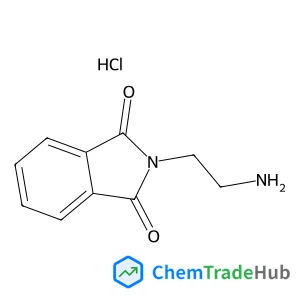
2-(2-Aminoethyl)-1H-isoindole-1,3(2H)-dione hydrochloride (1:1)
CAS Number:
30250-67-0
Molecular Formula:
C10H11ClN2O2
Recommended Suppliers





Disclaimer
This page provides academic journal information for reference and research purposes only. We are not affiliated with any journal publishers and do not handle publication submissions. For publication-related inquiries, please contact the respective journal publishers directly.
If you notice any inaccuracies in the information displayed, please contact us at support@chemtradehub.com. We will promptly review and address your concerns.