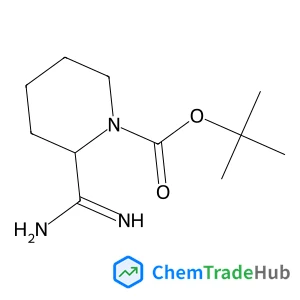
2-Methyl-2-propanyl 2-carbamimidoyl-1-piperidinecarboxylate
CAS Number:
1258640-98-0
Molecular Formula:
C11H21N3O2
Chao Liu, Jun Wang, Zexiang Chen, Jianqiang Wang
Passive NOx adsorbers (PNAs) are capable of trapping NOx at low temperature and releasing the trapped NOx into the gas circuit at higher temperatures, where downstream NOx reduction catalysts are activated. Hydrocarbons have a significant effect on the performance of PNAs, nonetheless research in this area has been overlooked. Here the chemistry of NOx adsorption and desorption in the presence of C3H6 was studied. For different pore-size zeolites (BEA, MFI and CHA), the addition of C3H6 always increased the NOx adsorption capacity at a low temperature and raised the NOx desorption temperature. Spectroscopic and computational investigations were performed using the model Pd/Beta to unravel the relevant mechanism. Fourier transform infrared (FTIR) spectra indicated that more Pd+ was formed in the presence of C3H6, which contributed to higher NOx storage capacity. An intermediate Pd–NC3H6O was probed and its evolution procedure was modeled by density functional theory (DFT) calculations. The results showed that a shielding effect of Pd–NC3H6O on Pd+–NO improved the NOx desorption temperature. This investigation has important implications for how short-chain olefins and even more complex gas mixtures affect the NOx adsorption and desorption performance of Pd/zeolite.
Yong-Lei Wang
DOI: 10.1039/C4CP03077J
Yuranan Hanlumyuang, Xiaobao Li
DOI: 10.1039/C4CP03131H
P. Hemant Kumar, Y. Venkatesh, S. Prashanthi, D. Siva, B. Ramakrishna, Prakriti Ranjan Bangal
DOI: 10.1039/C4CP02505A
Geng-Geng Luo, Kai Fang, Ji-Huai Wu, Jing-Cao Dai, Qing-Hua Zhao
DOI: 10.1039/C4CP03343D
Kinga Góra-Marek, Adam Stępniewski, Mariusz Radoń, Ewa Broclawik
DOI: 10.1039/C4CP03350G
J. C. J. Camp, J. McGregor, I. M. Watson, R. A. Cox, M. Kalberer, A. D. Ward, F. D. Pope
DOI: 10.1039/C4CP00994K
Reinhard Schweitzer-Stenner, Siobhan E. Toal
DOI: 10.1039/C4CP02108H
Jiandong Wu, Guohua Gao, Guangming Wu, Bo Liu, Huiyu Yang, Xiaowei Zhou, Jichao Wang
DOI: 10.1039/C4CP03176H
Sigalit Aharon, Shany Gamliel, Bat El Cohen, Lioz Etgar
DOI: 10.1039/C4CP00460D
N-(4-Methoxybenzyl)-2-pyridinamine (CAS: 52818-63-0) is increasingly being used ...
When handling Ethyl 4-(2-chlorophenyl)-1,3-thiazole-2-carboxylate, appropriate p...
Diethyldiselane (CAS: 628-39-7) is classified under the Globally Harmonized Syst...
The market for oxocopper (CAS: 12053-18-8) is primarily driven by its use in cat...
The market for 5-{[(2-Methyl-2-propanyl)oxy]carbonyl}-5-azaspiro[2.4]heptane-7-c...
2-(1-Pyrrolidinyl)-4-pyridinamine is a chemical compound with the CAS number 359...
2-(3-Pyridinyl)-1-azabicyclo[2.2.2]octane (CAS: 91556-75-1) is a crystalline sol...
(S)-Alpha-allyl-proline hydrochloride is usually synthesized via a Wittig reacti...
3-Methyl-1,2-oxazole-5-carboxylic acid (CAS: 4857-42-5) is an organic compound w...
Lys-SMCC-DM1 is synthesized via a multi-step process involving the coupling of S...

Physical Chemistry Chemical Physics (PCCP) is an international journal co-owned by 19 physical chemistry and physics societies from around the world. This journal publishes original, cutting-edge research in physical chemistry, chemical physics and biophysical chemistry. To be suitable for publication in PCCP, articles must include significant innovation and/or insight into physical chemistry; this is the most important criterion that reviewers and Editors will judge against when evaluating submissions. The journal has a broad scope and welcomes contributions spanning experiment, theory, computation and data science. Topical coverage includes spectroscopy, dynamics, kinetics, statistical mechanics, thermodynamics, electrochemistry, catalysis, surface science, quantum mechanics, quantum computing and machine learning. Interdisciplinary research areas such as polymers and soft matter, materials, nanoscience, energy, surfaces/interfaces, and biophysical chemistry are welcomed if they demonstrate significant innovation and/or insight into physical chemistry. Joined experimental/theoretical studies are particularly appreciated when complementary and based on up-to-date approaches.
![1-[6-(1H-Imidazol-1-yl)-3-pyridinyl]methanamine structure](https://static.chemtradehub.com/structs/914/914637-08-4-8825.webp "1-[6-(1H-Imidazol-1-yl)-3-pyridinyl]methanamine structure")
![1,10-bis(3,5-dimethylphenyl)-12-hydroxy-4,5,6,7-tetrahydroiindeno[7,1-de:1',7'-fg][1,3,2]dioxaphosphocine 12-oxide structure](https://static.chemtradehub.com/structs/141/1412439-82-7-b9a9.webp "1,10-bis(3,5-dimethylphenyl)-12-hydroxy-4,5,6,7-tetrahydroiindeno[7,1-de:1',7'-fg][1,3,2]dioxaphosphocine 12-oxide structure")