












Spectroscopic properties and spin–orbit coupling of electronic excited states of the germanium dimer
Literature Information
Publication Date
2020-12-08
DOI
10.1039/D0CP05712F
Impact Factor
3.676
Authors
Yong Liu, Yi Lian, Rui Li, Xueshen Liu, Haifeng Xu, Bing Yan
View Original
Abstract
The electronic structure and spectroscopic properties of the germanium dimer have been investigated by high-level ab initio calculations with consideration of spin–orbit coupling (SOC). The potential energy curves (PECs) of 19 Λ–S states, as well as those of 52 Ω states generated from the Λ–S states, are calculated by the multireference configuration interaction plus Davidson correction (MRCI + Q) method. The properties of the F3Σ+u1−X3Σ−g1 and H3Σ−u1−X3Σ−g1 transitions as well as the interactions of the F3Σ+u and H3Σ−u states with other excited states induced by SOC are investigated based on the calculated SO matrix and the PECs of the Ω states. Our results indicate that the previously observed spectra of Ge2 in the range 20 500–22 000 cm−1 should be assigned as the transition between the Ω = 1g component of the X3Σ−g state and Ω = 1u of the F3Σ+u state. Moreover, owing to the strong SOC with the repulsive 25Πu state, the H3Σ−u state is predissociative, leading to the Ge(3P2) + Ge(3P1) channel at vibrational levels higher than v′ = 6. Our theoretical study would provide comprehensive information and shed light on understanding the spectroscopy and dynamics of the electronic excited states of Ge2.
Recommended Journals
Related Literature
Fabrication of oriented zeolite L monolayers employing luminescent perylenediimide-bridged silsesquioxane precursor as the covalent linker
Huanrong Li, Yige Wang, Wenjun Zhang, Binyuan Liu, Gion Calzaferri
2007-04-27
Communication
DOI: 10.1039/B702175E
Simple linear asymmetrical complexes of silver(i): NC–Ag–NH3 and Br–Ag–NH3
Ann M. Chippindale, Laura E. Head, Simon J. Hibble
2008-05-14
Communication
DOI: 10.1039/B803500H
Transition metal-catalyzed three-component coupling of allenes and the related allylation reactions
Masilamani Jeganmohan, Chien-Hong Cheng
2008-05-15
Feature Article
DOI: 10.1039/B800440D
Synthesis and self-assembly of propeller-shaped amphiphilic molecules
Kyung-Soo Moon, Eunji Lee, Myongsoo Lee
2008-04-23
Communication
DOI: 10.1039/B801108G
One-pot, large-scale synthesis of SnO2nanotubes at room temperature
Ning Du, Hui Zhang, Bingdi Chen, Xiangyang Ma, Deren Yang
2008-04-21
Communication
DOI: 10.1039/B800401C
Safe, facile radical-based reduction and hydrosilylation reactions in a microreactor using tris(trimethylsilyl)silane
Arjan Odedra, Karolin Geyer, Tomas Gustafsson, Ryan Gilmour, Peter H. Seeberger
2008-04-29
Communication
DOI: 10.1039/B803715A
The selective trimerisation of isoprene with chromium N,N-bis(diarylphosphino)amine catalysts
Lucy E. Bowen, Manutsavin Charernsuk, Duncan F. Wass
2007-05-01
Communication
DOI: 10.1039/B702331F
Templated fabrication of sub-100 nm periodic nanostructures
Chih-Hung Sun, Wei-Lun Min, Peng Jiang
2008-05-07
Communication
DOI: 10.1039/B804182B
You might also like
Compound Q&A
Are there alternatives to 1-(4-Chlorophenyl)-N-hydroxymethanimine (CAS: 3848-36-0) in synthesis?
When considering alternatives to 1-(4-Chlorophenyl)-N-hydroxymethanimine (CAS: 3...
3848-36-01-(4-Chlorophenyl)-N...
Compound Q&A
How should (1R,9S,10S,12S,14E,16S,19R,20R,21S,22R)-3,9,21-Trihydroxy-5,10,12,14,16,20,22-heptamethyl-23,24-dioxatetracyclo[17.3.1.1~6,9~.0~2,7~]tetracosa-2,5,7,14-tetraen-4-one (CAS: 183202-73-5) be stored?
This compound should be stored in a cool, dry place away from direct sunlight. I...
183202-73-5(1R,9S,10S,12S,14E,1...
Compound Q&A
How is 3-(4-Bromophenyl)-5-(2-fluorophenyl)-1,2,4-oxadiazole (CAS: 419553-16-5) typically synthesized?
3-(4-Bromophenyl)-5-(2-fluorophenyl)-1,2,4-oxadiazole is synthesized through a m...
419553-16-53-(4-Bromophenyl)-5-...
Compound Q&A
How is 5-Chloro-2-(4-chlorophenyl)-4-methyl-6-[3-(1-piperidinyl)propoxy]pyrimidine (CAS: 1639220-19-1) typically synthesized?
5-Chloro-2-(4-chlorophenyl)-4-methyl-6-[3-(1-piperidinyl)propoxy]pyrimidine (CAS...
1639220-19-15-Chloro-2-(4-chloro...
Compound Q&A
What industries use 2-Chloro-4-(difluoromethoxy)pyridine (CAS: 1206978-15-5)?
2-Chloro-4-(difluoromethoxy)pyridine is used in the pharmaceutical industry for ...
1206978-15-52-Chloro-4-(difluoro...
Compound Q&A
What regulatory guidelines apply to 3-Chloro-6-methylpyridazine (CAS: 1121-79-5)?
3-Chloro-6-methylpyridazine (CAS: 1121-79-5) is classified under the Globally Ha...
1121-79-53-Chloro-6-methylpyr...
Compound Q&A
Are there alternatives to Methyl 4,5-dimethyl-2-nitrobenzoate in synthesis?
Several alternatives can be used in the synthesis of Methyl 4,5-dimethyl-2-nitro...
90922-74-0Methyl 4,5-dimethyl-...
Compound Q&A
Are there alternatives to (2E,2'E)-3,3'-(1,4-Phenylene)bisacrylaldehyde in synthesis?
Alternatives to (2E,2'E)-3,3'-(1,4-Phenylene)bisacrylaldehyde include other acry...
63405-68-5(2E,2'E)-3,3'-(1,4-P...
Compound Q&A
What is 3-Amino-5-chloropyridin-2-ol hydrochloride (CAS: 1261906-29-9)?
3-Amino-5-chloropyridin-2-ol hydrochloride is an organic compound with the CAS n...
1261906-29-93-Amino-5-chloropyri...
Compound Q&A
What precautions should be taken when handling 6,7-Difluoro-2,3-dihydro-4H-chromen-4-one (CAS: 1092349-93-3)?
When handling 6,7-Difluoro-2,3-dihydro-4H-chromen-4-one, it is essential to wear...
1092349-93-36,7-Difluoro-2,3-dih...
Source Journal
Physical Chemistry Chemical Physics

CiteScore:
5.5
Self-citation Rate:
10.3%
Articles per Year:
3036
Physical Chemistry Chemical Physics (PCCP) is an international journal co-owned by 19 physical chemistry and physics societies from around the world. This journal publishes original, cutting-edge research in physical chemistry, chemical physics and biophysical chemistry. To be suitable for publication in PCCP, articles must include significant innovation and/or insight into physical chemistry; this is the most important criterion that reviewers and Editors will judge against when evaluating submissions. The journal has a broad scope and welcomes contributions spanning experiment, theory, computation and data science. Topical coverage includes spectroscopy, dynamics, kinetics, statistical mechanics, thermodynamics, electrochemistry, catalysis, surface science, quantum mechanics, quantum computing and machine learning. Interdisciplinary research areas such as polymers and soft matter, materials, nanoscience, energy, surfaces/interfaces, and biophysical chemistry are welcomed if they demonstrate significant innovation and/or insight into physical chemistry. Joined experimental/theoretical studies are particularly appreciated when complementary and based on up-to-date approaches.
Recommended Compounds
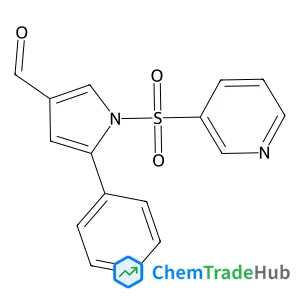
5-Phenyl-1-(pyridin-3-ylsulfonyl)-1H-pyrrole-3-carbaldehyde
CAS Number:
881676-90-0
Molecular Formula:
C16H12N2O3S
![2-{[(1R,2S)-2-Aminocyclohexyl]amino}-4-{[3-(2H-1,2,3-triazol-2-yl)phenyl]amino}-5-pyrimidinecarboxamide structure](https://static.chemtradehub.com/structs/137/1370261-96-3-40df.webp "2-{[(1R,2S)-2-Aminocyclohexyl]amino}-4-{[3-(2H-1,2,3-triazol-2-yl)phenyl]amino}-5-pyrimidinecarboxamide structure")
2-{[(1R,2S)-2-Aminocyclohexyl]amino}-4-{[3-(2H-1,2,3-triazol-2-yl)phenyl]amino}-5-pyrimidinecarboxamide
CAS Number:
1370261-96-3
Molecular Formula:
C19H23N9O
Recommended Suppliers



Disclaimer
This page provides academic journal information for reference and research purposes only. We are not affiliated with any journal publishers and do not handle publication submissions. For publication-related inquiries, please contact the respective journal publishers directly.
If you notice any inaccuracies in the information displayed, please contact us at support@chemtradehub.com. We will promptly review and address your concerns.