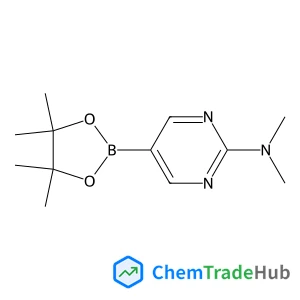
N,N-Dimethyl-5-(4,4,5,5-tetramethyl-1,3,2-dioxaborolan-2-yl)-2-pyrimidinamine
CAS Number:
1032759-30-0
Molecular Formula:
C12H20BN3O2
The first page of this article is displayed as the abstract.
S. Güryel, M. Walker, P. Geerlings, F. De Proft, M. R. Wilson
DOI: 10.1039/C7CP01552F
Long Van Duong
DOI: 10.1039/C7CP01740E
Yucheng Wang, Yuming Zhang, Tiqiang Pang, Jie Xu, Ziyang Hu, Yuejin Zhu, Xiaoyan Tang, Suzhen Luan, Renxu Jia
DOI: 10.1039/C7CP01799E
DOI: 10.1039/C7CP01864A
Gabriel Marchand, Olivier Siri
DOI: 10.1039/C7CP02600E
Akarsh Verma, Avinash Parashar
DOI: 10.1039/C7CP02366A
Meihong Yang, Chunyan Huo, Anyang Li, Yibo Lei, Chaoyuan Zhu
DOI: 10.1039/C7CP00102A
Liangshuai Zhong, Xiaofang Chen, Jingshan Qi
DOI: 10.1039/C7CP00964J
Jie Pan, Vladimir Chorošajev, Mikas Vengris, S. Seckin Senlik, Jian-Ren Shen, Darius Abramavicius, Jennifer P. Ogilvie
DOI: 10.1039/C7CP01673E
D. Harries
DOI: 10.1039/C7CP01921A
When considering alternatives to 1-(4-Chlorophenyl)-N-hydroxymethanimine (CAS: 3...
This compound should be stored in a cool, dry place away from direct sunlight. I...
3-(4-Bromophenyl)-5-(2-fluorophenyl)-1,2,4-oxadiazole is synthesized through a m...
5-Chloro-2-(4-chlorophenyl)-4-methyl-6-[3-(1-piperidinyl)propoxy]pyrimidine (CAS...
2-Chloro-4-(difluoromethoxy)pyridine is used in the pharmaceutical industry for ...
3-Chloro-6-methylpyridazine (CAS: 1121-79-5) is classified under the Globally Ha...
Several alternatives can be used in the synthesis of Methyl 4,5-dimethyl-2-nitro...
Alternatives to (2E,2'E)-3,3'-(1,4-Phenylene)bisacrylaldehyde include other acry...
3-Amino-5-chloropyridin-2-ol hydrochloride is an organic compound with the CAS n...
When handling 6,7-Difluoro-2,3-dihydro-4H-chromen-4-one, it is essential to wear...

ChemComm publishes urgent research which is of outstanding significance and interest to experts in the field, while also appealing to the journal’s broad chemistry readership. Our communication format is ideally suited to short, urgent studies that are of such importance that they require accelerated publication. Our scope covers all topics in chemistry, and research at the interface of chemistry and other disciplines (such as materials science, nanoscience, physics, engineering and biology) where there is a significant novelty in the chemistry aspects. Major topic areas covered include: Analytical Chemistry Catalysis Chemical Biology and medicinal chemistry Computational Chemistry and Machine Learning Energy and sustainable chemistry Environmental Chemistry Green Chemistry Inorganic Chemistry Materials Chemistry Nanoscience Organic Chemistry Physical Chemistry Polymer Chemistry Supramolecular Chemistry