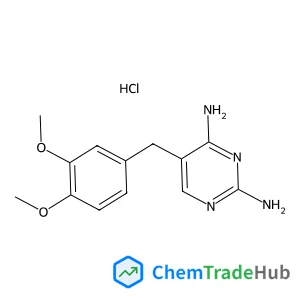
5-(3,4-Dimethoxybenzyl)-2,4-pyrimidinediamine hydrochloride (1:1)
CAS Number:
2507-23-5
Molecular Formula:
C13H17ClN4O2
The first page of this article is displayed as the abstract.
Xue Zhang, Na Li, Yajie Zhang, Richard Berndt
DOI: 10.1039/C7CP01568B
Xuepeng Wu, Caili Dai, Sisi Fang, Hao Li, Yining Wu, Xin Sun, Mingwei Zhao
DOI: 10.1039/C7CP00131B
Danilo Loche, Claudia Marras, Daniela Carta, Maria Francesca Casula, Gavin Mountjoy, Anna Corrias
DOI: 10.1039/C7CP02260C
Nabanita Saikia, Shashi P. Karna, Ravindra Pandey
DOI: 10.1039/C7CP02944F
Pedro P. Madeira, Helena Passos, Joana Gomes, João A. P. Coutinho, Mara G. Freire
DOI: 10.1039/C6CP08210F
Agne Ivanauskaite, Ramunas Lygaitis, Steponas Raisys, Karolis Kazlauskas, Gediminas Kreiza, Dmytro Volyniuk, Dalius Gudeika, Saulius Jursenas, Juozas V. Grazulevicius
DOI: 10.1039/C7CP02248D
Akarsh Verma, Avinash Parashar
DOI: 10.1039/C7CP02366A
Chuan-Jian Zhong
DOI: 10.1039/C7CP01445G
Nathan W. Ulrich, John Andre, Jaimal Williamson, Kang-Wook Lee, Zhan Chen
DOI: 10.1039/C7CP00567A
Cang Lang Yao, Jian Chen Li, Wang Gao, Qing Jiang
DOI: 10.1039/C7CP01881A
When considering alternatives to 1-(4-Chlorophenyl)-N-hydroxymethanimine (CAS: 3...
This compound should be stored in a cool, dry place away from direct sunlight. I...
3-(4-Bromophenyl)-5-(2-fluorophenyl)-1,2,4-oxadiazole is synthesized through a m...
5-Chloro-2-(4-chlorophenyl)-4-methyl-6-[3-(1-piperidinyl)propoxy]pyrimidine (CAS...
2-Chloro-4-(difluoromethoxy)pyridine is used in the pharmaceutical industry for ...
3-Chloro-6-methylpyridazine (CAS: 1121-79-5) is classified under the Globally Ha...
Several alternatives can be used in the synthesis of Methyl 4,5-dimethyl-2-nitro...
Alternatives to (2E,2'E)-3,3'-(1,4-Phenylene)bisacrylaldehyde include other acry...
3-Amino-5-chloropyridin-2-ol hydrochloride is an organic compound with the CAS n...
When handling 6,7-Difluoro-2,3-dihydro-4H-chromen-4-one, it is essential to wear...

ChemComm publishes urgent research which is of outstanding significance and interest to experts in the field, while also appealing to the journal’s broad chemistry readership. Our communication format is ideally suited to short, urgent studies that are of such importance that they require accelerated publication. Our scope covers all topics in chemistry, and research at the interface of chemistry and other disciplines (such as materials science, nanoscience, physics, engineering and biology) where there is a significant novelty in the chemistry aspects. Major topic areas covered include: Analytical Chemistry Catalysis Chemical Biology and medicinal chemistry Computational Chemistry and Machine Learning Energy and sustainable chemistry Environmental Chemistry Green Chemistry Inorganic Chemistry Materials Chemistry Nanoscience Organic Chemistry Physical Chemistry Polymer Chemistry Supramolecular Chemistry
![[4-(Isobutyrylamino)phenyl]boronic acid structure](https://static.chemtradehub.com/structs/874/874219-50-8-6ab5.webp "[4-(Isobutyrylamino)phenyl]boronic acid structure")