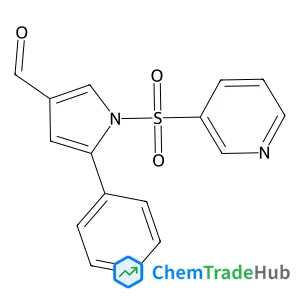
5-Phenyl-1-(pyridin-3-ylsulfonyl)-1H-pyrrole-3-carbaldehyde
CAS Number:
881676-90-0
Molecular Formula:
C16H12N2O3S
Huanrong Li, Yige Wang, Wenjun Zhang, Binyuan Liu, Gion Calzaferri
Oriented zeolite L (LTL, (M)9[Al9Si27O72]·nH2O (M = K+ and Na+)) monolayers with dense packing and high coverage degree has been obtained by using a luminescent perylenediimide-bridged silsesquioxane precursor as the novel molecular binder.
D. Harries
DOI: 10.1039/C7CP01921A
DOI: 10.1039/C7CP01780D
S. Güryel, M. Walker, P. Geerlings, F. De Proft, M. R. Wilson
DOI: 10.1039/C7CP01552F
Amador García-Fuente, Andrés Vega
DOI: 10.1039/C7CP02786A
Junbo Ren, Weibin Qiu, Houbo Chen, Pingping Qiu, Zhili Lin, Jia-Xian Wang, Qiang Kan, Jiao-Qing Pan
DOI: 10.1039/C7CP01734K
Agne Ivanauskaite, Ramunas Lygaitis, Steponas Raisys, Karolis Kazlauskas, Gediminas Kreiza, Dmytro Volyniuk, Dalius Gudeika, Saulius Jursenas, Juozas V. Grazulevicius
DOI: 10.1039/C7CP02248D
Carlos A. Polanco-Ramírez, Javier Carmona-Espíndola, José L. Gázquez, Paul W. Ayers
DOI: 10.1039/C7CP00691H
DOI: 10.1039/C7CP01103B
Nathan W. Ulrich, John Andre, Jaimal Williamson, Kang-Wook Lee, Zhan Chen
DOI: 10.1039/C7CP00567A
Zean Tian, Rangsu Liu, Lili Zhou, Zhaoyang Hou
DOI: 10.1039/C7CP00865A
When considering alternatives to 1-(4-Chlorophenyl)-N-hydroxymethanimine (CAS: 3...
This compound should be stored in a cool, dry place away from direct sunlight. I...
3-(4-Bromophenyl)-5-(2-fluorophenyl)-1,2,4-oxadiazole is synthesized through a m...
5-Chloro-2-(4-chlorophenyl)-4-methyl-6-[3-(1-piperidinyl)propoxy]pyrimidine (CAS...
2-Chloro-4-(difluoromethoxy)pyridine is used in the pharmaceutical industry for ...
3-Chloro-6-methylpyridazine (CAS: 1121-79-5) is classified under the Globally Ha...
Several alternatives can be used in the synthesis of Methyl 4,5-dimethyl-2-nitro...
Alternatives to (2E,2'E)-3,3'-(1,4-Phenylene)bisacrylaldehyde include other acry...
3-Amino-5-chloropyridin-2-ol hydrochloride is an organic compound with the CAS n...
When handling 6,7-Difluoro-2,3-dihydro-4H-chromen-4-one, it is essential to wear...

ChemComm publishes urgent research which is of outstanding significance and interest to experts in the field, while also appealing to the journal’s broad chemistry readership. Our communication format is ideally suited to short, urgent studies that are of such importance that they require accelerated publication. Our scope covers all topics in chemistry, and research at the interface of chemistry and other disciplines (such as materials science, nanoscience, physics, engineering and biology) where there is a significant novelty in the chemistry aspects. Major topic areas covered include: Analytical Chemistry Catalysis Chemical Biology and medicinal chemistry Computational Chemistry and Machine Learning Energy and sustainable chemistry Environmental Chemistry Green Chemistry Inorganic Chemistry Materials Chemistry Nanoscience Organic Chemistry Physical Chemistry Polymer Chemistry Supramolecular Chemistry
![4-[(3-Chloro-2-fluorophenyl)amino]-7-methoxy-6-quinazolinyl acetate structure](https://static.chemtradehub.com/structs/740/740081-22-5-f58f.webp "4-[(3-Chloro-2-fluorophenyl)amino]-7-methoxy-6-quinazolinyl acetate structure")