












Character angle effects on dissociated dislocation core energy in aluminum‡
Literature Information
Publication Date
2021-01-18
DOI
10.1039/D0CP05333C
Impact Factor
3.676
Authors
X. W. Zhou, M. E. Foster
View Original
Abstract
Dislocation core energy is an important property in materials mechanics but can only be obtained from atomistic simulations. Periodic boundary conditions are ideally suited for atomistic calculations of dislocation energies but have faced two major challenges. First, viable methods to extract core energies from atomistic data of total energies have been developed only for non-dissociated dislocations whereas realistic dislocations are often dissociated into partials. Second, core energy is a function of dislocation character angle. This functional dependence can only be revealed through calculations at a variety of character angles. This requires both additional computational resources and a robust method to implement arbitrary character angles. Here a new procedure has been developed to overcome both challenges. By applying this approach, we have calculated 22 core energies of dissociated dislocations in aluminium over the entire character angle range between 0° and 90°. In addition to the discrete core energy data for dissociated dislocations, we found that core energy can be approximated by a continuous function of character angle. Specifically, our dissociated dislocation core energies have been well fitted to a polynomial Sinoidal function of character angle. We have also discovered that there exists a critical system dimension below which dislocation core energies cannot be calculated due to dislocation transformation.
Related Literature
Poly(γ-benzyl-l-glutamate) decorated with cyanoferrate complex: synthesis, characterization and electrochemical properties
Qihua Wu, Wangping Qin, Suping Bao
2013-04-19
Paper
DOI: 10.1039/C3PY00404J
Poly(acrylic acid)-graft-poly(N-vinylcaprolactam): a novel pH and thermo dual-stimuli responsive system
Xiuyu Jiang, Guolin Lu, Chun Feng, Yongjun Li, Xiaoyu Huang
2013-04-23
Paper
DOI: 10.1039/C3PY00415E
Synthesis and versatile postpolymerization modification of couplable A(BC)mD heterografted comblike block quaterpolymers
Xiao Jiang, Wei Shao, Kun Jiang, Meijing Zhang, Huanhuan Liu, Chunnuan Ye, Youliang Zhao
2013-04-05
Paper
DOI: 10.1039/C3PY00217A
Atom transfer radical polymerization of hydrophilic monomers and its applications
Weiwei He, Hongjuan Jiang, Lifen Zhang, Zhenping Cheng, Xiulin Zhu
2013-01-30
Review Article
DOI: 10.1039/C3PY00122A
Hybrid organic–inorganic nanomaterial sensors for selective detection of Au3+ using rhodamine-based modified polyacrylic acid (PAA)-coated FeNPs
Noi Niamsa, Chatthai Kaewtong, Weerapol Srinonmuang, Banchob Wanno, Buncha Pulpoka, Thawatchai Tuntulani
2013-03-04
Paper
DOI: 10.1039/C3PY00229B
An efficient approach to prepare ether and amide-based self-catalyzed phthalonitrile resins
Michael R. Kessler, Zhou Heng, Javid Hussain Zaidi, Shahid Hameed
2013-03-21
Paper
DOI: 10.1039/C3PY00237C
One-step facile synthesis of monodisperse raspberry-like P(S–MPS–AA) colloidal particles
Yangyi Sun, Yuyong Yin, Min Chen, Shuxue Zhou, Limin Wu
2013-03-01
Paper
DOI: 10.1039/C3PY21155J
Organocatalyzed controlled ROP of β-lactones towards poly(hydroxyalkanoate)s: from β-butyrolactone to benzyl β-malolactone polymers
Cédric G. Jaffredo, Jean-François Carpentier, Sophie M. Guillaume
2013-04-24
Paper
DOI: 10.1039/C3PY00401E
You might also like
Compound Q&A
Is 6-(3-Fluorophenyl)picolinic acid (CAS: 887982-40-3) safe?
6-(3-Fluorophenyl)picolinic acid is generally considered safe for laboratory use...
887982-40-36-(3-Fluorophenyl)pi...
Compound Q&A
What industries use (3R)-3-Pyrrolidinol (CAS: 2799-21-5)?
(3R)-3-Pyrrolidinol is used in the pharmaceutical industry as a precursor for dr...
2799-21-5(3R)-3-Pyrrolidinol
Compound Q&A
What precautions should be taken when handling (4R,5R)-4,5-Diethoxycarbonyl-2,2-dimethyldioxolane (CAS: 59779-75-8)?
When handling (4R,5R)-4,5-Diethoxycarbonyl-2,2-dimethyldioxolane (CAS: 59779-75-...
59779-75-8(4R,5R)-4,5-Diethoxy...
Compound Q&A
How is 1-(6-Chloroimidazo[1,2-b]pyridazin-3-yl)ethanone (CAS: 90734-71-7) typically synthesized?
1-(6-Chloroimidazo[1,2-b]pyridazin-3-yl)ethanone is often synthesized via a mult...
90734-71-71-(6-Chloroimidazo[1...
Compound Q&A
What is the market or research trend for N-Ethyl-3,4-dimethylbenzylamine (CAS: 39180-83-1)?
The market for N-Ethyl-3,4-dimethylbenzylamine (CAS: 39180-83-1) remains steady,...
39180-83-1N-Ethyl-3,4-dimethyl...
Compound Q&A
What is Tert-butyl 3-(pyrrolidin-1-yl)azetidine-1-carboxylate (CAS: 1019008-21-9)?
Tert-butyl 3-(pyrrolidin-1-yl)azetidine-1-carboxylate is a chemical compound wit...
1019008-21-9Tert-butyl 3-(pyrrol...
Compound Q&A
What regulatory guidelines apply to 1-Bromo-3-chloro-2,4-dimethoxybenzene (CAS: 1228956-93-1)?
1-Bromo-3-chloro-2,4-dimethoxybenzene (CAS: 1228956-93-1) falls under the classi...
1228956-93-11-Bromo-3-chloro-2,4...
Compound Q&A
Is 8-Bromo-2-methyl-3,4-dihydroisoquinolin-1(2H)-one (CAS: 1368622-07-4) safe?
The safety of 8-Bromo-2-methyl-3,4-dihydroisoquinolin-1(2H)-one (CAS: 1368622-07...
1368622-07-48-Bromo-2-methyl-3,4...
Compound Q&A
Is Benzyl [(3S)-2,6-dioxo-3-piperidinyl]carbamate (CAS: 22785-43-9) safe?
Benzyl [(3S)-2,6-dioxo-3-piperidinyl]carbamate is generally safe when handled wi...
22785-43-9Benzyl [(3S)-2,6-dio...
Compound Q&A
How should 1-{[4-(4,4,5,5-Tetramethyl-1,3,2-dioxaborolan-2-yl)phenyl]sulfonyl}pyrrolidine (CAS: 928657-21-0) be stored?
1-{[4-(4,4,5,5-Tetramethyl-1,3,2-dioxaborolan-2-yl)phenyl]sulfonyl}pyrrolidine s...
928657-21-01-{[4-(4,4,5,5-Tetra...
Source Journal
Physical Chemistry Chemical Physics

CiteScore:
5.5
Self-citation Rate:
10.3%
Articles per Year:
3036
Physical Chemistry Chemical Physics (PCCP) is an international journal co-owned by 19 physical chemistry and physics societies from around the world. This journal publishes original, cutting-edge research in physical chemistry, chemical physics and biophysical chemistry. To be suitable for publication in PCCP, articles must include significant innovation and/or insight into physical chemistry; this is the most important criterion that reviewers and Editors will judge against when evaluating submissions. The journal has a broad scope and welcomes contributions spanning experiment, theory, computation and data science. Topical coverage includes spectroscopy, dynamics, kinetics, statistical mechanics, thermodynamics, electrochemistry, catalysis, surface science, quantum mechanics, quantum computing and machine learning. Interdisciplinary research areas such as polymers and soft matter, materials, nanoscience, energy, surfaces/interfaces, and biophysical chemistry are welcomed if they demonstrate significant innovation and/or insight into physical chemistry. Joined experimental/theoretical studies are particularly appreciated when complementary and based on up-to-date approaches.
Recommended Compounds
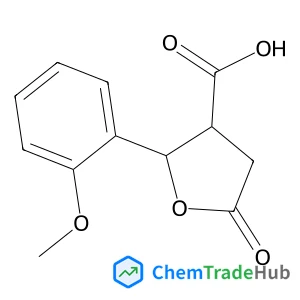
trans-2-(2-Methoxyphenyl)-5-oxotetrahydrofuran-3-carboxylic acid
CAS Number:
99226-02-5
Molecular Formula:
C12H12O5
Recommended Suppliers







Disclaimer
This page provides academic journal information for reference and research purposes only. We are not affiliated with any journal publishers and do not handle publication submissions. For publication-related inquiries, please contact the respective journal publishers directly.
If you notice any inaccuracies in the information displayed, please contact us at support@chemtradehub.com. We will promptly review and address your concerns.