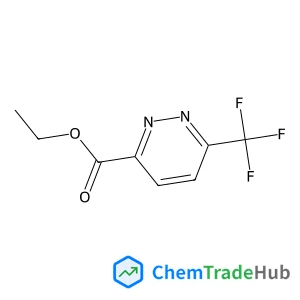
Ethyl 6-(trifluoromethyl)pyridazine-3-carboxylate
CAS Number:
1192155-06-8
Molecular Formula:
C8H7F3N2O2
Michael R. Kessler, Zhou Heng, Javid Hussain Zaidi, Shahid Hameed
Phthalonitrile polymers with amide and ortho-, meta-, and para-substituted ether linkages in the backbone were synthesized successfully and their thermal properties were investigated. The monomer building blocks for these polymers were cured without the addition of catalysts due to the self-catalyzing nature of the monomer's amino group. The ether and amide functionalities in the chain enhanced their processability without compromising thermal stability. The resins exhibited a low complex viscosity over a wide processing window between the monomer melting temperature and the polymer cure temperature, with the processing temperature range varying significantly for para-, ortho-, and meta-substituted polymer architectures. All three systems exhibited high thermal and thermo-oxidative stability. The high char yields, which ranged from 66–75% at 900 °C under nitrogen atmosphere, and the high glass transition temperatures of the polymers indicate a high crosslinking density in the network structure.
Pan Xiang, Wentao Zhang, Junfeng Li, Beibei Xiao, Longshan Li, Kuisen Deng
DOI: 10.1039/C7CP04989G
C. T. Liu, J. F. Chu, C. K. Lin, C. W. Hong
DOI: 10.1039/C7CP00541E
Saeid Arabnejad, Koichi Yamashita, Sergei Manzhos
DOI: 10.1039/C7CP00510E
Joscha Hoche, Hans-Christian Schmitt, Alexander Humeniuk, Ingo Fischer, Roland Mitrić, Merle I. S. Röhr
DOI: 10.1039/C7CP03990E
Sarah D. Hann, Daeyeon Lee, Kathleen J. Stebe
DOI: 10.1039/C7CP02809A
Noriyuki Isobe, James H. Clark, Seishi Shimizu
DOI: 10.1039/C7CP04647B
J. S. Eardley, N. Warner, L. Z. Deng, E. Wrede
DOI: 10.1039/C7CP00458C
Jing Kong, Zheng Bo, Huachao Yang, Jinyuan Yang, Xiaorui Shuai, Jianhua Yan, Kefa Cen
DOI: 10.1039/C6CP08752C
Dian Wang, Kah H. Chan, Naveen Kumar Elumalai, Md. Arafat Mahmud, Mushfika B. Upama, Ashraf Uddin, Supriya Pillai
DOI: 10.1039/C7CP04053A
Wenting Zhang, Chaoyuan Zhu
DOI: 10.1039/C7CP04376G
6-(3-Fluorophenyl)picolinic acid is generally considered safe for laboratory use...
(3R)-3-Pyrrolidinol is used in the pharmaceutical industry as a precursor for dr...
When handling (4R,5R)-4,5-Diethoxycarbonyl-2,2-dimethyldioxolane (CAS: 59779-75-...
1-(6-Chloroimidazo[1,2-b]pyridazin-3-yl)ethanone is often synthesized via a mult...
The market for N-Ethyl-3,4-dimethylbenzylamine (CAS: 39180-83-1) remains steady,...
Tert-butyl 3-(pyrrolidin-1-yl)azetidine-1-carboxylate is a chemical compound wit...
1-Bromo-3-chloro-2,4-dimethoxybenzene (CAS: 1228956-93-1) falls under the classi...
The safety of 8-Bromo-2-methyl-3,4-dihydroisoquinolin-1(2H)-one (CAS: 1368622-07...
Benzyl [(3S)-2,6-dioxo-3-piperidinyl]carbamate is generally safe when handled wi...
1-{[4-(4,4,5,5-Tetramethyl-1,3,2-dioxaborolan-2-yl)phenyl]sulfonyl}pyrrolidine s...

Polymer Chemistry welcomes submissions in all areas of polymer science that have a strong focus on macromolecular chemistry. Manuscripts may cover a broad range of fields, yet no direct application focus is required.