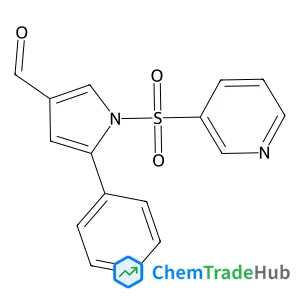
5-Phenyl-1-(pyridin-3-ylsulfonyl)-1H-pyrrole-3-carbaldehyde
CAS Number:
881676-90-0
Molecular Formula:
C16H12N2O3S
W. X. Zhang, Y. Yin, C. He
Graphene-based van der Waals (vdW) heterostructures composed of two-dimensional transition metal dichalcogenides (TMDs) and graphene show great potential in the design and manufacture of field effect transistors. However, the Schottky barrier generated by the contact between metal and semiconductor hinders the conduction of electrons, so it is necessary to effectively adjust the Schottky barrier and form a low-resistance Ohmic contact. Based on first-principles calculations, graphene/WSSe (G/WSSe) heterostructures have been established and the corresponding electronic properties have been studied. Firstly, these heterostructures form an n-type Schottky contact with a SBH of 0.35 eV and a p-type Schottky contact with a SBH of 0.66 eV at their respective interfaces. In addition, the Schottky contact can be significantly adjusted by changing the interlayer coupling or applying an external biaxial strain, and an Ohmic contact could also be formed under the biaxial strain. This study not only offers a basic understanding of G/WSSe heterostructures, but also provides a reference for the application of G/WSSe heterostructures in optoelectronic and nanoelectronic devices.

Russian Journal of Bioorganic Chemistry

Drug Discovery Today

Acta Materialia

Chemistry Education Research and Practice

Russian Journal of Applied Chemistry

Current Opinion in Solid State & Materials Science

Russian Journal of Organic Chemistry

Current Opinion in Colloid & Interface Science

Russian Journal of General Chemistry

Journal of Natural Medicines
Jian-Rong Li, Qun Yu, E. Carolina Sañudo, Ying Tao, Xian-He Bu
DOI: 10.1039/B702988H
Satish Kumar Nune, Masato Tanaka
DOI: 10.1039/B703165C
András Stirling, Andrea Hamza, Tibor András Rokob, Imre Pápai
DOI: 10.1039/B804662J
Nans Roques, Daniel Maspoch, Inhar Imaz, Angela Datcu, Jean-Pascal Sutter, Concepció Rovira, Jaume Veciana
DOI: 10.1039/B802196A
Giulio Gasparini, Bruno Vitorge, Paolo Scrimin, Damien Jeannerat, Leonard J. Prins
DOI: 10.1039/B803074J
Rong-Tang Liao, Woei-Chyuan Yang, P. Thanasekaran, Chen-Chuan Tsai, M. Sathiyendiran, Yen-Hsiang Liu, T. Rajendran, Hsiu-Mei Lin, Tien-Wen Tseng, Kuang-Lieh Lu
DOI: 10.1039/B802777C
Roberto Ballini, Alessandro Palmieri, Luciano Barboni
DOI: 10.1039/B800941D
Pengfei Li, Yongcan Wang, Jinxing Ye
DOI: 10.1039/B804540B
Shelli R. Waetzig, Jon A. Tunge
DOI: 10.1039/B806949B
When considering alternatives to 1-(4-Chlorophenyl)-N-hydroxymethanimine (CAS: 3...
This compound should be stored in a cool, dry place away from direct sunlight. I...
3-(4-Bromophenyl)-5-(2-fluorophenyl)-1,2,4-oxadiazole is synthesized through a m...
5-Chloro-2-(4-chlorophenyl)-4-methyl-6-[3-(1-piperidinyl)propoxy]pyrimidine (CAS...
2-Chloro-4-(difluoromethoxy)pyridine is used in the pharmaceutical industry for ...
3-Chloro-6-methylpyridazine (CAS: 1121-79-5) is classified under the Globally Ha...
Several alternatives can be used in the synthesis of Methyl 4,5-dimethyl-2-nitro...
Alternatives to (2E,2'E)-3,3'-(1,4-Phenylene)bisacrylaldehyde include other acry...
3-Amino-5-chloropyridin-2-ol hydrochloride is an organic compound with the CAS n...
When handling 6,7-Difluoro-2,3-dihydro-4H-chromen-4-one, it is essential to wear...

Physical Chemistry Chemical Physics (PCCP) is an international journal co-owned by 19 physical chemistry and physics societies from around the world. This journal publishes original, cutting-edge research in physical chemistry, chemical physics and biophysical chemistry. To be suitable for publication in PCCP, articles must include significant innovation and/or insight into physical chemistry; this is the most important criterion that reviewers and Editors will judge against when evaluating submissions. The journal has a broad scope and welcomes contributions spanning experiment, theory, computation and data science. Topical coverage includes spectroscopy, dynamics, kinetics, statistical mechanics, thermodynamics, electrochemistry, catalysis, surface science, quantum mechanics, quantum computing and machine learning. Interdisciplinary research areas such as polymers and soft matter, materials, nanoscience, energy, surfaces/interfaces, and biophysical chemistry are welcomed if they demonstrate significant innovation and/or insight into physical chemistry. Joined experimental/theoretical studies are particularly appreciated when complementary and based on up-to-date approaches.
![4-[(3-Chloro-2-fluorophenyl)amino]-7-methoxy-6-quinazolinyl acetate structure](https://static.chemtradehub.com/structs/740/740081-22-5-f58f.webp "4-[(3-Chloro-2-fluorophenyl)amino]-7-methoxy-6-quinazolinyl acetate structure")