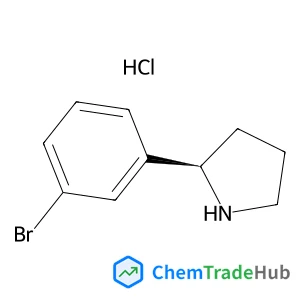
(2R)-2-(3-Bromophenyl)pyrrolidine hydrochloride (1:1)
CAS Number:
1391550-13-2
Molecular Formula:
C10H13BrClN
Huiyi Yang, Qiyi He, Junkang Pan, Ding Shen, Huanxin Xiao, Xiping Cui, Suqing Zhao
The traditional gold-nanoparticle-based lateral flow immunoassay (LFIA) cannot satisfy the requirements for the sensitive detection of dehydroepiandrosterone (DHEA) in human urine. To enhance the sensitivity of the LFIA, platinum–iridium nanocubes (Pt–Ir NCs) with high catalytic efficiency and stability were synthesized and labelled with polyclonal antibody (pAb) to form a pAb–Pt–Ir probe. For the detection of DHEA, a novel LFIA with Pt–Ir NCs as an optical label and an enhanced LFIA in which the peroxidase-like activity of the Pt–Ir NCs was triggered by the introduction of the chromogenic substrate 3-amino-9-ethyl-carbazole (AEC) were developed and compared with a LFIA with platinum nanocubes (PtNCs) as an optical label. The visual limit of detection was 0.5 ng mL−1 for Pt–Ir-LFIA and 0.05 ng mL−1 for AEC-enhanced Pt–Ir-LFIA, in comparison to 100 ng mL−1 for PtNCs-LFIA and 50 ng mL−1 for AEC-enhanced PtNCs-LFIA. The average recoveries from spiked urine samples ranged from 90.8% to 110.4%, with a coefficient of variation below 12.6%, suggesting the accuracy and reliability of our developed immunoassay. Achieving excellent sensitivity, specificity, and reproducibility, Pt–Ir-LFIA provided a promising platform for monitoring DHEA.
Catherine Dendrinou-Samara, Curtis M. Zaleski, Andri Evagorou, Jeff W. Kampf, Vincent L. Pecoraro, Dimitris P. Kessissoglou
DOI: 10.1039/B309439A
Sophie Favette, Bernold Hasenknopf, Jacqueline Vaissermann, Pierre Gouzerh, Cécile Roux
DOI: 10.1039/B308889H
Craig R. Stewart, Jonathan M. Goodman
DOI: 10.1039/B309488J
Rachael A. Hughes, Stewart P. Thompson, Lilian Alcaraz, Christopher J. Moody
DOI: 10.1039/B401580K
John D. Harvey, Christopher J. Ziegler
DOI: 10.1039/B310522A
Song-De Tan, Mika Yamamura
DOI: 10.1039/B312952G
Yan Zhao, Bryce Sadtler, Min Lin, Gregory H. Hockerman, Alexander Wei
DOI: 10.1039/B317061F
John Baty, Michael L. Sinnott
DOI: 10.1039/B316417A
Leonardo Manzoni
DOI: 10.1039/B311448A
Barbara F. M. Kimmich, Paul J. Fagan, Elisabeth Hauptman, R. Morris Bullock
DOI: 10.1039/B401760A
N-(4-Methoxybenzyl)-2-pyridinamine (CAS: 52818-63-0) is increasingly being used ...
When handling Ethyl 4-(2-chlorophenyl)-1,3-thiazole-2-carboxylate, appropriate p...
Diethyldiselane (CAS: 628-39-7) is classified under the Globally Harmonized Syst...
The market for oxocopper (CAS: 12053-18-8) is primarily driven by its use in cat...
The market for 5-{[(2-Methyl-2-propanyl)oxy]carbonyl}-5-azaspiro[2.4]heptane-7-c...
2-(1-Pyrrolidinyl)-4-pyridinamine is a chemical compound with the CAS number 359...
2-(3-Pyridinyl)-1-azabicyclo[2.2.2]octane (CAS: 91556-75-1) is a crystalline sol...
(S)-Alpha-allyl-proline hydrochloride is usually synthesized via a Wittig reacti...
3-Methyl-1,2-oxazole-5-carboxylic acid (CAS: 4857-42-5) is an organic compound w...
Lys-SMCC-DM1 is synthesized via a multi-step process involving the coupling of S...

Analyst publishes analytical and bioanalytical research that reports premier fundamental discoveries and inventions, and the applications of those discoveries, unconfined by traditional discipline barriers.