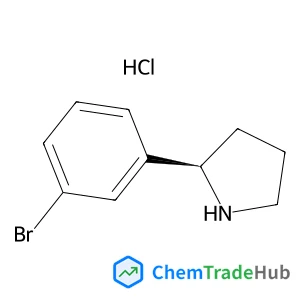
(2R)-2-(3-Bromophenyl)pyrrolidine hydrochloride (1:1)
CAS Number:
1391550-13-2
Molecular Formula:
C10H13BrClN
Shuai Xia, Yibin Zhang, Nick Whisman, Jianheng Bi, Tessa E. Steenwinkel, Shulin Wan, Jerry Medford, Momoko Tajiri, Rudy L. Luck, Thomas Werner, Haiying Liu
Two ratiometric near-infrared fluorescent probes have been developed to selectively detect mitochondrial pH changes based on highly efficient through-bond energy transfer (TBET) from cyanine donors to near-infrared hemicyanine acceptors. The probes consist of identical cyanine donors connected to different hemicyanine acceptors with a spirolactam ring structure linked via a biphenyl linkage. At neutral or basic pH, the probes display only fluorescence of the cyanine donors when they are excited at 520 nm. However, acidic pH conditions trigger spirolactam ring opening, leading to increased π-conjugation of the hemicyanine acceptors, resulting in new near-infrared fluorescence peaks at 740 nm and 780 nm for probes A and B, respectively. This results in ratiometric fluorescence responses of the probes to pH changes indicated by decreases of the donor fluorescence and increases of the acceptor fluorescence under donor excitation at 520 nm due to a highly efficient TBET from the donors to the acceptors. The probes only show cyanine donor fluorescence in alkaline-pH mitochondria. However, the probes show moderate fluorescence decreases of the cyanine donor and considerable fluorescence increases of hemicyanine acceptors during the mitophagy process induced by nutrient starvation or under drug treatment. The probes display rapid, selective, and sensitive responses to pH changes over metal ions, good membrane penetration, good photostability, large pseudo-Stokes shifts, low cytotoxicity, mitochondria-targeting, and mitophagy-tracking capabilities.
Ki-Sub Kim, Sukjeong Choi, D. Demberelnyamba, Huen Lee, Jaeseung Oh, Byoung-Bae Lee, Su-Jin Mun
DOI: 10.1039/B400198B
Nathaniel C. Lim, Christian Brückner
DOI: 10.1039/B403448A
Kristina Orrling, Peter Nilsson, Mats Gullberg, Mats Larhed
DOI: 10.1039/B317049G
Mikhail Zolotukhin, Serguei Fomine, Roberto Salcedo, Leonard Khalilov
DOI: 10.1039/B317108F
John Baty, Michael L. Sinnott
DOI: 10.1039/B316417A
Bernard Boitrel, Zakaria Halime, Lydie Michaudet, Mohamed Lachkar, Loïc Toupet
DOI: 10.1039/B309615G
David M. Hodgson, Frédéric Le Strat
DOI: 10.1039/B316908A
Hayley J. Whitfield, Roger J. Griffin, Ian R. Hardcastle, Andrew Henderson, Jerome Meneyrol, Veronique Mesguiche, Kerry L. Sayle, Bernard T. Golding
DOI: 10.1039/B308948G
Jing Sun, Lian Gao, Mikio Iwasa
DOI: 10.1039/B400817K
Mònica Soler, Wolfgang Wernsdorfer, Ziming Sun, John C. Huffman, David N. Hendrickson, George Christou
DOI: 10.1039/B306246E
N-(4-Methoxybenzyl)-2-pyridinamine (CAS: 52818-63-0) is increasingly being used ...
When handling Ethyl 4-(2-chlorophenyl)-1,3-thiazole-2-carboxylate, appropriate p...
Diethyldiselane (CAS: 628-39-7) is classified under the Globally Harmonized Syst...
The market for oxocopper (CAS: 12053-18-8) is primarily driven by its use in cat...
The market for 5-{[(2-Methyl-2-propanyl)oxy]carbonyl}-5-azaspiro[2.4]heptane-7-c...
2-(1-Pyrrolidinyl)-4-pyridinamine is a chemical compound with the CAS number 359...
2-(3-Pyridinyl)-1-azabicyclo[2.2.2]octane (CAS: 91556-75-1) is a crystalline sol...
(S)-Alpha-allyl-proline hydrochloride is usually synthesized via a Wittig reacti...
3-Methyl-1,2-oxazole-5-carboxylic acid (CAS: 4857-42-5) is an organic compound w...
Lys-SMCC-DM1 is synthesized via a multi-step process involving the coupling of S...
Journal of Materials Chemistry A, B & C cover high quality studies across all fields of materials chemistry. The journals focus on those theoretical or experimental studies that report new understanding, applications, properties and synthesis of materials. The journals have a strong history of publishing quality reports of interest to interdisciplinary communities and providing an efficient and rigorous service through peer review and publication. The journals are led by an international team of Editors-in-Chief and Associate Editors who are all active researchers in their fields. Journal of Materials Chemistry A, B & C are separated by the intended application of the material studied. Broadly, applications in energy and sustainability are of interest to Journal of Materials Chemistry A, applications in biology and medicine are of interest to Journal of Materials Chemistry B, and applications in optical, magnetic and electronic devices are of interest to Journal of Materials Chemistry C. More than one Journal of Materials Chemistry journal may be suitable for certain fields and researchers are encouraged to submit their paper to the journal that they feel best fits for their particular article. Example topic areas within the scope of Journal of Materials Chemistry B are listed below. This list is neither exhaustive nor exclusive. Antifouling coatings Biocompatible materials Bioelectronics Bioimaging Biomimetics Biomineralisation Bionics Biosensors Diagnostics Drug delivery Gene delivery Immunobiology Nanomedicine Regenerative medicine & Tissue engineering Scaffolds Soft robotics Stem cells Therapeutic devices image block All articles published in Journal of Materials Chemistry B from 2019 onwards will be indexed in MEDLINE®. Articles that primarily focus on providing insight into the underlying science and performance of biomaterials within a biological environment are more suited to our companion journal, Biomaterials Science.