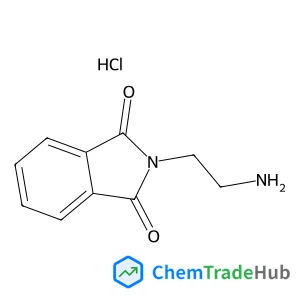
2-(2-Aminoethyl)-1H-isoindole-1,3(2H)-dione hydrochloride (1:1)
CAS Number:
30250-67-0
Molecular Formula:
C10H11ClN2O2
Junfei Zhou, Brian Guo, Meng Sun, Monday M. Onakpa, Guangmin Yao, Ming Zhao, Chun-Tao Che
Seven new diterpenoids (1–7) and five known analogs (8–12) were isolated from the tuber of Icacina oliviformis. Their chemical structures were elucidated by spectroscopic analyses, with the spatial configurations defined based on calculated 13C NMR-DP4 analysis and electronic circular dichroism methods. Oliviformislactones A (1) and B (2) are the first examples of rearranged 3,4-seco-pimarane possessing a 6/6/5/5 tetracyclic ring system featuring an unprecedented 4,12-dioxatetracyclo[8.6.0.02,7.010,14]hexadecane core; secopimaranlactone A (3) and secocleistanthone A (4) are the first examples of 3,4-seco-pimarane and 3,4-seco-cleistanthane type diterpenoids, respectively, obtained from the Icacinaceae family. The plausible biosynthetic routes for 1–3 are proposed. Compounds 1–4 and 12 exhibited PTP1B inhibitory activity with IC50 values ranging from 3.24 to 58.05 μM. Among them, 1 (IC50 = 6.78 μM, Ki = 1.51 μM) and 3 (IC50 = 3.24 μM, Ki = 1.25 μM) displayed uncompetitive inhibition responses. In addition, the 16-p-bromobenzoyl derivative of oliviformislactone A (1a) displayed higher potency (IC50 = 87.51 nM, Ki = 0.44 μM) than its natural precursor.

New Journal of Chemistry

Russian Journal of Organic Chemistry

Acta Materialia

Drug Discovery Today

Journal of Saudi Chemical Society

Journal of Natural Medicines

Organic Process Research & Development

Russian Journal of Applied Chemistry

Current Opinion in Colloid & Interface Science

Russian Journal of Bioorganic Chemistry
M. Esther Morilla, M. Mar Díaz-Requejo, Tomás R. Belderrain, M. Carmen Nicasio, Swiatoslaw Trofimenko, Pedro J. Pérez
DOI: 10.1039/B207389G
Luca Fadini, Antonio Togni
DOI: 10.1039/B210680A
Thierry Gacoin, Christian Ricolleau, Jean-Pierre Boilot
DOI: 10.1039/B208357D
Nicolas Barrier, Simon J. Clarke
DOI: 10.1039/B209747H
T. Keith Hollis, Yi Joon Ahn, Fook S. Tham
DOI: 10.1039/B208945A
Josep L. Torres, Begoña Varela, Enric Brillas, Luis Juliá
DOI: 10.1039/B209985C
Andrew Tsotinis, Andreas Eleutheriades, Katherine Hough, David Sugden
DOI: 10.1039/B210731G
Haidoo Kwen, Sean Tomlinson, Eric A. Maatta, Céline Dablemont, René Thouvenot, Anna Proust, Pierre Gouzerh
DOI: 10.1039/B209173A
DOI: 10.1039/B211036A
Silvia Milanesi, Maurizio Fagnoni, Angelo Albini
DOI: 10.1039/B210243A
(1R,3S)-1,3-Cyclopentanediol finds applications in various industries. In the ph...
When handling N'-[4-(Dimethylamino)phenyl]-N,N-dimethyl-1,4-benzenediamine, it i...
There are several alternatives to 5-(2,4-Difluorophenyl)-2-methoxypyrimidine in ...
1-(3-Methoxyphenoxy)propan-2-ol (CAS: 382141-68-6) must comply with the Globally...
Tetrodotoxin Citrate is extremely dangerous and should be handled with extreme c...
2-Methyl-2-propanyl [(1R,3S)-3-hydroxycyclopentyl]carbamate (CAS: 225641-84-9) i...
Waste containing 4-(2-Hydroxyhexafluoroisopropyl)Benzoic Acid (CAS: 16261-80-6) ...
2-Methyl-2-proanyl {(2S)-1-[(benzyloxy)amino]-3-hydroxy-3-methyl-1-oxo-2-butanyl...
Benzeneethanamine, α-ethyl-, hydrochloride (1:1) is an organic compound with the...
In the synthesis of compounds similar to 3-{(E)-[4-(Dimethylamino)phenyl]diazeny...

Organic Chemistry Frontiers publishes high-quality research from across organic chemistry. Emphases are placed on studies that make significant contributions to the field of organic chemistry by reporting either new or significantly improved protocols or methodologies. Topics include, but are not limited to the following: Organic synthesis Development of synthetic methodologies Catalysis Natural products Functional organic materials Supramolecular and macromolecular chemistry Physical and computational organic chemistry