












A novel layered oxysulfide intergrowth compound Sr4Mn2Cu5O4S5 containing a fragment of the α-Cu2S antifluorite structure
Literature Information
Publication Date
2002-12-02
DOI
10.1039/B209747H
Impact Factor
6.222
Authors
Nicolas Barrier, Simon J. Clarke
View Original
Abstract
Sr4Mn2Cu5O4S5 contains manganese oxide sheets separated by unusual antifluorite-type Cu3S3 layers in which copper(I) ions are distributed over three- and four-coordinate sites in a similar fashion to in α-Cu2−xS and suggestive of high two-dimensional copper ion mobility.
Related Literature
Pattern recognition as a new strategy in high-resolution spectroscopy: application to methanol OH-stretch overtones
Jozef Rakovský, Ondrej Votava
2021-08-09
Paper
DOI: 10.1039/D1CP02639A
A theoretical study on the electronic, structural and optical properties of armchair, zigzag and chiral silicon–germanium nanotubes
Alejandro Herrera-Carbajal, Ventura Rodríguez-Lugo, Juan Hernández-Ávila, Ariadna Sánchez-Castillo
2021-05-09
Paper
DOI: 10.1039/D1CP00519G
Correction: De novo prediction of cross-effect efficiency for magic angle spinning dynamic nuclear polarization
Anne-Laure Barra, Johan van Tol, Sabine Hediger, Daniel Lee, Gaël De Paëpe
2021-06-11
Correction
DOI: 10.1039/D1CP90117F
Gaseous cyclodextrin-closo-dodecaborate complexes χCD·B12X122− (χ = α, β, and γ; X = F, Cl, Br, and I): electronic structures and intramolecular interactions
Yanrong Jiang, Qinqin Yuan, Wenjin Cao, Marc C. Nierstenhöfer, Zhipeng Li, Yan Yang, Cheng Zhong, Carsten Jenne, Xue-Bin Wang
2021-04-26
Paper
DOI: 10.1039/D1CP01131F
Probing reaction processes and reversibility in Earth-abundant Na3FeF6 for Na-ion batteries
Anthony Wong, Gabriel Ménard
2021-07-01
Paper
DOI: 10.1039/D1CP02763H
The impact of insufficient time resolution on dye regeneration lifetime determined using transient absorption spectroscopy
Inseong Cho, Pawel Wagner, Peter C. Innis, Attila J. Mozer
2021-05-29
Paper
DOI: 10.1039/D1CP01217G
Time-resolved observations of vibrationally excited NO X 2Π (v′) formed from collisional quenching of NO A 2Σ+ (v = 0) by NO X 2Π: evidence for the participation of the NO a 4Π state
James D. Fletcher, Lucia Lanfri, Grant A. D. Ritchie, Gus Hancock, Meez Islam, Graham Richmond
2021-09-08
Paper
DOI: 10.1039/D1CP03360C
The necessity of periodic boundary conditions for the accurate calculation of crystalline terahertz spectra
Peter A. Banks, Luke Burgess, Michael T. Ruggiero
2021-09-08
Perspective
DOI: 10.1039/D1CP02496E
You might also like
Compound Q&A
What is the market or research trend for N-(4-Methoxybenzyl)-2-pyridinamine (CAS: 52818-63-0)?
N-(4-Methoxybenzyl)-2-pyridinamine (CAS: 52818-63-0) is increasingly being used ...
52818-63-0N-(4-Methoxybenzyl)-...
Compound Q&A
What precautions should be taken when handling Ethyl 4-(2-chlorophenyl)-1,3-thiazole-2-carboxylate (CAS: 1050507-06-6)?
When handling Ethyl 4-(2-chlorophenyl)-1,3-thiazole-2-carboxylate, appropriate p...
1050507-06-6Ethyl 4-(2-chlorophe...
Compound Q&A
What regulatory guidelines apply to diethyldiselane (CAS: 628-39-7)?
Diethyldiselane (CAS: 628-39-7) is classified under the Globally Harmonized Syst...
628-39-7Diethyldiselane
Compound Q&A
What is the market or research trend for oxocopper (CAS: 12053-18-8)?
The market for oxocopper (CAS: 12053-18-8) is primarily driven by its use in cat...
12053-18-8oxocopper; oxo-(oxoc...
Compound Q&A
What is the market or research trend for 5-{[(2-Methyl-2-propanyl)oxy]carbonyl}-5-azaspiro[2.4]heptane-7-carboxylic acid?
The market for 5-{[(2-Methyl-2-propanyl)oxy]carbonyl}-5-azaspiro[2.4]heptane-7-c...
1268519-54-55-{[(2-Methyl-2-prop...
Compound Q&A
What is 2-(1-Pyrrolidinyl)-4-pyridinamine (CAS: 35981-63-6)?
2-(1-Pyrrolidinyl)-4-pyridinamine is a chemical compound with the CAS number 359...
35981-63-62-(1-Pyrrolidinyl)-4...
Compound Q&A
What are the physical and chemical properties of 2-(3-Pyridinyl)-1-azabicyclo[2.2.2]octane (CAS: 91556-75-1)?
2-(3-Pyridinyl)-1-azabicyclo[2.2.2]octane (CAS: 91556-75-1) is a crystalline sol...
91556-75-12-(3-Pyridinyl)-1-az...
Compound Q&A
How is (S)-Alpha-allyl-proline hydrochloride (CAS: 129704-91-2) typically synthesized?
(S)-Alpha-allyl-proline hydrochloride is usually synthesized via a Wittig reacti...
129704-91-2(S)-Alpha-allyl-prol...
Compound Q&A
What is 3-Methyl-1,2-oxazole-5-carboxylic acid (CAS: 4857-42-5)?
3-Methyl-1,2-oxazole-5-carboxylic acid (CAS: 4857-42-5) is an organic compound w...
4857-42-53-Methyl-1,2-oxazole...
Compound Q&A
How is Lys-SMCC-DM1 (CAS: 1281816-04-3) typically synthesized?
Lys-SMCC-DM1 is synthesized via a multi-step process involving the coupling of S...
1281816-04-3Lys-SMCC-DM1
Source Journal
Chemical Communications

CiteScore:
8.6
Self-citation Rate:
4.7%
Articles per Year:
2458
ChemComm publishes urgent research which is of outstanding significance and interest to experts in the field, while also appealing to the journal’s broad chemistry readership. Our communication format is ideally suited to short, urgent studies that are of such importance that they require accelerated publication. Our scope covers all topics in chemistry, and research at the interface of chemistry and other disciplines (such as materials science, nanoscience, physics, engineering and biology) where there is a significant novelty in the chemistry aspects. Major topic areas covered include: Analytical Chemistry Catalysis Chemical Biology and medicinal chemistry Computational Chemistry and Machine Learning Energy and sustainable chemistry Environmental Chemistry Green Chemistry Inorganic Chemistry Materials Chemistry Nanoscience Organic Chemistry Physical Chemistry Polymer Chemistry Supramolecular Chemistry
Recommended Compounds


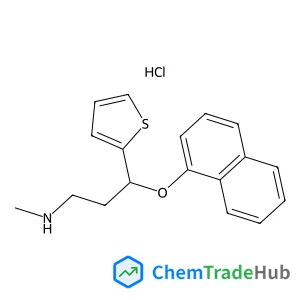
N-Methyl-3-(1-naphthyloxy)-3-(2-thienyl)-1-propanamine hydrochloride (1:1)
CAS Number:
1188266-11-6
Molecular Formula:
C18H20ClNOS
Recommended Suppliers






Disclaimer
This page provides academic journal information for reference and research purposes only. We are not affiliated with any journal publishers and do not handle publication submissions. For publication-related inquiries, please contact the respective journal publishers directly.
If you notice any inaccuracies in the information displayed, please contact us at support@chemtradehub.com. We will promptly review and address your concerns.