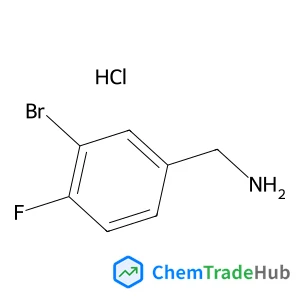
1-(3-Bromo-4-fluorophenyl)methanamine hydrochloride (1:1)
CAS Number:
202865-68-7
Molecular Formula:
C7H8BrClFN
Wei Guo, Panwang Zhou, Zhe Tang
The effects of the heteroatom and position on excited-state intramolecular proton transfer (ESIPT) of 2-[4′-(N-4,6-dichloro-1,3,5-triazi-n-2-yl)2′hydroxyphenyl]benzoxazole (4THBO) have been investigated via time-dependent density functional theory studies. The heteroatoms refer to O and S atoms, and the position effect refers to the N-4,6-trichloro-1,3,5-triazin-2-yl (TCT) substituents in the para and meta positions. The configuration of the four compounds (4THBO, 4THBT, 5THBO and 5THBT) was optimized and the bond lengths, bond angles and infrared spectra of the atoms participating in the proton transfer in the S0 and S1 states were studied. The occurrence of ultrafast ESIPT in the four compounds was demonstrated. Moreover, the potential energy curves of the S0 and S1 states were constructed, and the effects of the heteroatom substitution and substituent position changes on the ESIPT mechanism of the four 4THBO derivatives were analyzed. The results show that the ESIPT barrier of the S atom substitution in the excited state is lower than that of the O atom-substituted molecule, and the energy barrier of the substituent (TCT) in the meta-position is significantly smaller than that in the para-position. These results indicate that the substitution of the S heteroatom promotes the ESIPT of the 4THBO compound and that the substituent (TCT) in the para position is more prone to proton transfer than that in the meta position. Our work could provide a theoretical basis for further experiments.
Lu Su, Yu Zhao, Guosong Chen, Ming Jiang
DOI: 10.1039/C2PY20110K
Tomohito Ogura, Yuta Saito, Tomoya Higashihara, Mitsuru Ueda
DOI: 10.1039/C2PY20093G
Erol Hasan, Steve Furzeland, Derek Atkins, Dave J. Adams, Jonathan V. M. Weaver
DOI: 10.1039/C2PY00564F
Shogo Takamuku, Patric Jannasch
DOI: 10.1039/C2PY00611A
Yi Zhang, Mingming Ding, Lijuan Zhou, Hong Tan, Jiehua Li, Huining Xiao, Jianshu Li, James Snow
DOI: 10.1039/C2PY00558A
Ruiwei Guo, Zhipeng Shi, Xingxing Wang, Anjie Dong
DOI: 10.1039/C2PY20102J
Hongkun Li, Jian Wang, Jing Zhi Sun, Rongrong Hu, Anjun Qin
DOI: 10.1039/C2PY00586G
Wen-Da Li, Jian-Bing Zeng, Xiao-Jie Lou, Jing-Jing Zhang, Yu-Zhong Wang
DOI: 10.1039/C2PY20068F
When considering alternatives to 1-(4-Chlorophenyl)-N-hydroxymethanimine (CAS: 3...
This compound should be stored in a cool, dry place away from direct sunlight. I...
3-(4-Bromophenyl)-5-(2-fluorophenyl)-1,2,4-oxadiazole is synthesized through a m...
5-Chloro-2-(4-chlorophenyl)-4-methyl-6-[3-(1-piperidinyl)propoxy]pyrimidine (CAS...
2-Chloro-4-(difluoromethoxy)pyridine is used in the pharmaceutical industry for ...
3-Chloro-6-methylpyridazine (CAS: 1121-79-5) is classified under the Globally Ha...
Several alternatives can be used in the synthesis of Methyl 4,5-dimethyl-2-nitro...
Alternatives to (2E,2'E)-3,3'-(1,4-Phenylene)bisacrylaldehyde include other acry...
3-Amino-5-chloropyridin-2-ol hydrochloride is an organic compound with the CAS n...
When handling 6,7-Difluoro-2,3-dihydro-4H-chromen-4-one, it is essential to wear...

Organic Chemistry Frontiers publishes high-quality research from across organic chemistry. Emphases are placed on studies that make significant contributions to the field of organic chemistry by reporting either new or significantly improved protocols or methodologies. Topics include, but are not limited to the following: Organic synthesis Development of synthetic methodologies Catalysis Natural products Functional organic materials Supramolecular and macromolecular chemistry Physical and computational organic chemistry
![2-{[(1R,2S)-2-Aminocyclohexyl]amino}-4-{[3-(2H-1,2,3-triazol-2-yl)phenyl]amino}-5-pyrimidinecarboxamide structure](https://static.chemtradehub.com/structs/137/1370261-96-3-40df.webp "2-{[(1R,2S)-2-Aminocyclohexyl]amino}-4-{[3-(2H-1,2,3-triazol-2-yl)phenyl]amino}-5-pyrimidinecarboxamide structure")