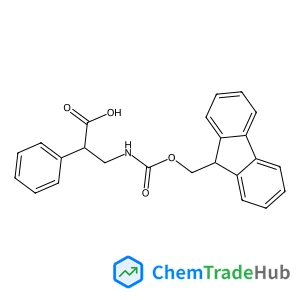
(S)-3-((((9H-Fluoren-9-yl)methoxy)carbonyl)amino)-2-phenylpropanoic acid
CAS Number:
1217663-60-9
Molecular Formula:
C24H21NO4
Wen-Da Li, Jian-Bing Zeng, Xiao-Jie Lou, Jing-Jing Zhang, Yu-Zhong Wang
A series of poly(butylene terephthalate)-poly(butylene succinate) (PBT-PBS) copolyesters were synthesized by the melt chain-extension reaction of dihydroxyl terminated PBT (HO-PBT-OH) and PBS (HO-PBS-OH) prepolymers using toluene-2,4-diisoyanate (TDI) as a chain extender. Transesterification between PBT and PBS during the chain-extension reaction has been investigated in detail. Both random and block PBT-PBS copolymers can be synthesized by changing the prepolymers' molecular weights at a given reaction time and temperature. The chemical structures and sequence distributions of the copolyesters were analyzed by proton nuclear magnetic resonance (1H-NMR) spectroscopy. The thermal transition behaviours of copolyesters with different sequence distribution were characterized by differential scanning calorimeter (DSC). The number-average molecular weight (Mn) of HO-PBT-OH played a dominant role in the sequence distribution of the resulting copolyesters. The degree of randomness of the copolymer was around 1 when Mn of HO-PBT-OH was 5000 g mol−1 regardless of that of HO-PBS-OH, it decreased to less than 1 when Mn of HO-PBT-OH was more than 10 000 g mol−1, and it gradually decreased with the increase in Mn of HO-PBS-OH. The copolyesters with different degrees of randomness showed different thermal transition and crystallization behaviours.
Yuanfeng Gao
DOI: 10.1039/C6PY01929C
Gérald Lopez, Marc Guerre, Bruno Améduri, Jean-Pierre Habas, Vincent Ladmiral
DOI: 10.1039/C7PY00580F
Sue Watson, Anna M. Grabowska
DOI: 10.1039/C4PY00369A
Marco Albuszis, Peter J. Roth, Werner Pauer, Hans-Ulrich Moritz
DOI: 10.1039/C4PY00709C
Jaipal Gupta, Daniel J. Keddie, Chaoying Wan, David M. Haddleton, Tony McNally
DOI: 10.1039/C6PY00522E
Jirong Wang, Jianyu Han, Mohd Yusuf Khan, Dan He, Haiyan Peng, Dianyu Chen, Xiaolin Xie, Zhigang Xue
DOI: 10.1039/C6PY02066F
Marc Guerre, Mona Semsarilar, Franck Godiard, Bruno Améduri, Vincent Ladmiral
DOI: 10.1039/C6PY02203K
Hongjun Yang, Zhongrui Wang, Yulei Zheng, Wenyan Huang, Xiaoqiang Xue, Bibiao Jiang
DOI: 10.1039/C7PY00174F
Yingda Huang, Jianyun He, Zhanxiong Liu, Guilong Cai, Shaowen Zhang, Xiaofang Li
DOI: 10.1039/C6PY01859A
Jing Zhang, Pu Xiao, Fabrice Morlet-Savary, Bernadette Graff, Jean Pierre Fouassier, Jacques Lalevée
DOI: 10.1039/C4PY00770K
When considering alternatives to 1-(4-Chlorophenyl)-N-hydroxymethanimine (CAS: 3...
This compound should be stored in a cool, dry place away from direct sunlight. I...
3-(4-Bromophenyl)-5-(2-fluorophenyl)-1,2,4-oxadiazole is synthesized through a m...
5-Chloro-2-(4-chlorophenyl)-4-methyl-6-[3-(1-piperidinyl)propoxy]pyrimidine (CAS...
2-Chloro-4-(difluoromethoxy)pyridine is used in the pharmaceutical industry for ...
3-Chloro-6-methylpyridazine (CAS: 1121-79-5) is classified under the Globally Ha...
Several alternatives can be used in the synthesis of Methyl 4,5-dimethyl-2-nitro...
Alternatives to (2E,2'E)-3,3'-(1,4-Phenylene)bisacrylaldehyde include other acry...
3-Amino-5-chloropyridin-2-ol hydrochloride is an organic compound with the CAS n...
When handling 6,7-Difluoro-2,3-dihydro-4H-chromen-4-one, it is essential to wear...

Polymer Chemistry welcomes submissions in all areas of polymer science that have a strong focus on macromolecular chemistry. Manuscripts may cover a broad range of fields, yet no direct application focus is required.