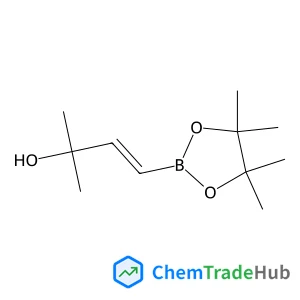
(E)-2-methyl-4-(4,4,5,5-tetramethyl-1,3,2-dioxaborolan-2-yl)but-3-en-2-ol
CAS Number:
581802-26-8
Molecular Formula:
C11H21BO3
Shogo Takamuku, Patric Jannasch
Sulfonated fully aromatic polymers with different positions of the acid groups, but with an identical polymer backbone, have been investigated and compared with respect to their properties as proton-exchange membranes. Three different series of sulfonated poly(arylene ether sulfone)s (SPAES) having the same backbone structure were prepared from 4,4′-dichlorodiphenyl sulfone (DCDPS) and 4,4′-dihydroxybiphenyl (BP), each series comprising three levels of the ion exchange capacity (IEC). The first series of SPAES had the sulfonic acid groups placed in ortho positions to the ether bridges (oeSPAES) and were prepared through post-polymerization sulfonation. The second and third series of SPAES carried the sulfonic acid groups in meta (msSPAES) and ortho (osSPAES) positions to the sulfone bridges, respectively, and were prepared by polycondensations of mixtures of BP, DCDPS and either 3,3′-disulfonated or 2,2′-disulfonated DCDPS, respectively. The latter monomer was synthesized via lithiation–sulfination–oxidation of DCDPS. Analysis of solvent cast membranes showed that the osSPAES copolymers had a high dimensional stability in water up to 100 °C, even at high ionic contents. Moreover, the osSPAES and the msSPAES membranes were better at retaining conductivity at reduced relative humidity than the oeSPAES membranes. Thermogravimetry of the membranes in the acid form under air indicated no significant differences based on the placement of the sulfonic acid groups. The resistance towards radical attack was analyzed by 1H NMR spectroscopy after immersing the membranes in Fenton's reagent at 60 °C, and the ability to retain IEC was found to increase in the order oeSPAES < msSPAES < osSPAES. Membrane stability was also studied in an accelerated hydrolysis test by immersing the membranes in 0.1 M aq. HCl at 200 °C in a sealed vessel. The results showed a dramatic loss of sulfonic acid in the oeSPAES membranes, presumably activated by the proximity of the ether bridges. Careful 1H NMR analysis also suggested that the osSPAES polymers degraded by scission of the sulfone bridges. The position of the sulfonic acid groups ortho to the sulfone bridges seemingly destabilized the latter under the severe conditions employed in the test.
Yaqing Qu, Fei Huo, Quanlong Li, Xin He, Shentong Li, Wangqing Zhang
DOI: 10.1039/C4PY00510D
Scott C. Radzinski, Jeffrey C. Foster, Sally E. Lewis, Eric V. French, John B. Matson
DOI: 10.1039/C6PY01982J
Merve Mocan, Joris de Grooth, Anton H. Hofman, Hanne M. van der Kooij, Katja Loos, Wiebe M. de Vos, Marleen Kamperman
DOI: 10.1039/C7PY00023E
Shinji Yamada, Akinori Takasu, Sadatsugu Takayama, Kazuhiko Kawamura
DOI: 10.1039/C4PY00639A
Jochen Willersinn, Anna Bogomolova, Marc Brunet Cabré, Bernhard V. K. J. Schmidt
DOI: 10.1039/C6PY02212J
Yang Wu, Yanyan Zhou, Jian Zhu, Wei Zhang, Xiangqiang Pan, Zhengbiao Zhang, Xiulin Zhu
DOI: 10.1039/C4PY00732H
Mariolino Carta, Richard Malpass-Evans, Matthew Croad, Yulia Rogan, Michael Lee, Ian Rose, Neil B. McKeown
DOI: 10.1039/C4PY00609G
Chih-Chia Cheng, Jyun-Jie Huang, Zhi-Sheng Liao, Shan-You Huang, Zhong Xin
DOI: 10.1039/C7PY00182G
Hyeonuk Yeo, Nam-Ho You, Se Gyu Jang, Seokhoon Ahn, Kwang-Un Jeong, Seung Hee Lee, Munju Goh
DOI: 10.1039/C7PY00243B
Xiaodong Liu, Qinghua Xu, Lifen Zhang, Zhenping Cheng, Xiulin Zhu
DOI: 10.1039/C7PY00366H
When considering alternatives to 1-(4-Chlorophenyl)-N-hydroxymethanimine (CAS: 3...
This compound should be stored in a cool, dry place away from direct sunlight. I...
3-(4-Bromophenyl)-5-(2-fluorophenyl)-1,2,4-oxadiazole is synthesized through a m...
5-Chloro-2-(4-chlorophenyl)-4-methyl-6-[3-(1-piperidinyl)propoxy]pyrimidine (CAS...
2-Chloro-4-(difluoromethoxy)pyridine is used in the pharmaceutical industry for ...
3-Chloro-6-methylpyridazine (CAS: 1121-79-5) is classified under the Globally Ha...
Several alternatives can be used in the synthesis of Methyl 4,5-dimethyl-2-nitro...
Alternatives to (2E,2'E)-3,3'-(1,4-Phenylene)bisacrylaldehyde include other acry...
3-Amino-5-chloropyridin-2-ol hydrochloride is an organic compound with the CAS n...
When handling 6,7-Difluoro-2,3-dihydro-4H-chromen-4-one, it is essential to wear...

Polymer Chemistry welcomes submissions in all areas of polymer science that have a strong focus on macromolecular chemistry. Manuscripts may cover a broad range of fields, yet no direct application focus is required.
![(2S)-2-{[(9H-Fluoren-9-ylmethoxy)carbonyl]amino}-4-(methylselanyl)butanoic acid structure](https://static.chemtradehub.com/structs/121/1217852-49-7-f252.webp "(2S)-2-{[(9H-Fluoren-9-ylmethoxy)carbonyl]amino}-4-(methylselanyl)butanoic acid structure")