












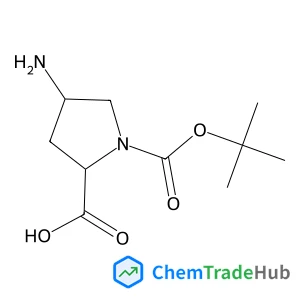
(2R,4R)-1-Boc-4-Aminopyrrolidine-2-carboxylic acid
CAS Number:
132622-98-1
Molecular Formula:
C10H18N2O4
Yangxin Chen, Ting Chen, Zhongai Zou, Yadong Feng, Qihua You
A novel strategy for the regiospecific synthesis of 2-(2-aminobenzoyl)benzoic acids via a base-promoted aerobic cascade reaction has been exploited. The protocol led to a wide panel of 2-(2-aminobenzoyl)benzoic acids with a broad substrate scope in an atom-economical manner. Six new bonds were sequentially formed in this one-pot procedure.
Sue Watson, Anna M. Grabowska
DOI: 10.1039/C4PY00369A
Toyokazu Tsutsuba
DOI: 10.1039/C7PY00100B
Xue Jiang, Guolin Lu, Huang Xiaoyu
DOI: 10.1039/C6PY02004F
Ferda Hacıvelioğlu
DOI: 10.1039/C7PY00189D
Hui Zhou, Jiesheng Li, Ming Hui Chua, Hong Yan, Beng Zhong Tang, Jianwei Xu
DOI: 10.1039/C4PY00518J
Chen Gao, Liwei Wang, Xiaoyu Li
DOI: 10.1039/C4PY00389F
Chih-Chia Cheng, Jyun-Jie Huang, Zhi-Sheng Liao, Shan-You Huang, Zhong Xin
DOI: 10.1039/C7PY00182G
Graeme Moad, San H. Thang
DOI: 10.1039/C4PY00496E
Chun Feng, Guolin Lu, Gang Sun, Xunwei Liu, Xiaoyu Huang
DOI: 10.1039/C4PY00772G
Parvesh Wadhwani, Rouven Müller
DOI: 10.1039/C6PY02108E
When considering alternatives to 1-(4-Chlorophenyl)-N-hydroxymethanimine (CAS: 3...
This compound should be stored in a cool, dry place away from direct sunlight. I...
3-(4-Bromophenyl)-5-(2-fluorophenyl)-1,2,4-oxadiazole is synthesized through a m...
5-Chloro-2-(4-chlorophenyl)-4-methyl-6-[3-(1-piperidinyl)propoxy]pyrimidine (CAS...
2-Chloro-4-(difluoromethoxy)pyridine is used in the pharmaceutical industry for ...
3-Chloro-6-methylpyridazine (CAS: 1121-79-5) is classified under the Globally Ha...
Several alternatives can be used in the synthesis of Methyl 4,5-dimethyl-2-nitro...
Alternatives to (2E,2'E)-3,3'-(1,4-Phenylene)bisacrylaldehyde include other acry...
3-Amino-5-chloropyridin-2-ol hydrochloride is an organic compound with the CAS n...
When handling 6,7-Difluoro-2,3-dihydro-4H-chromen-4-one, it is essential to wear...

Organic Chemistry Frontiers publishes high-quality research from across organic chemistry. Emphases are placed on studies that make significant contributions to the field of organic chemistry by reporting either new or significantly improved protocols or methodologies. Topics include, but are not limited to the following: Organic synthesis Development of synthetic methodologies Catalysis Natural products Functional organic materials Supramolecular and macromolecular chemistry Physical and computational organic chemistry
![2-{[(1R,2S)-2-Aminocyclohexyl]amino}-4-{[3-(2H-1,2,3-triazol-2-yl)phenyl]amino}-5-pyrimidinecarboxamide structure](https://static.chemtradehub.com/structs/137/1370261-96-3-40df.webp "2-{[(1R,2S)-2-Aminocyclohexyl]amino}-4-{[3-(2H-1,2,3-triazol-2-yl)phenyl]amino}-5-pyrimidinecarboxamide structure")




