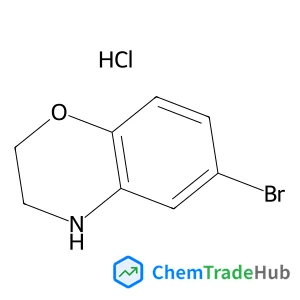
6-Bromo-3,4-dihydro-2H-1,4-benzoxazine hydrochloride (1:1)
CAS Number:
1260803-10-8
Molecular Formula:
C8H9BrClNO
Ferda Hacıvelioğlu
An easy and efficient method has been developed to prepare sulfonic acid functional cyclic and polymeric phosphazenes. Hexa(ethyl 4-oxybenzenesulfonate)cyclotriphosphazene and its sulfonic acid derivative, hexa(4-oxybenzenesulfonic acid)cyclotriphosphazene were successfully synthesized. Fully sulfonated polybis(4-oxybenzenesulfonic acid)phosphazene and three different copolymers composed of 4-methylphenol and 4-hydroxybenzenesulfonic acid have been prepared, in which the degree of sulfonation for whole polymers ranged from 25% to 100%. 1H, 31P NMR and FT-IR techniques were used to characterise the composition of the materials obtained by this new synthetic route. The structure of the hexa(ethyl 4-oxybenzenesulfonate)cyclotriphosphazene was also determined by single crystal X-ray diffraction. The thermal properties of the materials have been investigated by DSC and TGA, and the ion exchange properties were measured using volumetric titrations. The mechanical properties of the cast membranes were measured by using a universal tensile apparatus and compared with Nafion and post sulfonated aryloxyphosphazenes. Impedance spectroscopy was used to investigate the proton conductivity properties of the phenoxysulfonic acid substituted cyclic and polymeric phosphazenes at various temperatures. It was found that the proton conductivity of fully sulfonic acid functional polyaryloxyphosphazene is higher than that of Nafion under anhydrous conditions. Due to the advantages of this new synthetic route over the previous methods, it will be possible to prepare novel sulfonated phosphazene derivatives for different applications.

Russian Journal of Applied Chemistry

Crystallography Reports

Chemistry Education Research and Practice

Journal of Saudi Chemical Society

Nature Medicine

Russian Journal of Organic Chemistry

Saudi Pharmaceutical Journal

Russian Chemical Bulletin

Journal of Peptide Science

Russian Journal of Coordination Chemistry
Xiaodong Lv, Fengyu Li, Jian Gong, Jinxing Gu, Shiru Lin, Zhongfang Chen
DOI: 10.1039/D0CP00967A
Mohammad Hasani, Lars Nordstierna, Anna Martinelli
DOI: 10.1039/C9CP03563J
Luís F. da Silva, Ariadne C. Catto, Waldir Avansi, Jr, Alexandre Mesquita, Lauro J. Q. Maia, Osmando F. Lopes, Máximo Siu Li, Mário L. Moreira, Elson Longo, Juan Andrés, Valmor R. Mastelaro
DOI: 10.1039/C9CP02893E
Philipp Frühwirt, Jens T. Törring, Tomaž Katrašnik, Georg Gescheidt
DOI: 10.1039/C9CP04986J
P. S. Ghosh, A. Arya
DOI: 10.1039/D0CP00220H
Enrique Wagemann, Yanbin Wang, Siddhartha Das, Sushanta K. Mitra
DOI: 10.1039/D0CP00200C
Catherine Stampfl, Berna Akgenc, Mitra Ghergherehchi, Ch. V. Nguyen
DOI: 10.1039/D0CP00093K
Shivani Gupta
DOI: 10.1039/C9CP04162A
Laura Le Bras, Roxanne Berthin, Ismaïl Hamdi, Maroua Louati, Stéphane Aloïse, Michinori Takeshita
DOI: 10.1039/C9CP06590C
Amr A. A. Attia, Alexandru Lupan, R. Bruce King, Sundargopal Ghosh
DOI: 10.1039/C9CP04263F
4-Nitrophenyl phosphate disodium salt hexahydrate is primarily used as a substra...
2-(Trifluoromethyl)-1,3-oxazole-4-carboxylic Acid (CAS: 1060816-01-4) is widely ...
2-Fluoro-4-biphenylcarboxylic acid should be stored in a cool, dry place at room...
Prednisolone-21-Carboxylic Acid is primarily used in the pharmaceutical industry...
4-(Hydrazinomethyl)-1,2,3-benzenetriol (CAS: 3614-72-0) should be stored in a co...
4-Amino-1-methyl-1H-pyrazole-5-carboxylic acid hydrochloride (CAS: 92534-70-8) i...
Dehydropachymic acid (CAS: 77012-31-8) is regulated by various agencies. It fall...
The market and research trends for 6-[(2,2-Dimethylpropanoyl)amino]nicotinic aci...
1,10-Phenanthroline-2,9-dicarbaldehyde should be stored in a cool, dry place awa...
5-Carbamoyl-11-oxo-10,11-dihydro-5H-dibenzo[b,f]azepin-10-yl acetate can be synt...

Polymer Chemistry welcomes submissions in all areas of polymer science that have a strong focus on macromolecular chemistry. Manuscripts may cover a broad range of fields, yet no direct application focus is required.