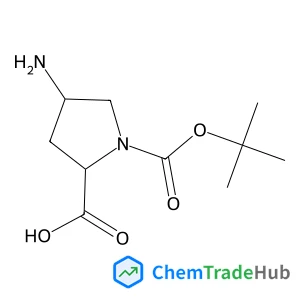
(2R,4R)-1-Boc-4-Aminopyrrolidine-2-carboxylic acid
CAS Number:
132622-98-1
Molecular Formula:
C10H18N2O4
Kouya Uchiyama, Hiroshi Ueno, Hiroshi Okada, Hiroshi Moriyama
Through an efficient octa-substitution reaction, octabromofullerene (C60Br8) was reacted with alcohols or anisole in the presence of silver triflate to produce octaalkoxy and octaaryl fullerenes, respectively, in up to 79% yield with retention of C2v-symmetry. The LUMO level could be widely tuned through the cumulative substituent effects of the eight addends. The difference in LUMO energy level between C60(OCH2CCl3)8 and C60(C6H4-OMe-4)8 was 0.53 eV, representing low-LUMO and high-LUMO fullerenes. Dynamic light scattering measurements revealed that these octa-substituted compounds were dispersed as single molecules both in toluene and in dichloromethane under low-concentration condition. This lack of aggregate formation is attributed to the polar and non-polar hemispheres of these molecules.
Li Qun Xu, Hua Jiang, Koon-Gee Neoh, En-Tang Kang, Guo Dong Fu
DOI: 10.1039/C2PY00552B
Tomohito Ogura, Yuta Saito, Tomoya Higashihara, Mitsuru Ueda
DOI: 10.1039/C2PY20093G
Anjan Bedi, Satyaprasad P. Senanayak, Soumyajit Das, K. S. Narayan, Sanjio S. Zade
DOI: 10.1039/C2PY20032E
Samuel Aleksanian, Behnoush Khorsand, Rolf Schmidt, Jung Kwon Oh
DOI: 10.1039/C2PY20154B
DOI: 10.1039/C2PY00512C
Harry R. Allcock, Nicole L. Morozowich
DOI: 10.1039/C1PY00468A
Pieter Espeel, Fabienne Goethals, Milan M. Stamenović, Lionel Petton, Filip E. Du Prez
DOI: 10.1039/C2PY00565D
Michael R. Kember, James Copley, Antoine Buchard, Charlotte K. Williams
DOI: 10.1039/C2PY00543C
When considering alternatives to 1-(4-Chlorophenyl)-N-hydroxymethanimine (CAS: 3...
This compound should be stored in a cool, dry place away from direct sunlight. I...
3-(4-Bromophenyl)-5-(2-fluorophenyl)-1,2,4-oxadiazole is synthesized through a m...
5-Chloro-2-(4-chlorophenyl)-4-methyl-6-[3-(1-piperidinyl)propoxy]pyrimidine (CAS...
2-Chloro-4-(difluoromethoxy)pyridine is used in the pharmaceutical industry for ...
3-Chloro-6-methylpyridazine (CAS: 1121-79-5) is classified under the Globally Ha...
Several alternatives can be used in the synthesis of Methyl 4,5-dimethyl-2-nitro...
Alternatives to (2E,2'E)-3,3'-(1,4-Phenylene)bisacrylaldehyde include other acry...
3-Amino-5-chloropyridin-2-ol hydrochloride is an organic compound with the CAS n...
When handling 6,7-Difluoro-2,3-dihydro-4H-chromen-4-one, it is essential to wear...

Organic Chemistry Frontiers publishes high-quality research from across organic chemistry. Emphases are placed on studies that make significant contributions to the field of organic chemistry by reporting either new or significantly improved protocols or methodologies. Topics include, but are not limited to the following: Organic synthesis Development of synthetic methodologies Catalysis Natural products Functional organic materials Supramolecular and macromolecular chemistry Physical and computational organic chemistry
![[4-(Isobutyrylamino)phenyl]boronic acid structure](https://static.chemtradehub.com/structs/874/874219-50-8-6ab5.webp "[4-(Isobutyrylamino)phenyl]boronic acid structure")