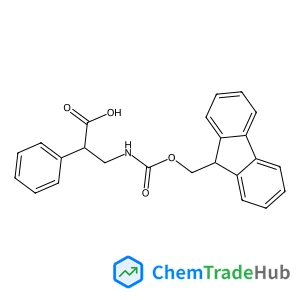
(S)-3-((((9H-Fluoren-9-yl)methoxy)carbonyl)amino)-2-phenylpropanoic acid
CAS Number:
1217663-60-9
Molecular Formula:
C24H21NO4
Various imidazolium-based ionic liquids (ILs), considered as “green” solvents, were used as efficient solvents for galactomannan and more specifically for guar gums of high molecular weight. FT-IR as well as the high activation energies reflect hydrogen bonds between the guar backbone and anions of ILs which act as chaotropic agents. Importantly, the dissolution was conducted under mild conditions which allowed the preservation of the chain integrity, as proved by SEC, FT-IR and ATG analyses collected for guar regenerated from IL solutions. For the first time, ILs were exploited as reactional media in which tailor-made guar derivatives were synthesized through a direct and homogeneous esterification with a variety of acid chlorides. We demonstrated that the degree of substitution of guar can be varied by experimental conditions and that it is necessary to adjust these conditions as a function of the esterifying reagent structure. The use of hexanoyl chloride imparted emulsifying properties to guar and esterification with acryloyl chloride and 2-chloropropionyl chloride allowed generation of reactive precursors such as macromonomer and macroinitiator, respectively. The reactivity of the guar macromonomer was assessed through a thermal cross-linking radical copolymerisation, which led to guar gel with solid-like behaviour.
Juxin He, Luyang Du, Cong Wang, Mingjian Jiang, Linlin Liu, Yueqi Mo, Zengqi Xie, Bing Yang, Yuguang Ma
DOI: 10.1039/C6PY01995A
Ruixue Chang, Heng An, Xu Li, Ruyi Zhou, Jianglei Qin, Yuelan Tian, Kuilin Deng
DOI: 10.1039/C6PY02122K
Ran Yu, Klaus Tauer
DOI: 10.1039/C4PY00458B
Stephanie M. Barbon, Joe B. Gilroy
DOI: 10.1039/C6PY00441E
Xiaohui Li, Zhijun Hu
DOI: 10.1039/C7PY00378A
Siddharth Chanpuriya, Marc A. Hillmyer, Frank S. Bates
DOI: 10.1039/C4PY00614C
Yangqing Tao, Fengkai He, Kaikai Jin, Jiajia Wang, Yuanqiang Wang, Junfeng Zhou, Jing Sun, Qiang Fang
DOI: 10.1039/C7PY00047B
Hongjun Yang, Zhongrui Wang, Yulei Zheng, Wenyan Huang, Xiaoqiang Xue, Bibiao Jiang
DOI: 10.1039/C7PY00174F
Sanjib Banerjee, Bhausaheb V. Tawade, Vincent Ladmiral, Lionel X. Dupuy, Bruno Améduri
DOI: 10.1039/C7PY00209B
When considering alternatives to 1-(4-Chlorophenyl)-N-hydroxymethanimine (CAS: 3...
This compound should be stored in a cool, dry place away from direct sunlight. I...
3-(4-Bromophenyl)-5-(2-fluorophenyl)-1,2,4-oxadiazole is synthesized through a m...
5-Chloro-2-(4-chlorophenyl)-4-methyl-6-[3-(1-piperidinyl)propoxy]pyrimidine (CAS...
2-Chloro-4-(difluoromethoxy)pyridine is used in the pharmaceutical industry for ...
3-Chloro-6-methylpyridazine (CAS: 1121-79-5) is classified under the Globally Ha...
Several alternatives can be used in the synthesis of Methyl 4,5-dimethyl-2-nitro...
Alternatives to (2E,2'E)-3,3'-(1,4-Phenylene)bisacrylaldehyde include other acry...
3-Amino-5-chloropyridin-2-ol hydrochloride is an organic compound with the CAS n...
When handling 6,7-Difluoro-2,3-dihydro-4H-chromen-4-one, it is essential to wear...

Polymer Chemistry welcomes submissions in all areas of polymer science that have a strong focus on macromolecular chemistry. Manuscripts may cover a broad range of fields, yet no direct application focus is required.
![(2S)-2-{[(9H-Fluoren-9-ylmethoxy)carbonyl]amino}-4-(methylselanyl)butanoic acid structure](https://static.chemtradehub.com/structs/121/1217852-49-7-f252.webp "(2S)-2-{[(9H-Fluoren-9-ylmethoxy)carbonyl]amino}-4-(methylselanyl)butanoic acid structure")