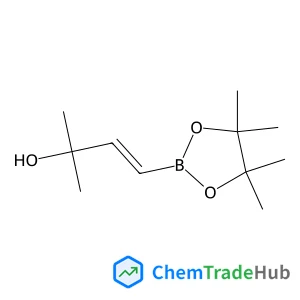
(E)-2-methyl-4-(4,4,5,5-tetramethyl-1,3,2-dioxaborolan-2-yl)but-3-en-2-ol
CAS Number:
581802-26-8
Molecular Formula:
C11H21BO3
Li Qun Xu, Hua Jiang, Koon-Gee Neoh, En-Tang Kang, Guo Dong Fu
Poly(dopamine acrylamide)-co-poly(propargyl acrylamide) (PDA-co-PPA) copolymers, containing alkyne- and catechol-functionalities, were prepared from reactive poly(pentafluorophenyl acrylate) (PPFA) via functionalization of the pentafluorophenyl-activated ester groups with dopamine hydrochloride and propargylamine. The bifunctional PDA-co-PPA copolymers were then coupled to the titanium (Ti) surface via coordination interaction of the catechol moieties, yielding a functionalizable Ti platform containing ‘clickable’ alkyne groups on the surface for the copper-catalyzed azide-alkyne 1,3-dipolar cycloaddition (CuAAC) of azide-labeled fluorescein, rhodamine, β-cyclodextrin, poly(ethylene glycol) (PEG), mannose and biotin. The functionalized Ti surfaces from the CuAAC reactions were characterized by fluorescence microscopy (for the rhodamine- and fluorescein-functionalized Ti surfaces), non-specific protein adsorption (for the PEG-grafted Ti surface), specific protein adsorption (for the mannose- and biotin-functionalized Ti surfaces) and host–guest interaction with antibiotics (for the β-cyclodextrin-functionalized Ti surface).
Mariolino Carta, Matthew Croad, Johannes C. Jansen, Paola Bernardo, Gabriele Clarizia, Neil B. McKeown
DOI: 10.1039/C4PY00607K
Christophe Detrembleur, Marie Hurtgen, Antoine Debuigne, Marie-Claire De Pauw-Gillet, Stéphane Mornet, Etienne Duguet, Christine Jérôme
DOI: 10.1039/C4PY00352G
Mariem Bouzrati-Zerelli, Nicolas Zivic, Frédéric Dumur, Didier Gigmes, Bernadette Graff, Jean Pierre Fouassier, Jacques Lalevée
DOI: 10.1039/C7PY00202E
Yilin Zhang, Liguo Xu, Rongrong Hu, Kam Sing Wong, William A. Goddard, III
DOI: 10.1039/C7PY00154A
Wei Wu, Qiujing Zhang, Jiantao Wang, Miao Chen, Shuai Li, Zaifu Lin, Jianshu Li
DOI: 10.1039/C4PY00575A
Laura Etchenausia, Abdel Khoukh, Elise Deniau Lejeune, Maud Save
DOI: 10.1039/C7PY00221A
Vincent Ladmiral, Thierry Lannuzel, Fabrice Domingues Dos Santos, Bruno Améduri
DOI: 10.1039/C6PY01874B
Liyi Fu, Pan Yuan, Zheng Ruan, Le Liu, Tuanwei Li, Lifeng Yan
DOI: 10.1039/C6PY01818A
When considering alternatives to 1-(4-Chlorophenyl)-N-hydroxymethanimine (CAS: 3...
This compound should be stored in a cool, dry place away from direct sunlight. I...
3-(4-Bromophenyl)-5-(2-fluorophenyl)-1,2,4-oxadiazole is synthesized through a m...
5-Chloro-2-(4-chlorophenyl)-4-methyl-6-[3-(1-piperidinyl)propoxy]pyrimidine (CAS...
2-Chloro-4-(difluoromethoxy)pyridine is used in the pharmaceutical industry for ...
3-Chloro-6-methylpyridazine (CAS: 1121-79-5) is classified under the Globally Ha...
Several alternatives can be used in the synthesis of Methyl 4,5-dimethyl-2-nitro...
Alternatives to (2E,2'E)-3,3'-(1,4-Phenylene)bisacrylaldehyde include other acry...
3-Amino-5-chloropyridin-2-ol hydrochloride is an organic compound with the CAS n...
When handling 6,7-Difluoro-2,3-dihydro-4H-chromen-4-one, it is essential to wear...

Polymer Chemistry welcomes submissions in all areas of polymer science that have a strong focus on macromolecular chemistry. Manuscripts may cover a broad range of fields, yet no direct application focus is required.