












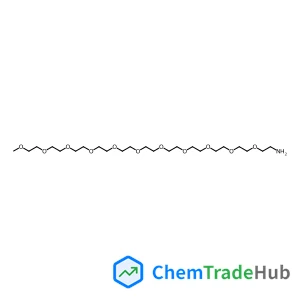
2,5,8,11,14,17,20,23,26,29,32-Undecaoxatetratriacontan-34-amine
CAS Number:
854601-60-8
Molecular Formula:
C23H49NO11
A graphical abstract is available for this content
Niels Boon, Peter Schurtenberger
DOI: 10.1039/C7CP02434G
Huiyun Zhang, Guixian Liu, Yanqiang Cao, Jing Chen, Kai Shen, Ashwini Kumar, Mingxiang Xu, Qi Li
DOI: 10.1039/C7CP03470A
Yun-Ru Huang, Melissa Lamson, Krzysztof Matyjaszewski
DOI: 10.1039/C7CP02841E
Zongyuan Liu, Carl O. Trindle, Quanli Gu, Wei Wu, Peifeng Su
DOI: 10.1039/C7CP03491A
J. A. Dharmadhikari, A. K. Dharmadhikari, S. Mazumdar
DOI: 10.1039/C7CP04858K
Qingyu Liu, Fang Zuo, Zhigang Zhao, Junxian Chen, Dingguo Xu
DOI: 10.1039/C7CP02292A
Jiapeng Liu
DOI: 10.1039/C7CP03703A
Oleg I. Gnezdilov, Nicklas Hjalmarsson, Oleg N. Antzutkin, István Furó
DOI: 10.1039/C7CP01772C
Piti Treesukul, Jakkapan Sirijaraensre, Jumras Limtrakul
DOI: 10.1039/C7CP04229A
3-Fluoro-2-methylbenzylamine is an organic compound with the CAS number 771573-3...
Tert-butyl 2-(oxetan-3-ylidene)acetate is considered safe for its intended uses ...
Proper personal protective equipment (PPE) such as gloves, goggles, and a lab co...
2-Ethyl-4-methyl-1,3-thiazole is commonly synthesized via the reaction of thiour...
This compound should be stored in a cool, dry place away from direct sunlight an...
L-Lysine Acetate Salt (CAS: 52315-92-1) is subject to various regulatory guideli...
6-Fluoro-3-hydroxy-2-pyrazinecarboxamide (CAS: 259793-96-9) is generally conside...
1,1'-Sulfonylbis(1H-imidazole) is a crystalline solid with a molecular weight of...
4-Methyl-7-nitro-1H-indole-3-carbonitrile (CAS: 289483-82-5) is primarily used i...
Waste containing 5-Bromo-3-indolyl-beta-galactoside (CAS: 97753-82-7) should be ...

Organic & Biomolecular Chemistry (OBC) publishes original and high impact research and reviews in organic chemistry. We welcome research that shows new or significantly improved protocols or methodologies in total synthesis, synthetic methodology or physical and theoretical organic chemistry as well as research that shows a significant advance in the organic chemistry or molecular design aspects of chemical biology, catalysis, supramolecular and macromolecular chemistry, theoretical chemistry, mechanism-oriented physical organic chemistry, medicinal chemistry or natural products. Articles published in the journal should report new work which makes a highly-significant impact in the field. Routine and incremental work is generally not suitable for publication in the journal. More details about key areas of our scope are below. In all cases authors should include in their article clear rationale for why their research has been carried out.
![1,1'-[(E)-1,2-Ethenediyl]bis(4-bromobenzene) structure](https://static.chemtradehub.com/structs/188/18869-30-2-c907.webp "1,1'-[(E)-1,2-Ethenediyl]bis(4-bromobenzene) structure")
![(1S,4aR,5R,7S,7aS)-1-(beta-D-Glucopyranosyloxy)-5-hydroxy-7-methyl-1,4a,5,6,7,7a-hexahydrocyclopenta[c]pyran-7-yl alpha-D-galactopyranoside structure](https://static.chemtradehub.com/structs/817/81720-07-2-4ffd.webp "(1S,4aR,5R,7S,7aS)-1-(beta-D-Glucopyranosyloxy)-5-hydroxy-7-methyl-1,4a,5,6,7,7a-hexahydrocyclopenta[c]pyran-7-yl alpha-D-galactopyranoside structure")
![5-Methoxy-1H-pyrrolo[3,2-b]pyridine structure](https://static.chemtradehub.com/structs/172/17288-40-3-a8d1.webp "5-Methoxy-1H-pyrrolo[3,2-b]pyridine structure")






