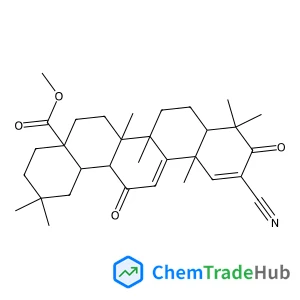
Methyl 2-cyano-3,12-dioxooleana-1,9(11)-dien-28-oate
CAS Number:
218600-53-4
Molecular Formula:
C32H43NO4
Majid Shahbabaei, Daejoong Kim
Using molecular dynamics simulations, herein, we illustrate that a bending structure shows different behaviors for fast water transport through aquaporin-mimicking membranes in multilayer graphene and tubular structures. This suggests that the bending structure enhances water transport through multilayer membranes, indicating the optimum state at θ = 45°. Disruption of the single-file water arrangement inside the membrane can contribute to promoting water transport in this system. However, a bending structure reduces the rate of water transport in tubular systems. Our results exhibit that a straight tubular membrane transfers water molecules faster than its non-straight counterpart. A stabilized form of the single-file water structure was observed in the membrane. Interestingly, we found that the tubular hourglass-shaped membranes possessed a lower free energy than the multilayer membranes with an hourglass shape. This can be attributed to the accommodation of the single-file water configuration in a confined space with hydrophobic characteristics. Accordingly, integrating an hourglass shape pore in a tubular structure in an impermeable membrane provides high water permeability compared with its multilayer counterpart. We also found that the wide variation in the dipole orientation of water molecules and the energy barrier have dominant effects in determining fast water transport through multilayer and tubular membranes, respectively. The contribution of interlayer spacing on fast water transport through multilayer membranes was also studied.
Thomas J. McDonough, Lushuai Zhang, Susmit Singha Roy, Nicholas M. Kearns, Michael S. Arnold, Martin T. Zanni
DOI: 10.1039/C6CP06454J
Chao Wu, Qingxun Guo, Wujun Ma, Xiaoping Li, Panlong Qiu, Jianyong Hu, Qiang Wang
DOI: 10.1039/C6CP08334J
Junghyun Choi, Pitchaimuthu Sudhagar, Joo Hyun Kim, Jiseok Kwon, Jeonghyun Kim, Chiaki Terashima, Akira Fujishima, Taeseup Song, Ungyu Paik
DOI: 10.1039/C6CP08199A
Z. J. Li, H. Y. Yu, G. Y. Song, J. Zhao, H. Zhang, M. Zhang, A. L. Meng, Q. D. Li
DOI: 10.1039/C6CP07457J
Elijah G. Schnitzler, Nathan A. Seifert, Supriya Ghosh, Javix Thomas, Yunjie Xu, Wolfgang Jäger
DOI: 10.1039/C6CP08741H
M. Ziatdinov, H. Lim, S. Fujii, K. Kusakabe, M. Kiguchi, T. Enoki, Y. Kim
DOI: 10.1039/C6CP08352H
H. W. Wang, C. L. Li, S. L. Yuan, J. F. Wang, C. L. Lu, J.-M. Liu
DOI: 10.1039/C6CP06369A
Sergio Giuffrida, Lorenzo Cordone
DOI: 10.1039/C6CP06848K
When handling 4-(2-Furylmethyl)thiomorpholine 1,1-dioxide (CAS: 79206-94-3), it ...
When handling 4-Chloro-N-[2-(4-morpholinyl)ethyl]benzamide (CAS: 71320-77-9), it...
Waste containing this compound (CAS: 62921-74-8) should be handled according to ...
Waste containing (S)-Methyl 2-amino-3-cyclohexylpropanoate should be collected i...
This compound can be synthesized using a multi-step process involving the conjug...
There are several alternatives to (2E)-3-(3,4-Dichlorophenyl)acrylic acid in syn...
Ethyl 6-(2-nitrophenyl)imidazo[2,1-b][1,3]thiazole-3-carboxylate (CAS: 925437-84...
Waste containing 2-(1,3-Thiazol-2-yl)ethanamine (CAS: 18453-07-1) should be coll...
Methyl 5-iodo-2-methylbenzoate can be synthesized through the iodination of meth...
5-Chloro[1,2,4]triazolo[1,5-a]pyridine is commonly synthesized via the condensat...

Physical Chemistry Chemical Physics (PCCP) is an international journal co-owned by 19 physical chemistry and physics societies from around the world. This journal publishes original, cutting-edge research in physical chemistry, chemical physics and biophysical chemistry. To be suitable for publication in PCCP, articles must include significant innovation and/or insight into physical chemistry; this is the most important criterion that reviewers and Editors will judge against when evaluating submissions. The journal has a broad scope and welcomes contributions spanning experiment, theory, computation and data science. Topical coverage includes spectroscopy, dynamics, kinetics, statistical mechanics, thermodynamics, electrochemistry, catalysis, surface science, quantum mechanics, quantum computing and machine learning. Interdisciplinary research areas such as polymers and soft matter, materials, nanoscience, energy, surfaces/interfaces, and biophysical chemistry are welcomed if they demonstrate significant innovation and/or insight into physical chemistry. Joined experimental/theoretical studies are particularly appreciated when complementary and based on up-to-date approaches.