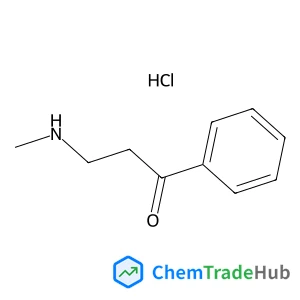
3-(Methylamino)-1-phenyl-1-propanone hydrochloride (1:1)
CAS Number:
2538-50-3
Molecular Formula:
C10H14ClNO
Elijah G. Schnitzler, Nathan A. Seifert, Supriya Ghosh, Javix Thomas, Yunjie Xu, Wolfgang Jäger
Intermolecular interactions between pyruvic acid, the simplest α-keto acid, and water are important in bio- and atmospheric chemistry. In this context, the pure rotational spectrum of the pyruvic acid–water complex was measured from 7 to 15 GHz using a cavity-based Fourier-transform microwave spectrometer. In the detected isomer, water acts as a hydrogen bond donor and acceptor, bridging the acidic hydrogen and the keto oxygen. Both a- and b-type transitions were observed; however, c-type transitions were not observed, due to vibrational averaging of the effectively barrier-less wagging motion of the free hydrogen of the water subunit, which results in an effective ground state structure with a plane of symmetry. The mass distribution out of the ab-plane, corrected for the out-of-plane hydrogen atoms of the methyl group, confirms that the complex has a plane of symmetry. The observed transitions exhibit splittings due to internal rotations of the water subunit and the methyl group. The proposed internal rotation of water nominally breaks one hydrogen bond, so it is remarkable that the barrier was calculated to be as low as 5.2 kJ mol−1; however, a non-covalent interactions analysis indicates that water rotation has surprisingly little effect on the interactions between the water and pyruvic acid subunits. The barrier to methyl internal rotation was determined to be about 4.6 kJ mol−1 experimentally, significantly higher than that of the pyruvic acid monomer. In general, the structure and dynamics investigated here provide insights into the interactions between pyruvic acid and water that dictate the fate of pyruvic acid in aqueous aerosols and living cells.
Fanfan Li, Yi Yu, Hanyu Lv, Guiting Cai, Yanwu Zhang
DOI: 10.1039/D0PY01643H
Simone Lazar, Ruiqing Shen, Yufeng Quan, Bethany Palen, Qingsheng Wang, Christopher J. Ellison
DOI: 10.1039/D1PY00111F
Lishan Li, Yiwen Li, Shuyuan Wang, Liandong Ye, Wei Zhang, Nianchen Zhou, Zhengbiao Zhang, Xiulin Zhu
DOI: 10.1039/D1PY00099C
Hao Lu, Jiansong Cai, Ke Zhang
DOI: 10.1039/D0PY01707H
Wenqing Xu, Xing Li, Wenhua Yuan, Jian Zhou
DOI: 10.1039/D1PY00702E
Anna P. Constantinou, Georgios Patias, Birsen Somuncuoğlu, Toby Brock, Daniel W. Lester, David M. Haddleton, Theoni K. Georgiou
DOI: 10.1039/D1PY00444A
Wei Wen
DOI: 10.1039/D1PY00223F
Jiajun Cao, Huangtianzhi Zhu, Liqing Shangguan, Yuezhou Liu, Peiren Liu, Qi Li, Yitao Wu
DOI: 10.1039/D1PY00535A
Alexis Theodorou, Petros Mandriotis, Athina Anastasaki, Kelly Velonia
DOI: 10.1039/D0PY01608J
When handling 4-(2-Furylmethyl)thiomorpholine 1,1-dioxide (CAS: 79206-94-3), it ...
When handling 4-Chloro-N-[2-(4-morpholinyl)ethyl]benzamide (CAS: 71320-77-9), it...
Waste containing this compound (CAS: 62921-74-8) should be handled according to ...
Waste containing (S)-Methyl 2-amino-3-cyclohexylpropanoate should be collected i...
This compound can be synthesized using a multi-step process involving the conjug...
There are several alternatives to (2E)-3-(3,4-Dichlorophenyl)acrylic acid in syn...
Ethyl 6-(2-nitrophenyl)imidazo[2,1-b][1,3]thiazole-3-carboxylate (CAS: 925437-84...
Waste containing 2-(1,3-Thiazol-2-yl)ethanamine (CAS: 18453-07-1) should be coll...
Methyl 5-iodo-2-methylbenzoate can be synthesized through the iodination of meth...
5-Chloro[1,2,4]triazolo[1,5-a]pyridine is commonly synthesized via the condensat...

Physical Chemistry Chemical Physics (PCCP) is an international journal co-owned by 19 physical chemistry and physics societies from around the world. This journal publishes original, cutting-edge research in physical chemistry, chemical physics and biophysical chemistry. To be suitable for publication in PCCP, articles must include significant innovation and/or insight into physical chemistry; this is the most important criterion that reviewers and Editors will judge against when evaluating submissions. The journal has a broad scope and welcomes contributions spanning experiment, theory, computation and data science. Topical coverage includes spectroscopy, dynamics, kinetics, statistical mechanics, thermodynamics, electrochemistry, catalysis, surface science, quantum mechanics, quantum computing and machine learning. Interdisciplinary research areas such as polymers and soft matter, materials, nanoscience, energy, surfaces/interfaces, and biophysical chemistry are welcomed if they demonstrate significant innovation and/or insight into physical chemistry. Joined experimental/theoretical studies are particularly appreciated when complementary and based on up-to-date approaches.
![[4-Amino-2-(methylsulfanyl)-5-pyrimidinyl]methanol structure](https://static.chemtradehub.com/structs/588/588-36-3-fc73.webp "[4-Amino-2-(methylsulfanyl)-5-pyrimidinyl]methanol structure")