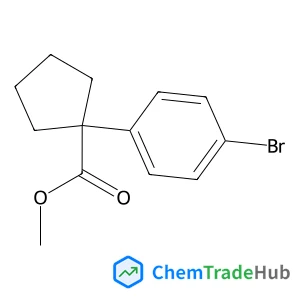
Methyl 1-(4-bromophenyl)cyclopentanecarboxylate
CAS Number:
1236357-64-4
Molecular Formula:
C13H15BrO2
Philipp Honegger, Othmar Steinhauser
This study is based on extensive MD simulations of a protein in a reverse micelle to mimic the effect of confinement on biomolecules. This permits the calculation of measurable quantities appearing in NQR and Nuclear Overhauser-NMR despite the high computational effort. We address the long-standing debate about the intermolecular NOE showing that absolute quantities derived from NOESY and ROESY spectra do indeed contain considerable long-range contributions, while ratios thereof are effectively short-ranged due to almost perfect compensation effects. Based on NQR relaxation times, we predict strong rotational retardation of interstitial water between the protein and the surfactant surface. The computed NOE to ROE ratio correlates fairly with experimental results. The solvation dynamics mapped onto the protein surface reflects the spatial heterogeneity of a cell-like system with slow water dynamics in proximity to the cell wall and almost bulk-like behaviour in the water core.
Claude Y. Legault, Christopher Kendall, André B. Charette
DOI: 10.1039/B506232B
Ismael Nieto, Francisco Cervantes-Lee, Jeremy M. Smith
DOI: 10.1039/B505985B
Ryoichi Kuwano, Naoki Ishida, Masahiro Murakami
DOI: 10.1039/B505105C
Masakazu Morimoto, Masahiro Irie
DOI: 10.1039/B505256D
Miguel Castro, Julián Cruz, Horacio López-Sandoval, Norah Barba-Behrens
DOI: 10.1039/B505554G
Veronica Esposito, Antonella Virgilio, Antonio Randazzo, Aldo Galeone, Luciano Mayol
DOI: 10.1039/B504455C
Wenxin Wang, Steven M. Howdle, Deyue Yan
DOI: 10.1039/B504251H
A. Iglesias-Juez, A. Martínez-Arias, M. A. Newton, S. G. Fiddy, M. Fernández-García
DOI: 10.1039/B502798E
Jun Hyuk Moon, Won Sun Kim, Jong-Wook Ha, Se Gyu Jang, Seung-Man Yang, Jung-Ki Park
DOI: 10.1039/B507542D
3-(2-Bromoimidazo[2,1-b]thiazol-6-yl)propanoic acid hydrochloride is typically s...
2-Isopropyl-1,3-dioxane-5-carboxylic acid is typically synthesized by the carbox...
Alisporivir (CAS: 254435-95-5) is an antiviral medication used in the treatment ...
[1,2,4]triazolo[3,4-a]phthalazine (CAS: 234-80-0) is a crystalline compound with...
Regulatory guidelines for (2S)-5-Hydroxy-2-(4-hydroxyphenyl)-4-oxo-3,4-dihydro-2...
2,2-Difluorocyclohexanamine hydrochloride is generally safe when handled under p...
3-Nitro-2-phenylthiophene is primarily used in the synthesis of other organic co...
1-(Trifluoroacetyl)-4-piperidinecarbonitrile (CAS: 77940-79-5) is a colorless to...
Research and market trends for 1,3,6,8-Tetranitro-9H-carbazole (CAS: 4543-33-3) ...
Waste containing Dibenzo[b,d]thiophen-1-ylboronic acid (CAS: 1245943-60-5) shoul...

Physical Chemistry Chemical Physics (PCCP) is an international journal co-owned by 19 physical chemistry and physics societies from around the world. This journal publishes original, cutting-edge research in physical chemistry, chemical physics and biophysical chemistry. To be suitable for publication in PCCP, articles must include significant innovation and/or insight into physical chemistry; this is the most important criterion that reviewers and Editors will judge against when evaluating submissions. The journal has a broad scope and welcomes contributions spanning experiment, theory, computation and data science. Topical coverage includes spectroscopy, dynamics, kinetics, statistical mechanics, thermodynamics, electrochemistry, catalysis, surface science, quantum mechanics, quantum computing and machine learning. Interdisciplinary research areas such as polymers and soft matter, materials, nanoscience, energy, surfaces/interfaces, and biophysical chemistry are welcomed if they demonstrate significant innovation and/or insight into physical chemistry. Joined experimental/theoretical studies are particularly appreciated when complementary and based on up-to-date approaches.