













Spin density transfer from guest to host in endohedral heterofullerene dimers
Literature Information
Publication Date
2019-02-28
DOI
10.1039/C9CP00442D
Impact Factor
3.676
Authors
Vinit, C. N. Ramachandran
View Original
Abstract
The endohedral heterofullerenes (B@C59B)2, (B@C59N)2, (N@C59B)2 and (B@C59N–N@C59B) are investigated using dispersion corrected density functional theory. Several spin states of these complexes are considered and their stable spin states are reported. For 1[(B@C59B)2] and 1[(B@C59N–N@C59B)], the encapsulated atoms are positioned near the surface of the host cages, in contrast to other spin states where they are positioned at the centre of the cages. In complexes 1[(B@C59N)2], 3[(B@C59N)2] and 7[(N@C59B)2], the guest atoms are found to be at the centre of the host cages. The spin polarization and the transfer of spin density between the components of the complexes for different stable spin states are analyzed. Based on the spin states of the complexes, the spin–spin interaction is found to be either ferromagnetic or anti-ferromagnetic. Unlike other complexes, in 1[(B@C59B)2] and 1[(B@C59N–N@C59B)] the spin density is transferred from the guest to the host followed by anti-ferromagnetic coupling between the monomers. The thermodynamic feasibility of formation of the complexes is also examined. The electron affinity, ionization potential and dipole moment of the above systems are determined. The singlet state of the heterodimer (B@C59N–N@C59B) showed high polarity due to the slight rotation along the dihedral angle ϕNCCB.
Related Literature
Aqueous MnO2/Mn2+ electrochemistry in batteries: progress, challenges, and perspectives
Haoshen Zhou
2023-12-06
Review Article
DOI: 10.1039/D3EE03661H
Expansion of bond dissociation prediction with machine learning to medicinally and environmentally relevant chemical space
Shree Sowndarya S. V., Yeonjoon Kim, Seonah Kim, Peter C. St. John, Robert S. Paton
2023-10-17
Paper
DOI: 10.1039/D3DD00169E
Domain-specific chatbots for science using embeddings
Kevin G. Yager
2023-10-10
Paper
DOI: 10.1039/D3DD00112A
Gibbs–Duhem-informed neural networks for binary activity coefficient prediction
Jan G. Rittig, Kobi C. Felton, Alexei A. Lapkin
2023-10-04
Paper
DOI: 10.1039/D3DD00103B
Understanding the patterns that neural networks learn from chemical spectra
Laura Hannemose Rieger, Max Wilson, Tejs Vegge, Eibar Flores
2023-11-10
Paper
DOI: 10.1039/D3DD00203A
Accelerating nano-XANES imaging via feature selection
Samantha Tetef, Ajith Pattammattel, Yong S. Chu, Maria K. Y. Chan, Gerald T. Seidler
2023-12-21
Paper
DOI: 10.1039/D3DD00146F
A database of molecular properties integrated in the Materials Project
Orion Archer Cohen, Samuel M. Blau, Jason M. Munro, Ruoxi Yang, Rishabh D. Guha, Sudarshan Vijay, Patrick Huck, Ryan Kingsbury, Matthew K. Horton
2023-10-13
Paper
DOI: 10.1039/D3DD00153A
High-rate cycling in 3D dual-doped NASICON architectures toward room-temperature sodium-metal-anode solid-state batteries
2023-12-13
Paper
DOI: 10.1039/D3EE03879C
You might also like
Compound Q&A
What are the main uses of 1H-Indazole-6-carbonitrile (CAS: 141290-59-7)?
1H-Indazole-6-carbonitrile finds applications in pharmaceuticals, where it serve...
141290-59-71H-Indazole-6-carbon...
Compound Q&A
How should waste containing Dioctyl (2E)-2-butenedioate (CAS: 2997-85-5) be handled?
Waste containing Dioctyl (2E)-2-butenedioate (CAS: 2997-85-5) should be collecte...
2997-85-5Dioctyl (2E)-2-buten...
Compound Q&A
What industries use Sodium [(1,2-benzoxazol-3-ylmethyl)sulfonyl]azanide (CAS: 68291-98-5)?
Sodium [(1,2-benzoxazol-3-ylmethyl)sulfonyl]azanide is primarily used in pharmac...
68291-98-5Sodium [(1,2-benzoxa...
Compound Q&A
Are there alternatives to Dimethyl 4-(4,4,5,5-tetramethyl-1,3,2-dioxaborolan-2-yl)-2,6-pyridinedicarboxylate (CAS: 741709-66-0) in synthesis?
Dimethyl 4-(4,4,5,5-tetramethyl-1,3,2-dioxaborolan-2-yl)-2,6-pyridinedicarboxyla...
741709-66-0Dimethyl 4-(4,4,5,5-...
Compound Q&A
How should waste containing 2-Fluoro-6-hydrazinopyridine (CAS: 80714-39-2) be handled?
Waste containing 2-Fluoro-6-hydrazinopyridine (CAS: 80714-39-2) should be manage...
80714-39-22-Fluoro-6-hydrazino...
Compound Q&A
What is 6-Formyl-2-pyridinecarboxylic acid (CAS: 499214-11-8)?
6-Formyl-2-pyridinecarboxylic acid is an organic compound with the molecular for...
499214-11-86-Formyl-2-pyridinec...
Compound Q&A
What is the market or research trend for 3-(3,4-dimethoxyphenyl)-2,5-dimethyl-N-(2-morpholin-4-ylethyl)pyrazolo[1,5-a]pyrimidin-7-amine (CAS: 900874-91-1)?
Research trends for this compound indicate a focus on its potential applications...
900874-91-13-(3,4-dimethoxyphen...
Compound Q&A
How is 9H-Tribenzo[b,d,f]azepine (CAS: 29875-73-8) typically synthesized?
9H-Tribenzo[b,d,f]azepine is typically synthesized via a multi-step process invo...
29875-73-89H-Tribenzo[b,d,f]az...
Compound Q&A
How is 1-Cyclopropyl-7-ethoxy-6-fluoro-8-methoxy-4-oxo-1,4-dihydro-3-quinolinecarboxylic acid (CAS: 1797982-51-4) typically synthesized?
1-Cyclopropyl-7-ethoxy-6-fluoro-8-methoxy-4-oxo-1,4-dihydro-3-quinolinecarboxyli...
1797982-51-41-Cyclopropyl-7-etho...
Compound Q&A
How should waste containing Methyl 3-oxo-1,2,3,4-tetrahydro-6-quinoxalinecarboxylate (CAS: 671820-52-3) be handled?
Waste containing Methyl 3-oxo-1,2,3,4-tetrahydro-6-quinoxalinecarboxylate (CAS: ...
671820-52-3Methyl 3-oxo-1,2,3,4...
Source Journal
Physical Chemistry Chemical Physics

CiteScore:
5.5
Self-citation Rate:
10.3%
Articles per Year:
3036
Physical Chemistry Chemical Physics (PCCP) is an international journal co-owned by 19 physical chemistry and physics societies from around the world. This journal publishes original, cutting-edge research in physical chemistry, chemical physics and biophysical chemistry. To be suitable for publication in PCCP, articles must include significant innovation and/or insight into physical chemistry; this is the most important criterion that reviewers and Editors will judge against when evaluating submissions. The journal has a broad scope and welcomes contributions spanning experiment, theory, computation and data science. Topical coverage includes spectroscopy, dynamics, kinetics, statistical mechanics, thermodynamics, electrochemistry, catalysis, surface science, quantum mechanics, quantum computing and machine learning. Interdisciplinary research areas such as polymers and soft matter, materials, nanoscience, energy, surfaces/interfaces, and biophysical chemistry are welcomed if they demonstrate significant innovation and/or insight into physical chemistry. Joined experimental/theoretical studies are particularly appreciated when complementary and based on up-to-date approaches.
Recommended Compounds
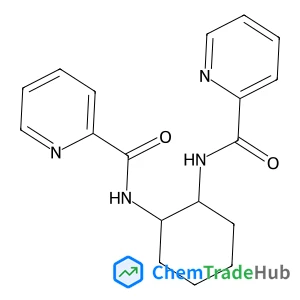
N,N'-(1R,2R)-1,2-Cyclohexanediyldi(2-pyridinecarboxamide)
CAS Number:
218290-24-5
Molecular Formula:
C18H20N4O2

Recommended Suppliers






Disclaimer
This page provides academic journal information for reference and research purposes only. We are not affiliated with any journal publishers and do not handle publication submissions. For publication-related inquiries, please contact the respective journal publishers directly.
If you notice any inaccuracies in the information displayed, please contact us at support@chemtradehub.com. We will promptly review and address your concerns.