



Domain-specific chatbots for science using embeddings
Literature Information
Publication Date
2023-10-10
DOI
10.1039/D3DD00112A
Impact Factor
0
Authors
Kevin G. Yager
View Original
Abstract
Large language models (LLMs) have emerged as powerful machine-learning systems capable of handling a myriad of tasks. Tuned versions of these systems have been turned into chatbots that can respond to user queries on a vast diversity of topics, providing informative and creative replies. However, their application to physical science research remains limited owing to their incomplete knowledge in these areas, contrasted with the needs of rigor and sourcing in science domains. Here, we demonstrate how existing methods and software tools can be easily combined to yield a domain-specific chatbot. The system ingests scientific documents in existing formats, and uses text embedding lookup to provide the LLM with domain-specific contextual information when composing its reply. We similarly demonstrate that existing image embedding methods can be used for search and retrieval across publication figures. These results confirm that LLMs are already suitable for use by physical scientists in accelerating their research efforts.
Recommended Journals

Journal of Asian Natural Products Research

Bioorganic & Medicinal Chemistry

Herald of the Russian Academy of Sciences

Chinese Journal of Chemistry

Acta Metallurgica Sinica-English Letters

Colloid Journal

Journal of the Indian Institute of Science

Atomization and Sprays

Bioorganic & Medicinal Chemistry Letters

Medicinal Chemistry Research
Related Literature
Recent progress in cobalt-mediated [2 + 2 + 2] cycloaddition reactions
Vincent Gandon, Corinne Aubert, Max Malacria
2006-03-16
Feature Article
DOI: 10.1039/B517696B
Insulated conducting polymers: manipulating charge transport using supramolecular complexes
Phoebe H. Kwan, Timothy M. Swager
2005-09-21
Communication
DOI: 10.1039/B508399K
Intramolecular alkene hydroaminations catalyzed by a bis(thiophosphinic amidate) Zr(iv) complex
Hyunseok Kim, Phil Ho Lee, Tom Livinghouse
2005-09-20
Communication
DOI: 10.1039/B505738H
A platinum-catalyzed annulation reaction leading to medium-sized rings
Dirk Hildebrandt, Wiebke Hüggenberg, Matthias Kanthak, Tobias Plöger, Iris M. Müller, Gerald Dyker
2006-04-25
Communication
DOI: 10.1039/B602498J
An electrochemical/photochemical information processing system using a monolayer-functionalized electrode
Ronan Baron, Avital Onopriyenko, Eugenii Katz, Oleg Lioubashevski, Itamar Willner, Sheng Wang, He Tian
2006-02-23
Communication
DOI: 10.1039/B518378B
Metal complexes of selenophosphinates from reactions with (R2PSe)2Se: [M(R2PSe2)n] (M = ZnII, CdII, PbII, InIII, GaIII, CuI, BiIII, NiII; R = iPr, Ph) and [MoV2O2Se2(Se2PiPr2)2]
Chinh Q. Nguyen, Adekunle Adeogun, Mohammad Afzaal, Mohammad A. Malik, Paul O'Brien
2006-04-21
Communication
DOI: 10.1039/B603198F
PNA forms an i-motif
Yamuna Krishnan-Ghosh, Elaine Stephens, Shankar Balasubramanian
2005-09-23
Communication
DOI: 10.1039/B510405J
Monitoring the formation of TTF dimers by Na+ complexation
Marc Sallé, Jean-Yves Balandier, Franck Le Derf, Eric Levillain, Magali Allain, Pascal Viel, Serge Palacin
2006-03-30
Communication
DOI: 10.1039/B518275A
You might also like
Compound Q&A
What are the main uses of 1H-Indazole-6-carbonitrile (CAS: 141290-59-7)?
1H-Indazole-6-carbonitrile finds applications in pharmaceuticals, where it serve...
141290-59-71H-Indazole-6-carbon...
Compound Q&A
How should waste containing Dioctyl (2E)-2-butenedioate (CAS: 2997-85-5) be handled?
Waste containing Dioctyl (2E)-2-butenedioate (CAS: 2997-85-5) should be collecte...
2997-85-5Dioctyl (2E)-2-buten...
Compound Q&A
What industries use Sodium [(1,2-benzoxazol-3-ylmethyl)sulfonyl]azanide (CAS: 68291-98-5)?
Sodium [(1,2-benzoxazol-3-ylmethyl)sulfonyl]azanide is primarily used in pharmac...
68291-98-5Sodium [(1,2-benzoxa...
Compound Q&A
Are there alternatives to Dimethyl 4-(4,4,5,5-tetramethyl-1,3,2-dioxaborolan-2-yl)-2,6-pyridinedicarboxylate (CAS: 741709-66-0) in synthesis?
Dimethyl 4-(4,4,5,5-tetramethyl-1,3,2-dioxaborolan-2-yl)-2,6-pyridinedicarboxyla...
741709-66-0Dimethyl 4-(4,4,5,5-...
Compound Q&A
How should waste containing 2-Fluoro-6-hydrazinopyridine (CAS: 80714-39-2) be handled?
Waste containing 2-Fluoro-6-hydrazinopyridine (CAS: 80714-39-2) should be manage...
80714-39-22-Fluoro-6-hydrazino...
Compound Q&A
What is 6-Formyl-2-pyridinecarboxylic acid (CAS: 499214-11-8)?
6-Formyl-2-pyridinecarboxylic acid is an organic compound with the molecular for...
499214-11-86-Formyl-2-pyridinec...
Compound Q&A
What is the market or research trend for 3-(3,4-dimethoxyphenyl)-2,5-dimethyl-N-(2-morpholin-4-ylethyl)pyrazolo[1,5-a]pyrimidin-7-amine (CAS: 900874-91-1)?
Research trends for this compound indicate a focus on its potential applications...
900874-91-13-(3,4-dimethoxyphen...
Compound Q&A
How is 9H-Tribenzo[b,d,f]azepine (CAS: 29875-73-8) typically synthesized?
9H-Tribenzo[b,d,f]azepine is typically synthesized via a multi-step process invo...
29875-73-89H-Tribenzo[b,d,f]az...
Compound Q&A
How is 1-Cyclopropyl-7-ethoxy-6-fluoro-8-methoxy-4-oxo-1,4-dihydro-3-quinolinecarboxylic acid (CAS: 1797982-51-4) typically synthesized?
1-Cyclopropyl-7-ethoxy-6-fluoro-8-methoxy-4-oxo-1,4-dihydro-3-quinolinecarboxyli...
1797982-51-41-Cyclopropyl-7-etho...
Compound Q&A
How should waste containing Methyl 3-oxo-1,2,3,4-tetrahydro-6-quinoxalinecarboxylate (CAS: 671820-52-3) be handled?
Waste containing Methyl 3-oxo-1,2,3,4-tetrahydro-6-quinoxalinecarboxylate (CAS: ...
671820-52-3Methyl 3-oxo-1,2,3,4...
Source Journal
Recommended Compounds
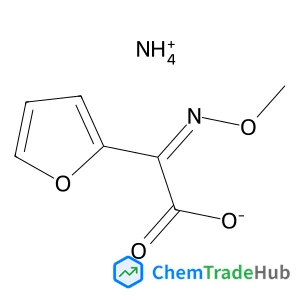
Ammonium (Z)-2-(furan-2-yl)-2-(methoxyimino)acetate
CAS Number:
97148-39-5
Molecular Formula:
C7H10N2O4
![Sodium 3-[(E)-(4-anilinophenyl)diazenyl]benzenesulfonate structure](https://static.chemtradehub.com/structs/587/587-98-4-035f.webp "Sodium 3-[(E)-(4-anilinophenyl)diazenyl]benzenesulfonate structure")
Sodium 3-[(E)-(4-anilinophenyl)diazenyl]benzenesulfonate
CAS Number:
587-98-4
Molecular Formula:
C18H14N3NaO3S
Recommended Suppliers








Disclaimer
This page provides academic journal information for reference and research purposes only. We are not affiliated with any journal publishers and do not handle publication submissions. For publication-related inquiries, please contact the respective journal publishers directly.
If you notice any inaccuracies in the information displayed, please contact us at support@chemtradehub.com. We will promptly review and address your concerns.