



Probing the origins of photodegradation in organic–inorganic metal halide perovskites with time-resolved mass spectrometry
Literature Information
Publication Date
2018-08-20
DOI
10.1039/C8SE00358K
Impact Factor
6.367
Authors
Zhaoning Song, Changlei Wang, Adam B. Phillips, Corey R. Grice, Dewei Zhao, Yue Yu, Cong Chen, Chongwen Li, Xinxing Yin, Randy J. Ellingson, Michael J. Heben, Yanfa Yan
View Original
Abstract
Operational and long-term stability of perovskite solar cells are critical for their commercialization on a large scale. To mitigate stability issues, a fundamental understanding of the physicochemical processes associated with the degradation of perovskite materials is needed. Here, we perform time resolved mass spectrometry of the gas species evolved during the photoinduced degradation of organic–inorganic lead trihalide perovskites made with commonly used monovalent cations, including methylammonium (MA), formamidinium (FA), and Cs. Our results indicate that the hot-carrier-induced deprotonation of MA+ cations is the fundamental origin of the photodegradation, which inevitably leads to the release of volatile species such as ammonia (NH3), aminocarbyne fragments (CNH2), hydrogen (H2), and iodine/hydrogen iodide (I/HI) from methylammonium lead iodide (MAPbI3) at different rates under simulated one sun solar illumination. Photodegradation processes can be mitigated by applying ultra-violet (UV) filters with suitable cutoff wavelengths to the light source. Additionally, we demonstrate that the incorporation of FA reduces the release of organic species but does not prevent the formation of I/HI. However, the addition of Cs effectively suppresses the release of all volatile gases. The best photostability is obtained with the FA/Cs mixed perovskites, showing that the complete removal of MA from mixed-cation perovskites is preferred for more photostable perovskites.
Recommended Journals

Current Opinion in Solid State & Materials Science

Russian Journal of Bioorganic Chemistry

Russian Journal of Applied Chemistry

Crystallography Reports

Chemistry Education Research and Practice

Acta Materialia

Drug Discovery Today

Chemical Communications

Russian Journal of Organic Chemistry

Russian Chemical Bulletin
Related Literature
Influence of the tyrosine environment on the second harmonic generation of iturinic antimicrobial lipopeptides at the air–water interface
Mehmet Nail Nasir, Emmanuel Benichou, Claire Loison, Isabelle Russier-Antoine, Françoise Besson, Pierre-François Brevet
2013-10-11
Paper
DOI: 10.1039/C3CP53098A
A roaming wavepacket in the dynamics of electronically excited 2-hydroxypyridine
Lionel Poisson, Benoît Soep, Majdi Hochlaf, Martial Boggio-Pasqua, Jean-Michel Mestdagh
2013-10-18
Paper
DOI: 10.1039/C3CP52923A
Copper(ii) binding to flexible triethanolamine-core PAMAM dendrimers: a combined experimental/in silico approach
Maria Francesca Ottaviani, Michela Cangiotti, Alberto Fattori, Concetta Coppola, Erik Laurini, Xiaoxuan Liu, Cheng Liu, Ling Peng
2013-11-04
Paper
DOI: 10.1039/C3CP54005G
Pore size modulation in electrochemically etched macroporous p-type silicon monitored by FFT impedance spectroscopy and Raman scattering
Enrique Quiroga-González, Jürgen Carstensen, Colm Glynn, Helmut Föll
2013-10-30
Paper
DOI: 10.1039/C3CP53600A
Estimation of the refractive indices of imidazolium-based ionic liquids using their polarisability values
Pablo Díaz-Rodríguez, John C. Cancilla, Natalia V. Plechkova, Gemma Matute, Kenneth R. Seddon, José S. Torrecilla
2013-10-28
Paper
DOI: 10.1039/C3CP53685H
Hydrodeoxygenation by deuterium gas – a powerful way to provide insight into the reaction mechanisms
Glen A. Ferguson, Yunqiao Pu, Fang Huang, Mark Jarvis, Mary Biddy
2013-10-14
Communication
DOI: 10.1039/C3CP53409J
Interactions of polymers with reduced graphene oxide: van der Waals binding energies of benzene on graphene with defects
Mohamed Hassan
2013-10-25
Communication
DOI: 10.1039/C3CP53922A
Probing excited state charge transfer dynamics in a heteroleptic ruthenium complex
Rajib Ghosh, Dipak K. Palit
2013-10-15
Paper
DOI: 10.1039/C3CP53886A
Influence of La-doping on phase transformation and photocatalytic properties of ZnTiO3 nanoparticles synthesized via modified sol–gel method
T. Surendar, Santosh Kumar, Vishnu Shanker
2013-10-21
Paper
DOI: 10.1039/C3CP53855A
Study of underpotential deposited Cu layers on Pt(111) and their stability against CO and CO2 in perchloric acid
Christian Schlaup, Sebastian Horch
2013-10-04
Paper
DOI: 10.1039/C3CP52649F
You might also like
Compound Q&A
How should waste containing 6-Chloro-5-(2'-hydroxy-3'-methoxy-4-biphenylyl)-3-(3-methoxyphenyl)-1H-pyrrolo[3,2-d]pyrimidine-2,4(3H,5H)-dione (CAS: 1346607-05-3) be handled?
Waste containing 6-Chloro-5-(2'-hydroxy-3'-methoxy-4-biphenylyl)-3-(3-methoxyphe...
1346607-05-36-Chloro-5-(2'-hydro...
Compound Q&A
What are the main uses of (3alpha,5alpha)-3-Hydroxypregnane-11,20-dione (CAS: 23930-19-0)?
(3alpha,5alpha)-3-Hydroxypregnane-11,20-dione is primarily used in the pharmaceu...
23930-19-0(3alpha,5alpha)-3-Hy...
Compound Q&A
What is the market or research trend for 4-Amino-6-chloro-2-pyridinecarboxylic acid (CAS: 546141-56-4)?
The market for 4-Amino-6-chloro-2-pyridinecarboxylic acid (CAS: 546141-56-4) is ...
546141-56-44-Amino-6-chloro-2-p...
Compound Q&A
Are there alternatives to (2-Benzoylethyl)trimethylammonium chloride (CAS: 24472-88-6) in synthesis?
Alternatives to (2-Benzoylethyl)trimethylammonium chloride (CAS: 24472-88-6) in ...
24472-88-6(2-Benzoylethyl)trim...
Compound Q&A
Is N-[4-Nitro-3-(trifluoromethyl)phenyl]acetamide (CAS: 393-12-4) safe?
N-[4-Nitro-3-(trifluoromethyl)phenyl]acetamide (CAS: 393-12-4) is generally safe...
393-12-4N-[4-Nitro-3-(triflu...
Compound Q&A
Are there alternatives to [(4R,5R,6S)-5-hydroxy-10-imino-3,7-dioxa-1,9-diazatricyclo[6.4.0.02,6]dodeca-8,11-dien-4-yl]methyl dihydrogen phosphate (CAS: 39679-56-6) in synthesis?
Alternative reagents such as other phosphates or similar functional groups can b...
39679-56-6[(4R,5R,6S)-5-hydrox...
Compound Q&A
Are there alternatives to N,N'-Bis(3-aminopropyl)-1,3-propanediamine (CAS: 4605-14-5) in synthesis?
There are alternatives to N,N'-Bis(3-aminopropyl)-1,3-propanediamine (CAS: 4605-...
4605-14-5N,N'-Bis(3-aminoprop...
Compound Q&A
What precautions should be taken when handling Aluminium trihexadecanoate (CAS: 555-35-1)?
When handling Aluminium trihexadecanoate, it is important to use appropriate per...
555-35-1Aluminium trihexadec...
Compound Q&A
What is (1,1-Dioxido-3-oxo-1,2-benzothiazol-2(3H)-yl)acetic acid (CAS: 52188-11-1)?
(1,1-Dioxido-3-oxo-1,2-benzothiazol-2(3H)-yl)acetic acid is a chemical compound ...
52188-11-1(1,1-Dioxido-3-oxo-1...
Compound Q&A
Are there alternatives to 5,5-dimethyloxolan-2-one (CAS: 3123-97-5) in synthesis?
Several alternatives to 5,5-dimethyloxolan-2-one (CAS: 3123-97-5) can be used in...
3123-97-55,5-dimethyloxolan-2...
Source Journal
Recommended Compounds
-1,2-cyclohexanediamine structure](https://static.chemtradehub.com/structs/928/928769-12-4-a4f0.webp "N,N'-Bis[3-(2-methoxyphenyl)-2-hydroxybenzyl](1R,2R)-1,2-cyclohexanediamine structure")
N,N'-Bis[3-(2-methoxyphenyl)-2-hydroxybenzyl](1R,2R)-1,2-cyclohexanediamine
CAS Number:
928769-12-4
Molecular Formula:
C34H38N2O4
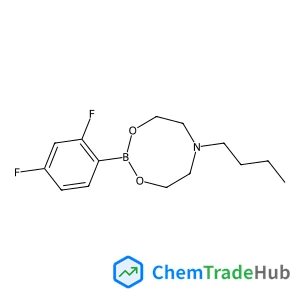
6-Butyl-2-(2,4-difluorophenyl)-1,3,6,2-dioxazaborocane
CAS Number:
1190988-98-7
Molecular Formula:
C14H20BF2NO2
Recommended Suppliers





Disclaimer
This page provides academic journal information for reference and research purposes only. We are not affiliated with any journal publishers and do not handle publication submissions. For publication-related inquiries, please contact the respective journal publishers directly.
If you notice any inaccuracies in the information displayed, please contact us at support@chemtradehub.com. We will promptly review and address your concerns.