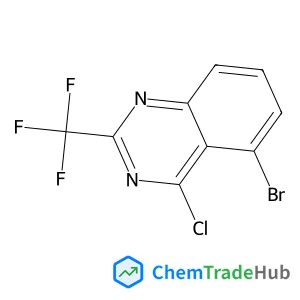
5-Bromo-4-chloro-2-(trifluoromethyl)quinazoline
CAS Number:
2089311-03-3
Molecular Formula:
C9H3BrClF3N2
Mehmet Nail Nasir, Emmanuel Benichou, Claire Loison, Isabelle Russier-Antoine, Françoise Besson, Pierre-François Brevet
The second harmonic generation (SHG) response at the air–water interface from the tyrosine-containing natural iturinic cyclo-lipopeptides mycosubtilin, iturin A and bacillomycin D is reported. It is shown that this response is dominated by the single tyrosine residue present in these molecules owing to the large first hyperpolarizability arising from the non-centrosymmetric aromatic ring structure of this amino acid. The SHG response of these iturinic antibiotics is also compared to the response of surfactin, a cyclo-lipopeptide with a similar L,D-amino acid sequence but lacking a tyrosine residue, and PalmATA, a synthetic linear lipopeptide possessing a single tyrosine residue but lacking the amino acid sequence structuring the cycle of the iturinic antibiotics. From the light polarization analysis of the SHG response, it is shown that the tyrosine local environment is critical in defining the SHG response of these peptides at the air–water interface. Our results demonstrate that tyrosine, similar to tryptophan, can be used as an endogenous molecular probe of peptides and proteins for SHG at the air–water interface, paving the way for SHG studies of other tyrosine-containing bioactive molecules.
Hong Zhang, Lin Fu, Wenli Zhang, Yupeng Yuan
DOI: 10.1039/D3SC04853E
Moritz Thürlemann, Sereina Riniker
DOI: 10.1039/D3SC04317G
J. Nolan McNeill, Jeremy P. Bard, Darren W. Johnson, Michael M. Haley
DOI: 10.1039/D3CS00737E
Chenxi Duan, Chunming Cui
DOI: 10.1039/D3CS00791J
Javier A. Cabeza, Javier F. Reynes, Pablo García-Álvarez, Rubén García-Soriano
DOI: 10.1039/D3SC90211K
Xinlu Zheng, Ziwei Ye, Zeeshan Akmal, Chun He, Jinlong Zhang, Lingzhi Wang
DOI: 10.1039/D3CS00462G
Marcus E. Graziotto, Clinton J. Kidman, Simon A. James, Hugh H. Harris
DOI: 10.1039/D3CS00509G
Xianhai Tian, Yuliang Liu, Shahboz Yakubov, Jonathan Schütte, Shunsuke Chiba, Joshua P. Barham
DOI: 10.1039/D2CS00581F
Yifeng Tang, Jeremiah Y. Kim, Carman K. M. IP, Azadeh Bahmani, Qing Chen, Matthew G. Rosenberger, Aaron P. Esser-Kahn, Andrew L. Ferguson
DOI: 10.1039/D3SC03613H
Waste containing 6-Chloro-5-(2'-hydroxy-3'-methoxy-4-biphenylyl)-3-(3-methoxyphe...
(3alpha,5alpha)-3-Hydroxypregnane-11,20-dione is primarily used in the pharmaceu...
The market for 4-Amino-6-chloro-2-pyridinecarboxylic acid (CAS: 546141-56-4) is ...
Alternatives to (2-Benzoylethyl)trimethylammonium chloride (CAS: 24472-88-6) in ...
N-[4-Nitro-3-(trifluoromethyl)phenyl]acetamide (CAS: 393-12-4) is generally safe...
Alternative reagents such as other phosphates or similar functional groups can b...
There are alternatives to N,N'-Bis(3-aminopropyl)-1,3-propanediamine (CAS: 4605-...
When handling Aluminium trihexadecanoate, it is important to use appropriate per...
(1,1-Dioxido-3-oxo-1,2-benzothiazol-2(3H)-yl)acetic acid is a chemical compound ...
Several alternatives to 5,5-dimethyloxolan-2-one (CAS: 3123-97-5) can be used in...

Physical Chemistry Chemical Physics (PCCP) is an international journal co-owned by 19 physical chemistry and physics societies from around the world. This journal publishes original, cutting-edge research in physical chemistry, chemical physics and biophysical chemistry. To be suitable for publication in PCCP, articles must include significant innovation and/or insight into physical chemistry; this is the most important criterion that reviewers and Editors will judge against when evaluating submissions. The journal has a broad scope and welcomes contributions spanning experiment, theory, computation and data science. Topical coverage includes spectroscopy, dynamics, kinetics, statistical mechanics, thermodynamics, electrochemistry, catalysis, surface science, quantum mechanics, quantum computing and machine learning. Interdisciplinary research areas such as polymers and soft matter, materials, nanoscience, energy, surfaces/interfaces, and biophysical chemistry are welcomed if they demonstrate significant innovation and/or insight into physical chemistry. Joined experimental/theoretical studies are particularly appreciated when complementary and based on up-to-date approaches.