












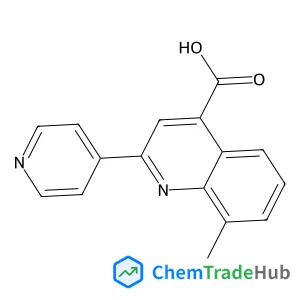
8-Methyl-2-pyridin-4-ylquinoline-4-carboxylic acid
CAS Number:
107027-42-9
Molecular Formula:
C16H12N2O2
Rajib Ghosh, Dipak K. Palit
Dynamics of metal to ligand charge transfer in the excited states of ruthenium polypyridyl complexes, which have shown promise as materials for artificial solar energy harvesting, has been of immense interest recently. Mixed ligand complexes are especially important for broader absorption in the visible region. Dynamics of ultrafast vibrational energy relaxation and inter-ligand charge transfer processes in the excited states of a heteroleptic ruthenium complex, [Ru(bpy)2(pap)](ClO4)2 (where bpy is 2,2′-bipyridine and pap is 2-(phenylazo)pyridine) have been investigated using femtosecond to nanosecond time-resolved transient absorption spectroscopic techniques. A good agreement between the TA spectrum of the lowest excited 3MLCT state of [Ru(bpy)2(pap)](ClO4)2 complex and the anion radical spectrum of the pap ligand, which has been generated using the pulse radiolysis technique, confirmed the charge localization at the pap ligand. While the lifetime of the inter-ligand charge transfer from the bpy to the pap ligand in the 3MLCT state is about 2.5 ps, vibrational cooling of the pap-localized3MLCT state occurs over a much longer time scale with a lifetime of about 35 ps. Ultrafast charge localization dynamics observed here may have important consequences in artificial solar energy harvesting systems, which employ heteroleptic ruthenium complexes.
Jitao Li, Gangyi Zhu, Junfeng Lu, Yueyue Wang, Zengliang Shi, Chunxiang Xu
DOI: 10.1039/C5CP05475C
Priya Bhasi, Zanele P. Nhlabatsi, Sanyasi Sitha
DOI: 10.1039/C5CP05190H
R. Janicki, A. Mondry
DOI: 10.1039/C5CP02429C
Santhanamoorthi Nachimuthu, Wei-Chieh Chen, Jyh-Chiang Jiang
DOI: 10.1039/C5CP04877J
Chao-Yang Li, Meng-Bo Luo, Jian-Hua Huang, Hong Li
DOI: 10.1039/C5CP06189J
DOI: 10.1039/C5CP05369B
K. Venkata Rao, Ritesh Haldar, Subi J. George
DOI: 10.1039/C5CP05052A
Diego M. Gil, María E. Tuttolomondo, Sebastian Blomeyer, Christian G. Reuter, Norbert W. Mitzel, Aída Ben Altabef
DOI: 10.1039/C5CP05295E
M. Calizzi, F. Venturi, M. Ponthieu, F. Cuevas, V. Morandi, T. Perkisas, S. Bals, L. Pasquini
DOI: 10.1039/C5CP03092G
Waste containing 6-Chloro-5-(2'-hydroxy-3'-methoxy-4-biphenylyl)-3-(3-methoxyphe...
(3alpha,5alpha)-3-Hydroxypregnane-11,20-dione is primarily used in the pharmaceu...
The market for 4-Amino-6-chloro-2-pyridinecarboxylic acid (CAS: 546141-56-4) is ...
Alternatives to (2-Benzoylethyl)trimethylammonium chloride (CAS: 24472-88-6) in ...
N-[4-Nitro-3-(trifluoromethyl)phenyl]acetamide (CAS: 393-12-4) is generally safe...
Alternative reagents such as other phosphates or similar functional groups can b...
There are alternatives to N,N'-Bis(3-aminopropyl)-1,3-propanediamine (CAS: 4605-...
When handling Aluminium trihexadecanoate, it is important to use appropriate per...
(1,1-Dioxido-3-oxo-1,2-benzothiazol-2(3H)-yl)acetic acid is a chemical compound ...
Several alternatives to 5,5-dimethyloxolan-2-one (CAS: 3123-97-5) can be used in...

Physical Chemistry Chemical Physics (PCCP) is an international journal co-owned by 19 physical chemistry and physics societies from around the world. This journal publishes original, cutting-edge research in physical chemistry, chemical physics and biophysical chemistry. To be suitable for publication in PCCP, articles must include significant innovation and/or insight into physical chemistry; this is the most important criterion that reviewers and Editors will judge against when evaluating submissions. The journal has a broad scope and welcomes contributions spanning experiment, theory, computation and data science. Topical coverage includes spectroscopy, dynamics, kinetics, statistical mechanics, thermodynamics, electrochemistry, catalysis, surface science, quantum mechanics, quantum computing and machine learning. Interdisciplinary research areas such as polymers and soft matter, materials, nanoscience, energy, surfaces/interfaces, and biophysical chemistry are welcomed if they demonstrate significant innovation and/or insight into physical chemistry. Joined experimental/theoretical studies are particularly appreciated when complementary and based on up-to-date approaches.

-1,2-cyclohexanediamine structure](https://static.chemtradehub.com/structs/928/928769-12-4-a4f0.webp "N,N'-Bis[3-(2-methoxyphenyl)-2-hydroxybenzyl](1R,2R)-1,2-cyclohexanediamine structure")




