












Reversible ionically-crosslinked single chain nanoparticles as bioinspired and recyclable nanoreactors for N-heterocyclic carbene organocatalysis
Literature Information
Publication Date
2018-10-16
DOI
10.1039/C8PY01293H
Impact Factor
5.582
Authors
Andrew P. Dove, Rachel K. O'Reilly
View Original
Abstract
The intrinsic advantages of poly(ionic liquid)s (PILs), based on their high chemical activity and flexible structure, have been harnessed by exploring their applicability as catalytic single chain nanoparticles (SCNPs). A non-covalent bioinspired approach has been established to ionically crosslink an imidazolium-based poly(ionic liquid) to form folded SCNPs. An amphiphilic styrenic-type coPIL was synthesized by reversible addition fragmentation chain transfer (RAFT) to include hydrophilic stabilizer units, hydrophobic spacers and two antagonist functionalities randomly distributed through the polymer backbone. The antagonist functionalities were then intramolecularly and ionically crosslinked using a simple anion metathesis reaction, which resulted in folding to form the SCNPs under mild conditions. The folding process enabled the protection of the N-heterocyclic carbene (NHC) functionality, through the benzoate–imidazolium interaction between antagonist monomer units. Upon the application of heat, free NHCs could be generated within the confined SCNPs, which could be further utilized in benzoin catalysis. Most importantly, the reversible nature of the crosslinking and reversible generation of the active functionality allowed for the utilization of the SCNPs as a recyclable catalytic support.
Recommended Journals
Related Literature
Hydrogen adsorption and desorption at the Pt(110)-(1×2) surface: experimental and theoretical study
Kees-Jan Weststrate, Ludo Juurlink
2013-03-05
Paper
DOI: 10.1039/C3CP44503H
Computing vibrational spectra from ab initio molecular dynamics
Martin Thomas, Martin Brehm, Reinhold Fligg, Peter Vöhringer, Barbara Kirchner
2013-01-23
Paper
DOI: 10.1039/C3CP44302G
An oxygen pumping anode for electrowinning aluminium
Changqing Liu, Xiaobo Ji, Pingmin Zhang, Qiyuan Chen, Craig E. Banks
2013-03-22
Paper
DOI: 10.1039/C3CP44171G
Spectroscopic and theoretical investigations of adenosine 5′-diphosphate and adenosine 5′-triphosphate dianions in the gas phase
Paul E. Crider, Matthias Vonderach, Patrick Weis
2012-12-05
Paper
DOI: 10.1039/C2CP43808A
Adsorption of diferrocenylacetylene on Au(111) studied by scanning tunneling microscopy
Rebecca C. Quardokus, Natalie A. Wasio, Ryan P. Forrest, Craig S. Lent, Steven A. Corcelli, John A. Christie, Kenneth W. Henderson, S. Alex Kandel
2013-03-19
Paper
DOI: 10.1039/C3CP50225B
A statistical approach for analyzing the development of 1H multiple-quantum coherence in solids
Yuuki Mogami, Yasuto Noda, Hiroto Ishikawa, K. Takegoshi
2013-04-12
Paper
DOI: 10.1039/C3CP43778G
Electron tunneling from electronically excited states of isolated bisdisulizole-derived trianion chromophores following UV absorption
Marc-Oliver Winghart, Michael Kühn, Andreas-Neil Unterreiner, Thomas J. A. Wolf, Phuong D. Dau, Hong-Tao Liu, Dao-Ling Huang, Lai-Sheng Wang
2013-03-18
Paper
DOI: 10.1039/C3CP50497B
The reaction force constant as an indicator of synchronicity/nonsynchronicity in [4+2] cycloaddition processes
Diana Yepes, Oscar Donoso-Tauda, Patricia Pérez, Pablo Jaque
2013-01-18
Paper
DOI: 10.1039/C3CP44197K
Reducing the spin–spin interaction of stable carbon radicals
Sharon Ruthstein
2013-03-14
Communication
DOI: 10.1039/C3CP50533B
Photovoltaic devices and characterization of a dodecyloxybenzothiadiazole-based copolymer
Purna P. Maharjan, Qiliang Chen, Lianjie Zhang, Olusegun Adebanjo, Nirmal Adhikari, Swaminathan Venkatesan, Prajwal Adhikary, Bjorn Vaagensmith, Qiquan Qiao
2013-03-14
Paper
DOI: 10.1039/C3CP51070K
You might also like
Compound Q&A
What precautions should be taken when handling 4-(2-Furylmethyl)thiomorpholine 1,1-dioxide (CAS: 79206-94-3)?
When handling 4-(2-Furylmethyl)thiomorpholine 1,1-dioxide (CAS: 79206-94-3), it ...
79206-94-34-(2-Furylmethyl)thi...
Compound Q&A
What precautions should be taken when handling 4-Chloro-N-[2-(4-morpholinyl)ethyl]benzamide (CAS: 71320-77-9)?
When handling 4-Chloro-N-[2-(4-morpholinyl)ethyl]benzamide (CAS: 71320-77-9), it...
71320-77-94-Chloro-N-[2-(4-mor...
Compound Q&A
How should waste containing 2-[2-(2-Methoxyethoxy)ethoxy]ethyl 4-methylbenzenesulfonate (CAS: 62921-74-8) be handled?
Waste containing this compound (CAS: 62921-74-8) should be handled according to ...
62921-74-82-[2-(2-Methoxyethox...
Compound Q&A
How should waste containing (S)-Methyl 2-amino-3-cyclohexylpropanoate be handled?
Waste containing (S)-Methyl 2-amino-3-cyclohexylpropanoate should be collected i...
40056-18-6(S)-Methyl 2-amino-3...
Compound Q&A
How is 5-({4-[(2S,4R)-4-Hydroxy-2-methyltetrahydro-2H-pyran-4-yl]-2-thienyl}sulfanyl)-1-methyl-1,3-dihydro-2H-indol-2-one (CAS: 166882-70-8) typically synthesized?
This compound can be synthesized using a multi-step process involving the conjug...
166882-70-85-({4-[(2S,4R)-4-Hyd...
Compound Q&A
Are there alternatives to (2E)-3-(3,4-Dichlorophenyl)acrylic acid (CAS: 7312-27-8) in synthesis?
There are several alternatives to (2E)-3-(3,4-Dichlorophenyl)acrylic acid in syn...
7312-27-8(2E)-3-(3,4-Dichloro...
Compound Q&A
How should Ethyl 6-(2-nitrophenyl)imidazo[2,1-b][1,3]thiazole-3-carboxylate (CAS: 925437-84-9) be stored?
Ethyl 6-(2-nitrophenyl)imidazo[2,1-b][1,3]thiazole-3-carboxylate (CAS: 925437-84...
925437-84-9Ethyl 6-(2-nitrophen...
Compound Q&A
How should waste containing 2-(1,3-Thiazol-2-yl)ethanamine (CAS: 18453-07-1) be handled?
Waste containing 2-(1,3-Thiazol-2-yl)ethanamine (CAS: 18453-07-1) should be coll...
18453-07-12-(1,3-Thiazol-2-yl)...
Compound Q&A
How is Methyl 5-iodo-2-methylbenzoate (CAS: 103440-54-6) typically synthesized?
Methyl 5-iodo-2-methylbenzoate can be synthesized through the iodination of meth...
103440-54-6Methyl 5-iodo-2-meth...
Compound Q&A
How is 5-Chloro[1,2,4]triazolo[1,5-a]pyridine (CAS: 1427399-34-5) typically synthesized?
5-Chloro[1,2,4]triazolo[1,5-a]pyridine is commonly synthesized via the condensat...
1427399-34-55-Chloro[1,2,4]triaz...
Source Journal
Polymer Chemistry

CiteScore:
8.6
Self-citation Rate:
7.3%
Articles per Year:
457
Polymer Chemistry welcomes submissions in all areas of polymer science that have a strong focus on macromolecular chemistry. Manuscripts may cover a broad range of fields, yet no direct application focus is required.
Recommended Compounds

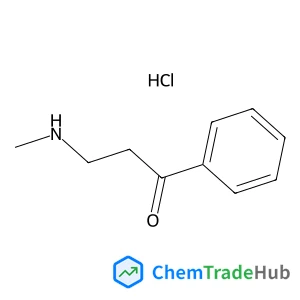
3-(Methylamino)-1-phenyl-1-propanone hydrochloride (1:1)
CAS Number:
2538-50-3
Molecular Formula:
C10H14ClNO
![[4-Amino-2-(methylsulfanyl)-5-pyrimidinyl]methanol structure](https://static.chemtradehub.com/structs/588/588-36-3-fc73.webp "[4-Amino-2-(methylsulfanyl)-5-pyrimidinyl]methanol structure")
Recommended Suppliers






Disclaimer
This page provides academic journal information for reference and research purposes only. We are not affiliated with any journal publishers and do not handle publication submissions. For publication-related inquiries, please contact the respective journal publishers directly.
If you notice any inaccuracies in the information displayed, please contact us at support@chemtradehub.com. We will promptly review and address your concerns.