












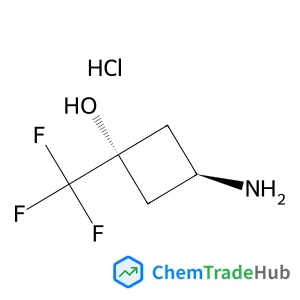
cis-3-Amino-1-(trifluoromethyl)cyclobutanol hydrochloride (1:1)
CAS Number:
1408075-16-0
Molecular Formula:
C5H9ClF3NO
Yue Cai, Qing Gu
An asymmetric N-alkylation of indole derivatives via the Reissert-type reaction was realized in the presence of a catalytic amount of chiral phosphoric acid. Various enantioenriched indoles with N-1 substituted by 1,2-dihydroisoquinoline could be obtained under mild conditions in good yields and enantioselectivities at room temperature (up to 98% yield, 94% ee). The current method is compatible with gram-scale reaction and the products can undergo versatile chemical transformations.
Joanna Matraszek, Martin Vogrin, Damian Pociecha, Ewa Gorecka
DOI: 10.1039/D0CP01579B
Lucie Duplouy, Alain Moissette, Matthieu Hureau, Vincent De Waele, Isabelle Batonneau-Gener
DOI: 10.1039/D0CP01701A
Jinyang Zhang, Chao Su, Fergus J. M. Rogers, Nadim Darwish, Michelle L. Coote, Simone Ciampi
DOI: 10.1039/D0CP01317J
Erdogan Celik, Rajendra S. Negi, Michele Bastianello, Dominic Boll, Andrey Mazilkin, Torsten Brezesinski
DOI: 10.1039/D0CP01619E
Aleks Reinhardt
DOI: 10.1039/D0CP02513E
Michiel Van Daele, Matthew B. E. Griffiths, Matthias M. Minjauw, Seán T. Barry, Christophe Detavernier, Jolien Dendooven
DOI: 10.1039/C9CP06855D
Naciye Esma Tirtom, Yang Hsu, Hung-Wen Li
DOI: 10.1039/D0CP01061H
Kazuya Arashiba, Shimpei Naniwa, Kazuo Kato, Hiromasa Tanaka, Kazunari Yoshizawa, Yoshiaki Nishibayashi
DOI: 10.1039/C9CP06761B
4-Nitrophenyl phosphate disodium salt hexahydrate is primarily used as a substra...
2-(Trifluoromethyl)-1,3-oxazole-4-carboxylic Acid (CAS: 1060816-01-4) is widely ...
2-Fluoro-4-biphenylcarboxylic acid should be stored in a cool, dry place at room...
Prednisolone-21-Carboxylic Acid is primarily used in the pharmaceutical industry...
4-(Hydrazinomethyl)-1,2,3-benzenetriol (CAS: 3614-72-0) should be stored in a co...
4-Amino-1-methyl-1H-pyrazole-5-carboxylic acid hydrochloride (CAS: 92534-70-8) i...
Dehydropachymic acid (CAS: 77012-31-8) is regulated by various agencies. It fall...
The market and research trends for 6-[(2,2-Dimethylpropanoyl)amino]nicotinic aci...
1,10-Phenanthroline-2,9-dicarbaldehyde should be stored in a cool, dry place awa...
5-Carbamoyl-11-oxo-10,11-dihydro-5H-dibenzo[b,f]azepin-10-yl acetate can be synt...

Organic & Biomolecular Chemistry (OBC) publishes original and high impact research and reviews in organic chemistry. We welcome research that shows new or significantly improved protocols or methodologies in total synthesis, synthetic methodology or physical and theoretical organic chemistry as well as research that shows a significant advance in the organic chemistry or molecular design aspects of chemical biology, catalysis, supramolecular and macromolecular chemistry, theoretical chemistry, mechanism-oriented physical organic chemistry, medicinal chemistry or natural products. Articles published in the journal should report new work which makes a highly-significant impact in the field. Routine and incremental work is generally not suitable for publication in the journal. More details about key areas of our scope are below. In all cases authors should include in their article clear rationale for why their research has been carried out.
![[(1S,2S,3R,4S,7R,9S,10S,12R,15S)-4,12-Diacetyloxy-15-[(2R,3S)-3-benzamido-3-phenyl-2-(2,2,2-trichloroethoxycarbonyloxy)propanoyl]oxy-1,9-dihydroxy-10,14,17,17-tetramethyl-11-oxo-6-oxatetracyclo[11.3.1.03,10.04,7]heptadec-13-en-2-yl] benzoate structure](https://static.chemtradehub.com/structs/100/100431-55-8-7104.webp "[(1S,2S,3R,4S,7R,9S,10S,12R,15S)-4,12-Diacetyloxy-15-[(2R,3S)-3-benzamido-3-phenyl-2-(2,2,2-trichloroethoxycarbonyloxy)propanoyl]oxy-1,9-dihydroxy-10,14,17,17-tetramethyl-11-oxo-6-oxatetracyclo[11.3.1.03,10.04,7]heptadec-13-en-2-yl] benzoate structure")
![(3R,5R)-1-[(Benzyloxy)carbonyl]-5-methyl-3-piperidinecarboxylic acid structure](https://static.chemtradehub.com/structs/126/1269757-29-0-c552.webp "(3R,5R)-1-[(Benzyloxy)carbonyl]-5-methyl-3-piperidinecarboxylic acid structure")



