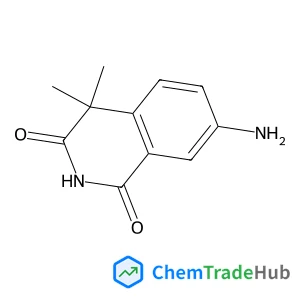
1,3(2H,4H)-Isoquinolinedione, 7-amino-4,4-dimethyl-
CAS Number:
14576-22-8
Molecular Formula:
C11H12N2O2
A graphical abstract is available for this content
Suil In, Alexander Orlov, Felipe García, Mintcho Tikhov, Dominic S. Wright, Richard M. Lambert
DOI: 10.1039/B610316B
Jiangying Qu, Zongbin Zhao, Jieshan Qiu, Yury Gogotsi
DOI: 10.1039/B805622F
Dolores Abella, Víctor Blanco, Elena Pía, Marcos Chas, Carlos Platas-Iglesias, Carlos Peinador, José M. Quintela
DOI: 10.1039/B802213E
Russell A. Taylor, David J. Law, Glenn J. Sunley, Andrew J. P. White, George J. P. Britovsek
DOI: 10.1039/B803370F
Stuart Licht, Xingwen Yu, Dong Zheng
DOI: 10.1039/B608716G
Jangwon Seo, Jong Won Chung, Eun-Hye Jo, Soo Young Park
DOI: 10.1039/B802096E
Tarkeshwar Gupta, Marc Altman, Sandra Lo Schiavo, Placido G. Mineo, Ignazio L. Fragalà, Guennadi Evmenenko, Pulak Dutta, Milko E. van der Boom
DOI: 10.1039/B802670J
Sudipta Ray, Apurba K. Das, Michael G. B. Drew, Arindam Banerjee
DOI: 10.1039/B607657B
Guohua Liu, Yan Gao, Xiaoquan Lu, Mouming Liu, Fang Zhang, Hexing Li
DOI: 10.1039/B803111H
Juan Carlos Ortiz, Lidia Ozores, Fernando Cagide-Fagín, Ricardo Alonso
DOI: 10.1039/B606277F
4-Nitrophenyl phosphate disodium salt hexahydrate is primarily used as a substra...
2-(Trifluoromethyl)-1,3-oxazole-4-carboxylic Acid (CAS: 1060816-01-4) is widely ...
2-Fluoro-4-biphenylcarboxylic acid should be stored in a cool, dry place at room...
Prednisolone-21-Carboxylic Acid is primarily used in the pharmaceutical industry...
4-(Hydrazinomethyl)-1,2,3-benzenetriol (CAS: 3614-72-0) should be stored in a co...
4-Amino-1-methyl-1H-pyrazole-5-carboxylic acid hydrochloride (CAS: 92534-70-8) i...
Dehydropachymic acid (CAS: 77012-31-8) is regulated by various agencies. It fall...
The market and research trends for 6-[(2,2-Dimethylpropanoyl)amino]nicotinic aci...
1,10-Phenanthroline-2,9-dicarbaldehyde should be stored in a cool, dry place awa...
5-Carbamoyl-11-oxo-10,11-dihydro-5H-dibenzo[b,f]azepin-10-yl acetate can be synt...

Physical Chemistry Chemical Physics (PCCP) is an international journal co-owned by 19 physical chemistry and physics societies from around the world. This journal publishes original, cutting-edge research in physical chemistry, chemical physics and biophysical chemistry. To be suitable for publication in PCCP, articles must include significant innovation and/or insight into physical chemistry; this is the most important criterion that reviewers and Editors will judge against when evaluating submissions. The journal has a broad scope and welcomes contributions spanning experiment, theory, computation and data science. Topical coverage includes spectroscopy, dynamics, kinetics, statistical mechanics, thermodynamics, electrochemistry, catalysis, surface science, quantum mechanics, quantum computing and machine learning. Interdisciplinary research areas such as polymers and soft matter, materials, nanoscience, energy, surfaces/interfaces, and biophysical chemistry are welcomed if they demonstrate significant innovation and/or insight into physical chemistry. Joined experimental/theoretical studies are particularly appreciated when complementary and based on up-to-date approaches.