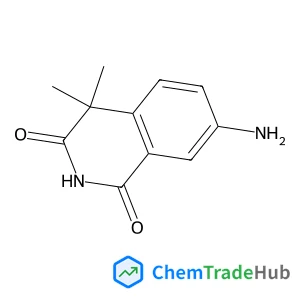
1,3(2H,4H)-Isoquinolinedione, 7-amino-4,4-dimethyl-
CAS Number:
14576-22-8
Molecular Formula:
C11H12N2O2
Michiel Van Daele, Matthew B. E. Griffiths, Matthias M. Minjauw, Seán T. Barry, Christophe Detavernier, Jolien Dendooven
The reaction mechanism of the recently reported Me3AuPMe3–H2 plasma gold ALD process was investigated using in situ characterization techniques in a pump-type ALD system. In situ RAIRS and in vacuo XPS measurements confirm that the CH3 and PMe3 ligands remain on the gold surface after chemisorption of the precursor, causing self-limiting adsorption. Remaining surface groups are removed by the H2 plasma in the form of CH4 and likely as PHxMey groups, allowing chemisorption of new precursor molecules during the next exposure. The decomposition behaviour of the Me3AuPMe3 precursor on a Au surface is also presented and linked to the stability of the precursor ligands that govern the self-limiting growth during ALD. Desorption of the CH3 ligands occurs at all substrate temperatures during evacuation to high vacuum, occurring faster at higher temperatures. The PMe3 ligand is found to be less stable on a gold surface at higher substrate temperatures and is accompanied by an increase in precusor decomposition on a gold surface, indicating that the temperature dependent stability of the precursor ligands is an important factor to ensure self-limiting precursor adsorption during ALD. Remarkably, precursor decomposition does not occur on a SiO2 surface, in situ transmission absorption infrared experiments indicate that nucleation on a SiO2 surface occurs on Si–OH groups. Finally, we comment on the use of different co-reactants during PE-ALD of Au and we report on different PE-ALD growth with the reported O2 plasma and H2O process in pump-type versus flow-type ALD systems.
Claire S. Adjiman, Adam J. Clarke, Gregory Cooper, Paul C. Taylor
DOI: 10.1039/B802921K
Xia Meng, Guang-Rong Tang, Guo-Xin Jin
DOI: 10.1039/B803382J
Jiangying Qu, Zongbin Zhao, Jieshan Qiu, Yury Gogotsi
DOI: 10.1039/B805622F
Tetsuya Tsuda, Takashi Tomioka, Charles L. Hussey
DOI: 10.1039/B802386G
Jangwon Seo, Jong Won Chung, Eun-Hye Jo, Soo Young Park
DOI: 10.1039/B802096E
Christopher F. Bender, Ross A. Widenhoefer
DOI: 10.1039/B804081H
Shaul Mizrahi, Dan Rizkov, Netanel Hayat, Ovadia Lev
DOI: 10.1039/B802155D
4-Nitrophenyl phosphate disodium salt hexahydrate is primarily used as a substra...
2-(Trifluoromethyl)-1,3-oxazole-4-carboxylic Acid (CAS: 1060816-01-4) is widely ...
2-Fluoro-4-biphenylcarboxylic acid should be stored in a cool, dry place at room...
Prednisolone-21-Carboxylic Acid is primarily used in the pharmaceutical industry...
4-(Hydrazinomethyl)-1,2,3-benzenetriol (CAS: 3614-72-0) should be stored in a co...
4-Amino-1-methyl-1H-pyrazole-5-carboxylic acid hydrochloride (CAS: 92534-70-8) i...
Dehydropachymic acid (CAS: 77012-31-8) is regulated by various agencies. It fall...
The market and research trends for 6-[(2,2-Dimethylpropanoyl)amino]nicotinic aci...
1,10-Phenanthroline-2,9-dicarbaldehyde should be stored in a cool, dry place awa...
5-Carbamoyl-11-oxo-10,11-dihydro-5H-dibenzo[b,f]azepin-10-yl acetate can be synt...

Physical Chemistry Chemical Physics (PCCP) is an international journal co-owned by 19 physical chemistry and physics societies from around the world. This journal publishes original, cutting-edge research in physical chemistry, chemical physics and biophysical chemistry. To be suitable for publication in PCCP, articles must include significant innovation and/or insight into physical chemistry; this is the most important criterion that reviewers and Editors will judge against when evaluating submissions. The journal has a broad scope and welcomes contributions spanning experiment, theory, computation and data science. Topical coverage includes spectroscopy, dynamics, kinetics, statistical mechanics, thermodynamics, electrochemistry, catalysis, surface science, quantum mechanics, quantum computing and machine learning. Interdisciplinary research areas such as polymers and soft matter, materials, nanoscience, energy, surfaces/interfaces, and biophysical chemistry are welcomed if they demonstrate significant innovation and/or insight into physical chemistry. Joined experimental/theoretical studies are particularly appreciated when complementary and based on up-to-date approaches.
![N-[2-(4-Hydroxyphenoxy)-4-nitrophenyl]methanesulfonamide structure](https://static.chemtradehub.com/structs/109/109032-22-6-7c88.webp "N-[2-(4-Hydroxyphenoxy)-4-nitrophenyl]methanesulfonamide structure")