












Irreproducibility in the triboelectric charging of insulators: evidence of a non-monotonic charge versus contact time relationship
Literature Information
Publication Date
2020-05-07
DOI
10.1039/D0CP01317J
Impact Factor
3.676
Authors
Jinyang Zhang, Chao Su, Fergus J. M. Rogers, Nadim Darwish, Michelle L. Coote, Simone Ciampi
View Original
Abstract
Here, we investigate the development and relaxation of static charges on the surface of plastic materials that are first brought in contact, and then macroscopically separated. Experimentalists dealing with the static electrification of insulators are aware of difficulties predictably attaining, and precisely reproducing, a given charging magnitude. Here we have observed for the first time that in homo-systems (e.g. PTFE rubbed against PTFE) charge densities reach the maximum value after a material-specific contact time. Attempts to charge a sample beyond its peak value leads to a progressive drop in charge. We propose this drop to result both from the electrostatically driven segregation of polymer ionic fragments, as well as from the discharge of unstable fragments by dielectric breakdown when a sufficiently high surface charge density is reached. We therefore highlight the general existence of two branches in the charging versus charging time curve: the assumption of a monotonous charging slope holds only left or right of the charging maxima and to achieve a specific charge density, care has to be taken to remain within one branch. Differences between materials in the tribocharging peak time are shown to reflect difference in material transfer rates and water adsorption, rather than differences in electronic factors such as the relative stability of cationic and anionic fragments.
Related Literature
A highly efficient method for the construction of cyclopropane-containing dihydroindole derivatives from indolemethylenecyclopropanes with DIAD and DEAD
Mintao Chen, Wenqing Zang, Yin Wei, Min Shi
2019-12-10
Paper
DOI: 10.1039/C9OB02520K
1,2-Addition to trifluoromethylated β-enamino diketones: regioselective synthesis of trifluoromethyl-containing azomethine pyrazoles and isoxazoles
Karlos Eduardo Pianoski, Julia Poletto, Michael Jackson Vieira da Silva, Jeniffer Nascimento Ascencio Camargo, Andrey Petita Jacomini, Davana Silva Gonçalves, Davi Fernando Back, Sidnei Moura, Fernanda Andreia Rosa
2020-03-11
Paper
DOI: 10.1039/D0OB00319K
Total synthesis of isatindigotindoline C
Juha H. Siitonen, Sherlin Lira, Muhammed Yousufuddin, László Kürti
2020-03-02
Communication
DOI: 10.1039/D0OB00270D
Biomimetic total syntheses of baefrutones A–D, baeckenon B, and frutescones A, D–F
Ji-Qin Hou, Jiang-Hong Yu, Heng Zhao, Ying-Ying Dong, Qiu-Shi Peng, Bao-Bao Zhang, Hao Wang
2020-01-14
Paper
DOI: 10.1039/C9OB02490E
Iodine(iii) promoted ring-rearrangement reaction of 1-arylamino-2-oxocyclopentane-1-carbonitriles to synthesize N-aryl-δ-valerolactams
Ajay Sharma
2019-12-19
Paper
DOI: 10.1039/C9OB02598G
Room temperature nickel-catalyzed cross-coupling of aryl-boronic acids with thiophenols: synthesis of diarylsulfides
Amit Bhowmik, Mahesh Yadav, Rodney A. Fernandes
2020-03-05
Paper
DOI: 10.1039/D0OB00244E
L. pneumophila CMP-5,7-di-N-acetyllegionaminic acid synthetase (LpCLS)-involved chemoenzymatic synthesis of sialosides and analogues
John B. McArthur, Abhishek Santra, Wanqing Li, Anoopjit S. Kooner, Ziqi Liu, Hai Yu, Xi Chen
2019-12-30
Paper
DOI: 10.1039/C9OB02476J
You might also like
Compound Q&A
What regulatory guidelines apply to 6-Bromo-2-methylimidazo[1,2-a]pyrimidine (CAS: 1111638-05-1)?
6-Bromo-2-methylimidazo[1,2-a]pyrimidine (CAS: 1111638-05-1) falls under various...
1111638-05-16-Bromo-2-methylimid...
Compound Q&A
Are there alternatives to 1-Pyrrolidineethanol, β-methyl-α-phenyl-, (αS,βR) (CAS: 123620-80-4) in synthesis?
While there are no direct alternatives, similar compounds like 1-Pyrrolidineetha...
123620-80-41-Pyrrolidineethanol...
Compound Q&A
Is 4-Methyl-2,6-bis(2-methyl-2-propanyl)phenyl methylcarbamate (CAS: 1918-11-2) safe?
4-Methyl-2,6-bis(2-methyl-2-propanyl)phenyl methylcarbamate (CAS: 1918-11-2) is ...
1918-11-24-Methyl-2,6-bis(2-m...
Compound Q&A
How should 2-(3-Bromo-4-fluorophenyl)-1,3-dioxolane (CAS: 77771-04-1) be stored?
2-(3-Bromo-4-fluorophenyl)-1,3-dioxolane (CAS: 77771-04-1) should be stored in a...
77771-04-12-(3-Bromo-4-fluorop...
Compound Q&A
What are the physical and chemical properties of 4,5,6,7-Tetrahydro-1H-indazole hydrochloride (CAS: 18161-11-0)?
4,5,6,7-Tetrahydro-1H-indazole hydrochloride is a white crystalline solid with a...
18161-11-04,5,6,7-Tetrahydro-1...
Compound Q&A
What is (2R)-1-Methoxy-3-phenyl-2-propanamine (CAS: 59919-07-2)?
(2R)-1-Methoxy-3-phenyl-2-propanamine is a chiral organic compound with the CAS ...
59919-07-2(2R)-1-Methoxy-3-phe...
Compound Q&A
What industries use Ethyl 1-(1-phenylethyl)-1H-imidazole-5-carboxylate (CAS: 56649-47-9)?
Ethyl 1-(1-phenylethyl)-1H-imidazole-5-carboxylate is used in various industries...
56649-47-9Ethyl 1-(1-phenyleth...
Compound Q&A
What regulatory guidelines apply to 4-[(1E,3S)-1-(4-Hydroxyphenyl)-1,4-pentadien-3-yl]phenol (CAS: 17676-24-3)?
4-[(1E,3S)-1-(4-Hydroxyphenyl)-1,4-pentadien-3-yl]phenol (CAS: 17676-24-3) falls...
17676-24-34-[(1E,3S)-1-(4-Hydr...
Compound Q&A
What industries use (S)-3-Amino-5-phenylpentanoic acid hydrochloride (CAS: 331846-97-0)?
(S)-3-Amino-5-phenylpentanoic acid hydrochloride is primarily used in the pharma...
331846-97-0(S)-3-Amino-5-phenyl...
Compound Q&A
How is 7-methoxy-1-benzothiophene-2-carboxylic acid (CAS: 88791-07-5) typically synthesized?
7-Methoxy-1-benzothiophene-2-carboxylic acid is typically synthesized by reactin...
88791-07-57-methoxy-1-benzothi...
Source Journal
Physical Chemistry Chemical Physics

CiteScore:
5.5
Self-citation Rate:
10.3%
Articles per Year:
3036
Physical Chemistry Chemical Physics (PCCP) is an international journal co-owned by 19 physical chemistry and physics societies from around the world. This journal publishes original, cutting-edge research in physical chemistry, chemical physics and biophysical chemistry. To be suitable for publication in PCCP, articles must include significant innovation and/or insight into physical chemistry; this is the most important criterion that reviewers and Editors will judge against when evaluating submissions. The journal has a broad scope and welcomes contributions spanning experiment, theory, computation and data science. Topical coverage includes spectroscopy, dynamics, kinetics, statistical mechanics, thermodynamics, electrochemistry, catalysis, surface science, quantum mechanics, quantum computing and machine learning. Interdisciplinary research areas such as polymers and soft matter, materials, nanoscience, energy, surfaces/interfaces, and biophysical chemistry are welcomed if they demonstrate significant innovation and/or insight into physical chemistry. Joined experimental/theoretical studies are particularly appreciated when complementary and based on up-to-date approaches.
Recommended Compounds
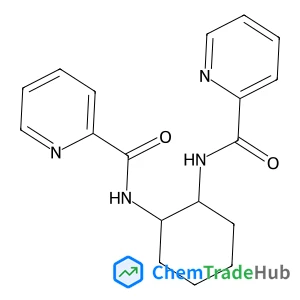
N,N'-(1R,2R)-1,2-Cyclohexanediyldi(2-pyridinecarboxamide)
CAS Number:
218290-24-5
Molecular Formula:
C18H20N4O2
Recommended Suppliers





Disclaimer
This page provides academic journal information for reference and research purposes only. We are not affiliated with any journal publishers and do not handle publication submissions. For publication-related inquiries, please contact the respective journal publishers directly.
If you notice any inaccuracies in the information displayed, please contact us at support@chemtradehub.com. We will promptly review and address your concerns.