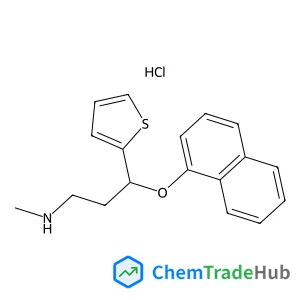
N-Methyl-3-(1-naphthyloxy)-3-(2-thienyl)-1-propanamine hydrochloride (1:1)
CAS Number:
1188266-11-6
Molecular Formula:
C18H20ClNOS
Kun Huang, Songtao Cai, Chang Liu, Xiaojie Jiao, Song He, Liancheng Zhao
Near-infrared (NIR) dyes are of great interest in biomedicine due to diminished interfering absorption and fluorescence from biological samples, reduced scattering, and enhanced tissue penetration depth. In this context, we report the synthesis of rectilinearly π-extended rhodamine dyes using a unique intramolecular nucleophilic substitution of aromatic hydrogen (SNArH) strategy. The strategy makes use of an SNArH reaction between a preorganized aromatic amino nitrogen and an electron-deficient carbon in the xanthylium ion. The SNArH reaction presented herein can be performed under mild conditions without a transition metal catalyst and can be expected to enable the preparation of a wide variety of π-extended near-infrared fluorescent rhodamine dyes. Using this strategy, seven rectilinearly π-extended rhodamines (RE1–RE7) that had fluorescence emission wavelengths in the near-infrared region were synthesized. RE1, RE3, and RE4 were lysosome targetable and showed good photostabilities. In addition, using dye RE1 as a precursor, we constructed a novel NIR fluorescent turn-on probe (RE1-Cu), which can be used for detecting Cu2+ in living cells, demonstrating the value of our NIR functional fluorescent dyes.

Russian Journal of Applied Chemistry

Current Opinion in Colloid & Interface Science

New Journal of Chemistry

Russian Chemical Bulletin

Current Opinion in Solid State & Materials Science

Organic Process Research & Development

Russian Journal of Organic Chemistry

Chemical Communications

Acta Materialia

Nature Medicine
Wanan Cai, Zhicheng Wang, Zhaohui Shu, Wenbin Liu, Jun Wang, Jian Qiu
DOI: 10.1039/D1PY01451J
Rodrigo Navarro, Carolina García, Juan Rodríguez-Hernández, Carlos Elvira, Angel Marcos-Fernández, Alberto Gallardo, Helmut Reinecke
DOI: 10.1039/D0PY00989J
Yuhan Cui, Yusheng Zhou, Guodong Liang
DOI: 10.1039/D1PY00919B
David K. Tran, Ahmed Z. Rashad, Donald J. Darensbourg
DOI: 10.1039/D1PY00784J
Jonny J. Blaker, Constantinos Soutis, François Tournilhac, Matthieu Gresil
DOI: 10.1039/D0PY00342E
Priscilla Arnould, Lionel Bosco, Federico Sanz, Frédéric N. Simon, Stéphane Fouquay, Guillaume Michaud, Jean Raynaud, Vincent Monteil
DOI: 10.1039/D0PY00864H
Jiajia Tan, Jinming Hu, Shiyong Liu
DOI: 10.1039/D1PY01095F
Alicja Balcerak, Dominika Kwiatkowska, Katarzyna Iwińska, Janina Kabatc
DOI: 10.1039/D0PY00763C
Keito Hagiwara
DOI: 10.1039/D0PY00648C
N-(4-Methoxybenzyl)-2-pyridinamine (CAS: 52818-63-0) is increasingly being used ...
When handling Ethyl 4-(2-chlorophenyl)-1,3-thiazole-2-carboxylate, appropriate p...
Diethyldiselane (CAS: 628-39-7) is classified under the Globally Harmonized Syst...
The market for oxocopper (CAS: 12053-18-8) is primarily driven by its use in cat...
The market for 5-{[(2-Methyl-2-propanyl)oxy]carbonyl}-5-azaspiro[2.4]heptane-7-c...
2-(1-Pyrrolidinyl)-4-pyridinamine is a chemical compound with the CAS number 359...
2-(3-Pyridinyl)-1-azabicyclo[2.2.2]octane (CAS: 91556-75-1) is a crystalline sol...
(S)-Alpha-allyl-proline hydrochloride is usually synthesized via a Wittig reacti...
3-Methyl-1,2-oxazole-5-carboxylic acid (CAS: 4857-42-5) is an organic compound w...
Lys-SMCC-DM1 is synthesized via a multi-step process involving the coupling of S...

Organic & Biomolecular Chemistry (OBC) publishes original and high impact research and reviews in organic chemistry. We welcome research that shows new or significantly improved protocols or methodologies in total synthesis, synthetic methodology or physical and theoretical organic chemistry as well as research that shows a significant advance in the organic chemistry or molecular design aspects of chemical biology, catalysis, supramolecular and macromolecular chemistry, theoretical chemistry, mechanism-oriented physical organic chemistry, medicinal chemistry or natural products. Articles published in the journal should report new work which makes a highly-significant impact in the field. Routine and incremental work is generally not suitable for publication in the journal. More details about key areas of our scope are below. In all cases authors should include in their article clear rationale for why their research has been carried out.
![1-[6-(1H-Imidazol-1-yl)-3-pyridinyl]methanamine structure](https://static.chemtradehub.com/structs/914/914637-08-4-8825.webp "1-[6-(1H-Imidazol-1-yl)-3-pyridinyl]methanamine structure")