












![5'-Fluoro-[2,3'-biindolinylidene]-2',3-dione structure](https://static.chemtradehub.com/structs/251/251903-00-1-9cb1.webp "5'-Fluoro-[2,3'-biindolinylidene]-2',3-dione structure")
Biochemical alterations of Candida albicans during the phenotypic transition from yeast to hyphae captured by Fourier transform mid-infrared-attenuated reflectance spectroscopy
Literature Information
Publication Date
2018-09-21
DOI
10.1039/C8AN01452C
Impact Factor
4.616
Authors
Qin-Yin Shi, Vicki Schlegel
View Original
Abstract
Candida albicans is an opportunistic human pathogen that can become virulent due to its ability to switch from a benign yeast to virulent hyphae phenotype. The emergence of C. albicans resistant to commonly used antifungal agents has necessitated the development of innovative treatments, which must be accompanied by an understanding of the molecular changes that occur during the phenotypic shift. For this purpose, Fourier transform mid-infrared spectroscopy in attenuated total reflectance mode (FT-mIR-ATR) was applied to monitor the structural and compositional changes in C. albicans during the yeast-to-hyphae transition. FT-mIR-ATR measurements were completed on the whole cell of C. albicans (SC5314) during hyphal formation induced by N-acetylglucosamine at 0, 1, 2, 3, 6 and 24 h. Principal component analysis separated the FT-mIR-ATR spectra into four groups that were aligned with the morphological changes captured by microscopic imaging. Spectral signatures indicating the structural and compositional modifications during the transition were identified mainly in the fatty acid region (3100–2800 cm−1), the protein and peptide region (1800–1500 cm−1), the mixed region (1500–1200 cm−1) and the polysaccharide region (1200–900 cm−1). A spectral fingerprint of the transition via a heat map was generated based on the peak shift in position. Quantitative evaluation of the spectra by curve fitting further revealed the dynamics of the cell's main components during the transition. This work provides valuable structural and functional information on the C. albicans phenotypic transition to hyphae, which has diagnostic implications.
Related Literature
Examination of the chemical behavior of the quercetin radical cation towards some bases
Zoran Marković, Dragan Amić, Dejan Milenković, Jasmina M. Dimitrić-Marković, Svetlana Marković
2013-03-22
Paper
DOI: 10.1039/C3CP44605K
Interaction of CO2 with oxygen adatoms on rutile TiO2(110)
Xiao Lin, Zhi-Tao Wang, Igor Lyubinetsky, Bruce D. Kay, Zdenek Dohnálek
2013-01-10
Paper
DOI: 10.1039/C3CP44040K
Switching kinetics of electrochemical metallization memory cells
Stephan Menzel, Stefan Tappertzhofen, Ilia Valov
2013-03-14
Paper
DOI: 10.1039/C3CP50738F
Manipulating dynamics with chemical structure: probing vibrationally-enhanced tunnelling in photoexcited catechol
Jamie D. Young, Dave Townsend, Justyna M. Żurek, Martin J. Paterson, Gareth M. Roberts, Vasilios G. Stavros
2013-03-22
Paper
DOI: 10.1039/C3CP51108A
Improving the thermoelectric properties of half-Heusler TiNiSn through inclusion of a second full-Heusler phase: microwave preparation and spark plasma sintering of TiNi1+xSn
Bethany R. Lettiere, Gareth Seward, Nisha Verma, Yichi Zhang
2013-04-04
Paper
DOI: 10.1039/C3CP50918D
Comparing molecular photofragmentation dynamics in the gas and liquid phases
Stephanie J. Harris, Daniel Murdock, Yuyuan Zhang, Thomas A. A. Oliver, Michael P. Grubb, Andrew J. Orr-Ewing, Gregory M. Greetham, Ian P. Clark, Michael Towrie, Stephen E. Bradforth, Michael N. R. Ashfold
2013-03-19
Perspective
DOI: 10.1039/C3CP50756D
A novel method for automatic single molecule tracking of blinking molecules at low intensities
Christoph Kölbl, Beate Stempfle
2013-02-06
Paper
DOI: 10.1039/C3CP44693J
Temperature and time dependence on ZnS microstructure and phases obtained through hydrothermal decomposition of diethyldithiocarbamate complexes
Guilherme Oliveira Siqueira, Tulio Matencio, Herculano Vieira da Silva, Yara Gonçalves de Souza, José Domingos Ardisson, Geraldo Magela de Lima, Arilza de Oliveira Porto
2013-03-04
Paper
DOI: 10.1039/C3CP50549A
QM/MM simulations of vibrational spectra of bacteriorhodopsin and channelrhodopsin-2
Kai Welke, Hiroshi C. Watanabe, Tino Wolter, Marcus Elstner
2013-01-17
Paper
DOI: 10.1039/C3CP44181D
Interpretation of experimental hydrogen-bond enthalpies and entropies from COSMO polarisation charge densities
Jens Reinisch, Frank Eckert, Jérôme Graton, Jean-Yves Le Questel
2013-03-22
Paper
DOI: 10.1039/C3CP44611E
You might also like
Compound Q&A
What is the market or research trend for N-(4-Methoxybenzyl)-2-pyridinamine (CAS: 52818-63-0)?
N-(4-Methoxybenzyl)-2-pyridinamine (CAS: 52818-63-0) is increasingly being used ...
52818-63-0N-(4-Methoxybenzyl)-...
Compound Q&A
What precautions should be taken when handling Ethyl 4-(2-chlorophenyl)-1,3-thiazole-2-carboxylate (CAS: 1050507-06-6)?
When handling Ethyl 4-(2-chlorophenyl)-1,3-thiazole-2-carboxylate, appropriate p...
1050507-06-6Ethyl 4-(2-chlorophe...
Compound Q&A
What regulatory guidelines apply to diethyldiselane (CAS: 628-39-7)?
Diethyldiselane (CAS: 628-39-7) is classified under the Globally Harmonized Syst...
628-39-7Diethyldiselane
Compound Q&A
What is the market or research trend for oxocopper (CAS: 12053-18-8)?
The market for oxocopper (CAS: 12053-18-8) is primarily driven by its use in cat...
12053-18-8oxocopper; oxo-(oxoc...
Compound Q&A
What is the market or research trend for 5-{[(2-Methyl-2-propanyl)oxy]carbonyl}-5-azaspiro[2.4]heptane-7-carboxylic acid?
The market for 5-{[(2-Methyl-2-propanyl)oxy]carbonyl}-5-azaspiro[2.4]heptane-7-c...
1268519-54-55-{[(2-Methyl-2-prop...
Compound Q&A
What is 2-(1-Pyrrolidinyl)-4-pyridinamine (CAS: 35981-63-6)?
2-(1-Pyrrolidinyl)-4-pyridinamine is a chemical compound with the CAS number 359...
35981-63-62-(1-Pyrrolidinyl)-4...
Compound Q&A
What are the physical and chemical properties of 2-(3-Pyridinyl)-1-azabicyclo[2.2.2]octane (CAS: 91556-75-1)?
2-(3-Pyridinyl)-1-azabicyclo[2.2.2]octane (CAS: 91556-75-1) is a crystalline sol...
91556-75-12-(3-Pyridinyl)-1-az...
Compound Q&A
How is (S)-Alpha-allyl-proline hydrochloride (CAS: 129704-91-2) typically synthesized?
(S)-Alpha-allyl-proline hydrochloride is usually synthesized via a Wittig reacti...
129704-91-2(S)-Alpha-allyl-prol...
Compound Q&A
What is 3-Methyl-1,2-oxazole-5-carboxylic acid (CAS: 4857-42-5)?
3-Methyl-1,2-oxazole-5-carboxylic acid (CAS: 4857-42-5) is an organic compound w...
4857-42-53-Methyl-1,2-oxazole...
Compound Q&A
How is Lys-SMCC-DM1 (CAS: 1281816-04-3) typically synthesized?
Lys-SMCC-DM1 is synthesized via a multi-step process involving the coupling of S...
1281816-04-3Lys-SMCC-DM1
Source Journal
Analyst

CiteScore:
7.8
Self-citation Rate:
5.6%
Articles per Year:
653
Analyst publishes analytical and bioanalytical research that reports premier fundamental discoveries and inventions, and the applications of those discoveries, unconfined by traditional discipline barriers.
Recommended Compounds
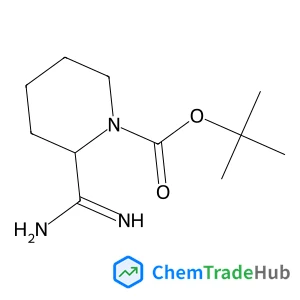
2-Methyl-2-propanyl 2-carbamimidoyl-1-piperidinecarboxylate
CAS Number:
1258640-98-0
Molecular Formula:
C11H21N3O2
Recommended Suppliers






Disclaimer
This page provides academic journal information for reference and research purposes only. We are not affiliated with any journal publishers and do not handle publication submissions. For publication-related inquiries, please contact the respective journal publishers directly.
If you notice any inaccuracies in the information displayed, please contact us at support@chemtradehub.com. We will promptly review and address your concerns.