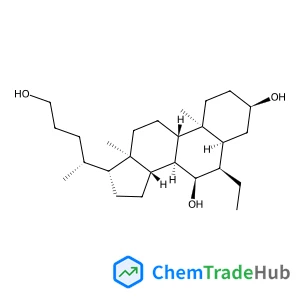
(3alpha,5beta,6alpha,7alpha)-6-Ethylcholane-3,7,24-triol
CAS Number:
1537866-49-1
Molecular Formula:
C26H46O3
The resistive-pulse technique provides a fast and label-free method for nanoparticle detection. To achieve higher sensitivity, thin nanopores such as silicon nitride nanopores are usually considered. In this study, nanoparticle detection has been mimicked with simulations. We found that the surface charges of particles can significantly affect current blockade in short pores, particularly under high electric fields. For particles with surface charge densities higher than −0.02 C m−2, current blockade ratios depend closely on the applied voltage. From our simulation results, an optimal voltage can be found for particle detection, at which the current blockade ratio does not depend on the surface charge density of the particle. This optimal voltage was obtained from the balance of current increase and decrease caused by cations and anions, respectively, due to negative surface charges of the particles. From this systematic study, the optimal voltage was found to represent a property of the system that only depends on the electrolyte type. We think our findings can provide some help for accurate particle detection in experiments.
Yeru Liu, James Robert Jennings, Xingzhu Wang, Qing Wang
DOI: 10.1039/C3CP50998B
B. Geil
DOI: 10.1039/C3CP00139C
Jens Reinisch, Frank Eckert, Jérôme Graton, Jean-Yves Le Questel
DOI: 10.1039/C3CP44611E
Yimin Cui, Wei Liu, Rongming Wang
DOI: 10.1039/C3CP00132F
Changqing Liu, Xiaobo Ji, Pingmin Zhang, Qiyuan Chen, Craig E. Banks
DOI: 10.1039/C3CP44171G
Xuefeng Lu, Hongjie Wang, Meng Chen, Lei Fan, Chao Wang, Shuhai Jia
DOI: 10.1039/C3CP50372K
Lijia Liu, Tsun-Kong Sham, Weiqiang Han
DOI: 10.1039/C3CP50498K
Aleksey B. Alekseyev, Heinz-Peter Liebermann, Robert J. Buenker
DOI: 10.1039/C3CP44237C
Stephanie J. Harris, Daniel Murdock, Yuyuan Zhang, Thomas A. A. Oliver, Michael P. Grubb, Andrew J. Orr-Ewing, Gregory M. Greetham, Ian P. Clark, Michael Towrie, Stephen E. Bradforth, Michael N. R. Ashfold
DOI: 10.1039/C3CP50756D
N-(4-Methoxybenzyl)-2-pyridinamine (CAS: 52818-63-0) is increasingly being used ...
When handling Ethyl 4-(2-chlorophenyl)-1,3-thiazole-2-carboxylate, appropriate p...
Diethyldiselane (CAS: 628-39-7) is classified under the Globally Harmonized Syst...
The market for oxocopper (CAS: 12053-18-8) is primarily driven by its use in cat...
The market for 5-{[(2-Methyl-2-propanyl)oxy]carbonyl}-5-azaspiro[2.4]heptane-7-c...
2-(1-Pyrrolidinyl)-4-pyridinamine is a chemical compound with the CAS number 359...
2-(3-Pyridinyl)-1-azabicyclo[2.2.2]octane (CAS: 91556-75-1) is a crystalline sol...
(S)-Alpha-allyl-proline hydrochloride is usually synthesized via a Wittig reacti...
3-Methyl-1,2-oxazole-5-carboxylic acid (CAS: 4857-42-5) is an organic compound w...
Lys-SMCC-DM1 is synthesized via a multi-step process involving the coupling of S...

Analyst publishes analytical and bioanalytical research that reports premier fundamental discoveries and inventions, and the applications of those discoveries, unconfined by traditional discipline barriers.
![(2R,6S)-6-[(Benzyloxy)methyl]-4-{[(2-methyl-2-propanyl)oxy]carbonyl}-2-morpholinecarboxylic acid structure](https://static.chemtradehub.com/structs/109/1093085-91-6-3382.webp "(2R,6S)-6-[(Benzyloxy)methyl]-4-{[(2-methyl-2-propanyl)oxy]carbonyl}-2-morpholinecarboxylic acid structure")