


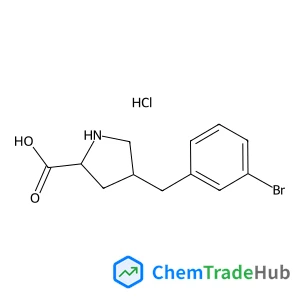
(2S,4R)-4-(3-Bromobenzyl)pyrrolidine-2-carboxylic acid hydrochloride
CAS Number:
1049734-10-2
Molecular Formula:
C12H15BrClNO2
Motoki Kida, Daisuke Shimoyama, Toshiaki Ikeda, Ryo Sekiya, Takeharu Haino, Takayuki Ebata, Christophe Jouvet, Yoshiya Inokuchi
We observe UV spectra of protonated dibenzylamine (dBAMH+) and its complexes with 15-crown-5 (dBAMH+–15C5), 18-crown-6 (dBAMH+–18C6), and 24-crown-8 (dBAMH+–24C8) under cold (∼10 K) gas-phase conditions by UV photodissociation (UVPD) and UV–UV hole-burning (HB) spectroscopy. The UVPD spectrum of the dBAMH+–15C5 complex shows an extensive low-frequency progression, which originates from a unique conformation of the dBAMH+ part with benzene rings facing closely to each other, while UVPD and calculation results suggest open conformations of the dBAMH+ part for dBAMH+–18C6 and dBAMH+–24C8. UV–UV HB spectra of the dBAMH+–24C8 complex indicate that there exist at least two conformers; multiple conformations can contribute to high stability of dBAMH+–24C8 pseudorotaxane due to “conformational” entropic effects. The UVPD experiment indicates that the dissociation probability of dBAMH+–24C8 into dBAMH+ and 24C8 is substantially smaller than that of dBAMH+–15C5 and dBAMH+–18C6, which can be related to the barrier height in the dissociation process. The energetics of the dBAMH+–24C8 complex is investigated experimentally with NMR spectroscopy and theoretically with the global reaction route mapping (GRRM) method. An energy barrier of ∼60 kJ mol−1 is present in the pseudorotaxane formation in solution, whereas there is no barrier in the gas phase. In the course of the photodissociation, excited dBAMH+–24C8 complexes can be trapped at many local minima corresponding to multiple conformations. This can result in effective dissipation of internal energy into degrees of freedom not correlated to the dissociation and decrease the dissociation probability for the dBAMH+–24C8 complex in the gas phase. The energy barrier for the pseudorotaxane formation in solution originates not simply from the slippage process but rather from solvent effects on the dBAMH+–24C8 complex.

Environmental Toxicology and Pharmacology

European Journal of Organic Chemistry

Angewandte Chemie International Edition

Physical Chemistry Chemical Physics

CrystEngComm

Current Pharmaceutical Biotechnology

Nature Reviews Drug Discovery

Journal of Enzyme inhibition and Medicinal Chemistry

Photochemical & Photobiological Sciences

Mini-Reviews in Medicinal Chemistry
Kui Lu, Quan Li, Xiaolan Xi, Yuna Huang, Zhi Gong, Peng Yu, Xia Zhao
DOI: 10.1039/C8QO00779A
Shang Wu, Quanlu Yang, Qinzheng Hu, Yanbin Wang, Lihua Chen, Hong Zhang, Lan Wu, Jia Li
DOI: 10.1039/C8QO00674A
Xincheng Li, Boshun Wan
DOI: 10.1039/C8QO00984H
Jinwei Yuan, Junhao Fu, Jihong Yin, Zhenhua Dong, Yongmei Xiao, Pu Mao
DOI: 10.1039/C8QO00731D
Chunhui Shan, Kangbao Zhong, Xiaotian Qi, Dongdong Xu, Ling-Bo Qu, Ruopeng Bai
DOI: 10.1039/C8QO00699G
Gang-Wei Wang, Shi-Xia Li, Quan-Xiang Wu
DOI: 10.1039/C5QO00053J
Hongming Jin, Zhengbo Zhu, Ning Jin, Jin Xie, Yixiang Cheng
DOI: 10.1039/C4QO00329B
Jiajing Tan, Binbin Liu, Shuaisong Su
DOI: 10.1039/C8QO00838H
Hideaki Takano
DOI: 10.1039/C4QO00355A
Wei-Lei Zhou, Xuan Zhao, Yong Chen
DOI: 10.1039/C8QO00790J
2-(2-Chloroacetamido)-3-phenylpropanoic acid (CAS: 7765-11-9) is generally consi...
2-(Benzyloxy)-5-bromobenzoic acid can be handled safely if appropriate precautio...
(4-Methyl-1,2,5-oxadiazol-3-yl)methanamine hydrochloride is a chemical compound ...
2-(5-Hexylthiophen-2-yl)-4,4,5,5-tetramethyl-1,3,2-dioxaborolane (CAS: 917985-54...
While 4-(8-Methyl-9H-1,3-dioxolo[4,5-h][2,3]benzodiazepin-5-yl)benzenamine (CAS:...
The market for tert-butyl 3-hydroxy-4,5,7,8-tetrahydro-2H-pyrazolo[3,4-d]azepine...
Waste containing 3,5-Diamino-1H-pyrazole-4-carbonitrile (CAS: 6844-58-2) should ...
(6-Fluoro-3-pyridinyl)boronic acid can be synthesized through the reaction of 6-...
Dibenzyl carbonimidoylbiscarbamate (CAS: 10065-79-9) finds applications in vario...
The market for (beta,beta,2,3,4,5,6-~2~H_7_)Phenylalanine (CAS: 74228-83-4) is g...
Physical Chemistry Chemical Physics (PCCP) is an international journal co-owned by 19 physical chemistry and physics societies from around the world. This journal publishes original, cutting-edge research in physical chemistry, chemical physics and biophysical chemistry. To be suitable for publication in PCCP, articles must include significant innovation and/or insight into physical chemistry; this is the most important criterion that reviewers and Editors will judge against when evaluating submissions. The journal has a broad scope and welcomes contributions spanning experiment, theory, computation and data science. Topical coverage includes spectroscopy, dynamics, kinetics, statistical mechanics, thermodynamics, electrochemistry, catalysis, surface science, quantum mechanics, quantum computing and machine learning. Interdisciplinary research areas such as polymers and soft matter, materials, nanoscience, energy, surfaces/interfaces, and biophysical chemistry are welcomed if they demonstrate significant innovation and/or insight into physical chemistry. Joined experimental/theoretical studies are particularly appreciated when complementary and based on up-to-date approaches.

![2-[(E)-(2-Methoxyphenyl)diazenyl]-3-oxo-N-(2-oxo-2,3-dihydro-1H-benzimidazol-5-yl)butanamide structure](https://static.chemtradehub.com/structs/821/82199-12-0-f1d0.webp "2-[(E)-(2-Methoxyphenyl)diazenyl]-3-oxo-N-(2-oxo-2,3-dihydro-1H-benzimidazol-5-yl)butanamide structure")





