












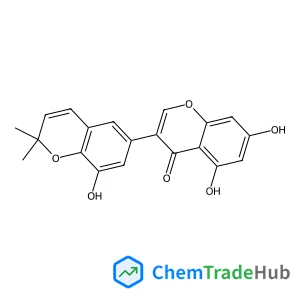
5,7,8'-Trihydroxy-2',2'-dimethyl-2'H,4H-3,6'-bichromen-4-one
CAS Number:
129280-33-7
Molecular Formula:
C20H16O6
Mirtha A. O. Lourenço, Paula Ferreira, José R. B. Gomes
Periodic mesoporous organosilicas (PMOs) were suggested as potential adsorbents for CO2/CH4 separation because of their large affinities towards CO2 and low interaction with CH4. Herewith, we present a comprehensive computational study on the binding properties of flue gas species with the pore walls of periodic mesoporous phenylene-silica (Ph-PMO) for understanding the possible impact of other gaseous species in the CO2/CH4 separation. The calculations considered three exchange–correlation functionals (PBE, PBE-D2 and M06-2X) based on the density functional theory and the walls of the periodic mesoporous phenylene-silica were modelled within the cluster model approach. The components of the flue gas considered were the diatomic CO, H2, N2, O2 and NO molecules, the triatomic CO2, H2O, H2S and SO2 species, the tetratomic SO3 and NH3 gases and the pentatomic CH4 molecule. The calculated data demonstrate that the presence of H2O, SO2, NH3, H2S and SO3 is a significant threat to CO2 capture by Ph-PMO and suggest that the Ph-PMO material would present high selectivity for CO2 over CH4, CO, H2 or N2 adsorption. The adsorption behaviour of flue gas components in Ph-PMO can be directly related to the experimental proton affinities, basicities or even the polarizabilities of the gaseous molecules.
Xiaobo Mao, Aihua Yang, Lin Niu, Shengnan Wang, Denghua Li, Yuanyuan Guo, Yibing Wang, Yanlian Yang, Chen Wang
DOI: 10.1039/C1CC12380G
Sergei I. Kozhushkov, Harish Kumar Potukuchi, Lutz Ackermann
DOI: 10.1039/C2CY20505J
Anne Griboval-Constant, Andrei Y. Khodakov, Fabrice Diehl
DOI: 10.1039/C1CC13800F
Nathan Fishkin, Erin K. Maloney, Ravi V. J. Chari, Rajeeva Singh
DOI: 10.1039/C1CC14164C
Jian Zhi, Depeng Song, Zhiwen Li, Xia Lei, Aiguo Hu
DOI: 10.1039/C1CC14169D
Dawei Li, Zhaoqi Yang, Yi Long, Guanjia Zhao, Bei Lv, Shuhui Hiew, Magdeline Tao Tao Ng, Juanjuan Guo, HongKee Tan, Hao Zhang, Weixing Yuan, Haibin Su, Tianhu Li
DOI: 10.1039/C1CC13158C
Seiji Shirakawa, Shogo J. Terao, Rongjun He, Keiji Maruoka
DOI: 10.1039/C1CC14043D
Ramkinkar Santra, Kaustuv Banerjee, Kumar Biradha
DOI: 10.1039/C1CC13994K
Laura Mitchell, Berenice Gonzalez-Santiago, John P. S. Mowat, Mary E. Gunn, Patrick Williamson, Nadia Acerbi, Matthew L. Clarke, Paul A. Wright
DOI: 10.1039/C2CY20577G
Kai E. O. Ylijoki, E. Peter Kündig
DOI: 10.1039/C1CC14209G
(1R,3S)-1,3-Cyclopentanediol finds applications in various industries. In the ph...
When handling N'-[4-(Dimethylamino)phenyl]-N,N-dimethyl-1,4-benzenediamine, it i...
There are several alternatives to 5-(2,4-Difluorophenyl)-2-methoxypyrimidine in ...
1-(3-Methoxyphenoxy)propan-2-ol (CAS: 382141-68-6) must comply with the Globally...
Tetrodotoxin Citrate is extremely dangerous and should be handled with extreme c...
2-Methyl-2-propanyl [(1R,3S)-3-hydroxycyclopentyl]carbamate (CAS: 225641-84-9) i...
Waste containing 4-(2-Hydroxyhexafluoroisopropyl)Benzoic Acid (CAS: 16261-80-6) ...
2-Methyl-2-proanyl {(2S)-1-[(benzyloxy)amino]-3-hydroxy-3-methyl-1-oxo-2-butanyl...
Benzeneethanamine, α-ethyl-, hydrochloride (1:1) is an organic compound with the...
In the synthesis of compounds similar to 3-{(E)-[4-(Dimethylamino)phenyl]diazeny...

Physical Chemistry Chemical Physics (PCCP) is an international journal co-owned by 19 physical chemistry and physics societies from around the world. This journal publishes original, cutting-edge research in physical chemistry, chemical physics and biophysical chemistry. To be suitable for publication in PCCP, articles must include significant innovation and/or insight into physical chemistry; this is the most important criterion that reviewers and Editors will judge against when evaluating submissions. The journal has a broad scope and welcomes contributions spanning experiment, theory, computation and data science. Topical coverage includes spectroscopy, dynamics, kinetics, statistical mechanics, thermodynamics, electrochemistry, catalysis, surface science, quantum mechanics, quantum computing and machine learning. Interdisciplinary research areas such as polymers and soft matter, materials, nanoscience, energy, surfaces/interfaces, and biophysical chemistry are welcomed if they demonstrate significant innovation and/or insight into physical chemistry. Joined experimental/theoretical studies are particularly appreciated when complementary and based on up-to-date approaches.

![N-[(1S,2R,4S)-2-Amino-4-(dimethylcarbamoyl)cyclohexyl]-N'-(5-chloro-2-pyridinyl)ethanediamide structure](https://static.chemtradehub.com/structs/480/480452-37-7-0898.webp "N-[(1S,2R,4S)-2-Amino-4-(dimethylcarbamoyl)cyclohexyl]-N'-(5-chloro-2-pyridinyl)ethanediamide structure")


