












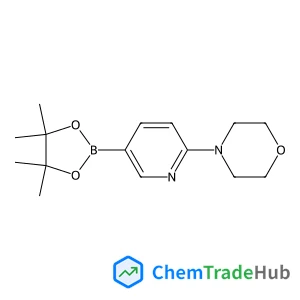
4-(5-(4,4,5,5-tetramethyl-1,3,2-dioxaborolan-2-yl)pyridin-2-yl)morpholine
CAS Number:
485799-04-0
Molecular Formula:
C15H23BN2O3
Shumei Chen, Huabin Zhang, Jian Zhang
Graphitic carbon nitride (g-C3N4) is an actively investigated metal-free photocatalyst for solar energy conversion. However, primary g-C3N4 usually exhibits limited utilization of visible light and fast combination of photoexcited charge carriers, resulting in low photocatalytic H2 evolution activity. Defect-modified g-C3N4 shows much enhanced photocatalytic H2 evolution activity owing to extended light absorption as well as efficient charge separation and transfer. Here, the photocatalyst simultaneously containing nitrogen vacancies and O-doping is successfully developed by using a two-step post-synthetic strategy for photocatalytic H2 evolution, resulting in a greatly-boosted H2 evolution activity (1.69 × 10³ μmol g−1 h−1) compared with that of pristine g-C3N4 (1.12 × 10² μmol g−1 h−1). It is believed that the newly developed double-defect strategy may open an avenue toward obtaining molecular level comprehension of the function of a catalyst in photocatalytic H2 evolution and can be extended to the modification of other semiconductors.
Ma.-Angeles Cano-Herrera, Luis D. Miranda
DOI: 10.1039/C1CC10759C
Shouxin Ren, Ling Gao
DOI: 10.1039/C0AN00433B
Yunxing Li, Zhaoqun Wang, Liang Yang, Hao Gu
DOI: 10.1039/C1CC14614A
João Nuno Moreira, Carlos F. G. C. Geraldes, Silvia Rizzitelli, Silvio Aime, Enzo Terreno
DOI: 10.1039/C1CC14019A
Davide Giust, José Luis Albasanz, Mairena Martín, Riccardo Marega, Arnaud Delforge
DOI: 10.1039/C1CC13971A
Eoin Rafter, Florian Löw, Gerd Buntkowsky, Bruno Chaudret, Piet W. N. M. van Leeuwen
DOI: 10.1039/C2CY20683H
Pallavi Sharma, Dougal J. Ritson, James Burnley, John E. Moses
DOI: 10.1039/C1CC13949E
Kalluri V. S. Ranganath, Frank Glorius
DOI: 10.1039/C0CY00069H
Dan Li, Zhaozi Lv, Erkang Wang
DOI: 10.1039/C1CC11374G
Nathan Fishkin, Erin K. Maloney, Ravi V. J. Chari, Rajeeva Singh
DOI: 10.1039/C1CC14164C
(1R,3S)-1,3-Cyclopentanediol finds applications in various industries. In the ph...
When handling N'-[4-(Dimethylamino)phenyl]-N,N-dimethyl-1,4-benzenediamine, it i...
There are several alternatives to 5-(2,4-Difluorophenyl)-2-methoxypyrimidine in ...
1-(3-Methoxyphenoxy)propan-2-ol (CAS: 382141-68-6) must comply with the Globally...
Tetrodotoxin Citrate is extremely dangerous and should be handled with extreme c...
2-Methyl-2-propanyl [(1R,3S)-3-hydroxycyclopentyl]carbamate (CAS: 225641-84-9) i...
Waste containing 4-(2-Hydroxyhexafluoroisopropyl)Benzoic Acid (CAS: 16261-80-6) ...
2-Methyl-2-proanyl {(2S)-1-[(benzyloxy)amino]-3-hydroxy-3-methyl-1-oxo-2-butanyl...
Benzeneethanamine, α-ethyl-, hydrochloride (1:1) is an organic compound with the...
In the synthesis of compounds similar to 3-{(E)-[4-(Dimethylamino)phenyl]diazeny...

Physical Chemistry Chemical Physics (PCCP) is an international journal co-owned by 19 physical chemistry and physics societies from around the world. This journal publishes original, cutting-edge research in physical chemistry, chemical physics and biophysical chemistry. To be suitable for publication in PCCP, articles must include significant innovation and/or insight into physical chemistry; this is the most important criterion that reviewers and Editors will judge against when evaluating submissions. The journal has a broad scope and welcomes contributions spanning experiment, theory, computation and data science. Topical coverage includes spectroscopy, dynamics, kinetics, statistical mechanics, thermodynamics, electrochemistry, catalysis, surface science, quantum mechanics, quantum computing and machine learning. Interdisciplinary research areas such as polymers and soft matter, materials, nanoscience, energy, surfaces/interfaces, and biophysical chemistry are welcomed if they demonstrate significant innovation and/or insight into physical chemistry. Joined experimental/theoretical studies are particularly appreciated when complementary and based on up-to-date approaches.
![Ethyl 3-((6-(4,5-dihydro-1H-benzo[d]azepin-3(2H)-yl)-2-(pyridin-2-yl)pyrimidin-4-yl)amino)propanoate structure](https://static.chemtradehub.com/structs/137/1373423-53-0-496a.webp "Ethyl 3-((6-(4,5-dihydro-1H-benzo[d]azepin-3(2H)-yl)-2-(pyridin-2-yl)pyrimidin-4-yl)amino)propanoate structure")
![N-[(5,6-Dichloro-1H-benzimidazol-2-yl)methyl]-9-(1-methyl-1H-pyrazol-4-yl)-2-(4-morpholinyl)-9H-purin-6-amine structure](https://static.chemtradehub.com/structs/238/2387704-62-1-25f4.webp "N-[(5,6-Dichloro-1H-benzimidazol-2-yl)methyl]-9-(1-methyl-1H-pyrazol-4-yl)-2-(4-morpholinyl)-9H-purin-6-amine structure")




