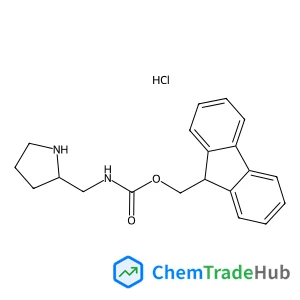
(S)-(9H-Fluoren-9-yl)methyl (pyrrolidin-2-ylmethyl)carbamate hydrochloride
CAS Number:
1217813-15-4
Molecular Formula:
C20H23ClN2O2
Kalluri V. S. Ranganath, Frank Glorius
The aim of this perspective is to highlight the potential application of (superpara)magnetic nanoparticles in asymmetric catalysis. The unique combination of high enantioselectivity and enhanced reactivity combined with its recyclability and ease of separation makes this chiral nanotechnology one of the most promising strategies for the formation of enantiomerically enriched compounds on an industrial scale. This perspective focuses on the most representative examples of this young and emerging research field and highlights recent achievements and future prospects of magnetic nanoparticles in asymmetric catalysis.
Mohit Chawla, Pau Besalú-Sala, Kanav Kalra, Romina Oliva, Luigi Cavallo
DOI: 10.1039/C7CP07656H
Victor Gray, Betül Küçüköz, Fredrik Edhborg, Maria Abrahamsson, Kasper Moth-Poulsen, Bo Albinsson
DOI: 10.1039/C8CP00884A
Benjamin D. Datko, Maksim Y. Livshits, Zhen Zhang, Dana Portlock, Yang Qin, Jeffrey J. Rack, John K. Grey
DOI: 10.1039/C8CP04061C
M. Oujja, J. G. Izquierdo, L. Bañares, R. de Nalda, M. Castillejo
DOI: 10.1039/C8CP02825G
Sieghard Albert, Ziqiu Chen, Robert Prentner, Martin Quack
DOI: 10.1039/C8CP00133B
T. I. Burganov, S. A. Katsyuba, S. M. Sharipova, A. A. Kalinin, A. Monari, X. Assfeld
DOI: 10.1039/C8CP03780A
Lei Wang, Zhaoxiang Dai, Rulong Zhou
DOI: 10.1039/C8CP02569J
Jinjin Wang, Zhanyu Wang, R. J. Zhang, Y. X. Zheng, L. Y. Chen, Chia-Chin Tsoo, Hung-Ji Huang
DOI: 10.1039/C8CP02624F
Sheng-Lung Chou, Jen-Iu Lo, Yu-Chain Peng, Hsiao-Chi Lu, Bing-Ming Cheng
DOI: 10.1039/C8CP00078F
P. S. Ghosh, K. Ali, A. Arya
DOI: 10.1039/C7CP05587K
Waste containing N-Methoxy-N-methyl-1,3-thiazole-5-carboxamide (CAS: 898825-89-3...
N-(4-Biphenylyl)dibenzo[b,d]furan-4-amine should be stored in a tightly sealed c...
The market for 3-Acetamido-5-amino-2,4,6-triiodobenzoic acid (CAS: 1713-07-1) is...
Benzyl 2-O-acetyl-3,4,6-tri-O-benzyl-beta-D-galactopyranoside (CAS: 61820-03-9) ...
2-Ethylpiperazine dihydrochloride (CAS: 438050-52-3) is regulated under the Glob...
1,1'-[1,3-Phenylenebis(methylene)]bis(3-methyl-1H-pyrrole-2,5-dione) (CAS: 11946...
Several alternatives can be used in the synthesis of 5-Fluoro-2-(1-pyrrolidinyl)...
Proper personal protective equipment (PPE) must be worn when handling this compo...
When handling 6-Bromoimidazo[1,2-a]pyridin-8-amine, it is important to wear appr...
Alternatives to (2S,4R)-4-(4-Nitrobenzyl)pyrrolidine-2-carboxylic acid hydrochlo...
Catalysis Science & Technology is committed to publishing research reporting high-quality, cutting-edge developments across the catalysis community at large. The journal places equal focus on publications from the heterogeneous, homogeneous, thermo-, electro-, photo-, organo- and biocatalysis communities. Works published in the journal feature a balanced mix of fundamental, technology-oriented, experimental, computational, digital and data-driven original research, thus appealing to catalysis practitioners in both academic and industrial environments. Original research articles published in the journal must demonstrate new catalytic discoveries and/or methodological advances that represent a significant advance on previously published work, from the molecular to the process scales. We welcome rigorous research in a wide range of timely or emerging applications related to the environment, health, energy and materials. Catalysis Science & Technology publishes Communications, Articles, Reviews and Perspectives. More details regarding manuscript types may be found in the Information for Authors section.

![4-Chloro-2-{[(2-chlorophenoxy)acetyl]amino}benzoic acid structure](https://static.chemtradehub.com/structs/351/351424-20-9-9467.webp "4-Chloro-2-{[(2-chlorophenoxy)acetyl]amino}benzoic acid structure")