












Hydrogen bonds of the imidazolium rings of ionic liquids with DMSO studied by NMR, soft X-ray spectroscopy, and SANS
Literature Information
Publication Date
2018-04-12
DOI
10.1039/C8CP00963E
Impact Factor
3.676
Authors
Takumi Tokuda, Takahiro Uchida, Kazuya Sonoda, Bogdan A. Marekha, Abdenacer Idrissi, Takashi Tokushima, Hiroyuki Sakurai, Masahiro Kawano, Koichiro Sadakane, Hiroki Iwase
View Original
Abstract
The hydrogen bonds of the imidazolium-ring H atoms of ionic liquids (ILs), 1-alkyl-3-methylimidazolium bis(trifluoromethylsulfonyl)amides ([Cnmim][TFSA], n = 2 to 12 where n represents the alkyl chain length), with the O atom of dimethyl sulfoxide (DMSO) have been elucidated using 1H, 13C, and 15N NMR spectroscopy and soft X-ray absorption and emission spectroscopy (XAS and XES). Density functional theory (DFT) calculations have been performed on an isolated DMSO molecule and two cluster models of [Cnmim]+–DMSO by hydrogen bonding to interpret the XES spectra for the [Cnmim][TFSA]–DMSO solutions. The 1H and 13C NMR chemical shifts of the imidazolium ring showed that deshielding of the ring H and C atoms is moderate as the DMSO mole fraction xDMSO increases to ∼0.8; however, it becomes more significant with further increase of xDMSO. This finding suggests that the hydrogen bonds of the three ring H atoms with the DMSO O atoms are saturated in solutions with xDMSO increased to ∼0.8. The 1H and 13C chemical shifts of the alkyl chains revealed that the electron densities of the chain H and C atoms gradually decrease with increasing xDMSO, except for the N1-bound carbon atom C7 of the chain. The 15N NMR chemical shifts showed that the imidazolium-ring N1 atom which is bound to the alkyl chain is shielded with increasing xDMSO in the range from 0 to 0.8 and is then deshielded with further increase of xDMSO. In contrast, the imidazolium ring N3 atom is simply deshielded with increasing xDMSO. Thus, the electron densities of the alkyl chain may be condensed at the C7 and N1 atoms of [Cnmim]+ by the hydrogen bonding of the ring H atoms with DMSO. The hydrogen bonding of DMSO with the ring results in low-energy shifts of the XES peaks of the O K-edge of DMSO. Small-angle neutron scattering experiments showed that [Cnmim][TFSA] and DMSO are homogeneously mixed with each other on the mesoscopic scale. This results from the strong hydrogen bonds of DMSO with the imidazolium-ring H atoms.
Related Literature
Palladium(ii)-mediated rapid 11C-cyanation of (hetero)arylborons
Zhouen Zhang, Takashi Niwa, Yasuyoshi Watanabe
2018-10-02
Paper
DOI: 10.1039/C8OB02049C
Cesium carbonate-promoted synthesis of aryl methyl sulfides using S-methylisothiourea sulfate under transition-metal-free conditions
Caiyang Zhang, You Zhou, Jintao Huang, Canhui Tu, Xiaoai Zhou, Guodong Yin
2018-08-15
Paper
DOI: 10.1039/C8OB01758A
Sulfono-γ-AA modified peptides that inhibit HIV-1 fusion
Olapeju Bolarinwa, Meng Zhang, Erin Mulry, Min Lu, Jianfeng Cai
2018-10-11
Paper
DOI: 10.1039/C8OB02159G
Cobalt(ii)-catalyzed regioselective C–H halogenation of anilides
Ze-lin Li, Kang-kang Sun, Chun Cai
2018-07-10
Paper
DOI: 10.1039/C8OB01448E
Dynamic Diels–Alder reactions of maleimide–furan amphiphiles and their fluorescence ON/OFF behaviours
Fen Li, Xiaohui Li, Xin Zhang
2018-10-02
Paper
DOI: 10.1039/C8OB01944D
Synthesis of α-oxygenated β,γ-unsaturated ketones by a catalytic rearrangement strategy
Luisa Lempenauer, Aline Soupart, Elisabet Duñach, Gilles Lemière
2018-07-11
Paper
DOI: 10.1039/C8OB01559G
Correction: Chiral NHC-catalyzed 1,3-dipolar [3 + 2] cycloaddition of azomethine imines with α-chloroaldehydes for the synthesis of bicyclic pyrazolidinones
Limin Yang, Yunbo Lv, Fei Wang, Guofu Zhong
2018-08-07
Correction
DOI: 10.1039/C8OB90095G
Regulating glutathione-responsiveness of naphthalimide-based fluorescent probes by an oxidation strategy
Guotao Liu, Weijie Chen, Zhiqiang Xu, Fengying Ye, Yingle Pan, Xiaoqiang Chen, Sheng Hua Liu, Lintao Zeng, Jun Yin
2018-07-13
Paper
DOI: 10.1039/C8OB01258J
Highly efficient synthesis of benzodioxins with a 2-site quaternary carbon structure by secondary amine-catalyzed dual Michael cascade reactions
Xuefeng He, Yongsu Li, Meng Wang, Hui-Xuan Chen, Bin Chen, Hao Liang, Yaqi Zhang, Jiyan Pang, Liqin Qiu
2018-07-10
Paper
DOI: 10.1039/C8OB01029C
You might also like
Compound Q&A
What are the main uses of 1-(3-Aminophenyl)-3-[(3R)-1-(3,3-dimethyl-2-oxobutyl)-2-oxo-5-(2-pyridinyl)-2,3-dihydro-1H-1,4-benzodiazepin-3-yl]urea (CAS: 155412-88-7)?
This compound is mainly used as an intermediate in the synthesis of antipsychoti...
155412-88-71-(3-Aminophenyl)-3-...
Compound Q&A
How should waste containing 1-(D-Ribofuranosyl)-1,4-dihydro-3-pyridinecarboxamide (CAS: 19132-12-8) be handled?
Waste containing 1-(D-Ribofuranosyl)-1,4-dihydro-3-pyridinecarboxamide (CAS: 191...
19132-12-81-(D-Ribofuranosyl)-...
Compound Q&A
What regulatory guidelines apply to 2-Methyl-2-propanyl 3-bromo-3-(hydroxymethyl)-1-azetidinecarboxylate (CAS: 2007919-81-3)?
2-Methyl-2-propanyl 3-bromo-3-(hydroxymethyl)-1-azetidinecarboxylate (CAS: 20079...
2007919-81-32-Methyl-2-propanyl ...
Compound Q&A
What is N-(4-Chloro-2-pyridinyl)acetamide (CAS: 245056-66-0)?
N-(4-Chloro-2-pyridinyl)acetamide (CAS: 245056-66-0) is a chemical compound with...
245056-66-0N-(4-Chloro-2-pyridi...
Compound Q&A
What is 5-Chloro-2-hydroxybenzoic acid (CAS: 321-14-2)?
5-Chloro-2-hydroxybenzoic acid, also known as 5-chlorosalicylic acid, is an arom...
321-14-25-Chloro-2-hydroxybe...
Compound Q&A
What precautions should be taken when handling 1,1-Dichloro-1-fluoroethane (CAS: 1717-00-6)?
When handling 1,1-Dichloro-1-fluoroethane (CAS: 1717-00-6), it is important to u...
1717-00-61,1-Dichloro-1-fluor...
Compound Q&A
What are the physical and chemical properties of Fmoc-(2S,3R)-3-phenylpyrrolidine-2-carboxylic acid (CAS: 281655-32-1)?
Fmoc-(2S,3R)-3-phenylpyrrolidine-2-carboxylic acid is a white crystalline solid ...
281655-32-1Fmoc-(2S,3R)-3-pheny...
Compound Q&A
What are the main uses of 4-Amino-5-bromo-2-pyridinecarboxylic acid (CAS: 1363381-01-4)?
4-Amino-5-bromo-2-pyridinecarboxylic acid is primarily used as a precursor in th...
1363381-01-44-Amino-5-bromo-2-py...
Compound Q&A
What precautions should be taken when handling (S)-tert-butyl 2-((2-(4-bromophenyl)-2-oxoethyl)carbamoyl)pyrrolidine-1-carboxylate (CAS: 1007881-98-2)?
Handling this compound should be done with personal protective equipment (PPE) i...
1007881-98-2(S)-tert-butyl 2-((2...
Compound Q&A
What precautions should be taken when handling 8-bromo-2,2-dimethyl-3,4-dihydro-2H-1,4-benzoxazin-3-one (CAS: 688363-73-7)?
When handling 8-bromo-2,2-dimethyl-3,4-dihydro-2H-1,4-benzoxazin-3-one, use prop...
688363-73-78-bromo-2,2-dimethyl...
Source Journal
Physical Chemistry Chemical Physics

CiteScore:
5.5
Self-citation Rate:
10.3%
Articles per Year:
3036
Physical Chemistry Chemical Physics (PCCP) is an international journal co-owned by 19 physical chemistry and physics societies from around the world. This journal publishes original, cutting-edge research in physical chemistry, chemical physics and biophysical chemistry. To be suitable for publication in PCCP, articles must include significant innovation and/or insight into physical chemistry; this is the most important criterion that reviewers and Editors will judge against when evaluating submissions. The journal has a broad scope and welcomes contributions spanning experiment, theory, computation and data science. Topical coverage includes spectroscopy, dynamics, kinetics, statistical mechanics, thermodynamics, electrochemistry, catalysis, surface science, quantum mechanics, quantum computing and machine learning. Interdisciplinary research areas such as polymers and soft matter, materials, nanoscience, energy, surfaces/interfaces, and biophysical chemistry are welcomed if they demonstrate significant innovation and/or insight into physical chemistry. Joined experimental/theoretical studies are particularly appreciated when complementary and based on up-to-date approaches.
Recommended Compounds
![Methyl 4-({[(2-methyl-2-propanyl)oxy]carbonyl}amino)bicyclo[2.2.2]octane-1-carboxylate structure](https://static.chemtradehub.com/structs/943/943845-74-7-b7e5.webp "Methyl 4-({[(2-methyl-2-propanyl)oxy]carbonyl}amino)bicyclo[2.2.2]octane-1-carboxylate structure")
Methyl 4-({[(2-methyl-2-propanyl)oxy]carbonyl}amino)bicyclo[2.2.2]octane-1-carboxylate
CAS Number:
943845-74-7
Molecular Formula:
C15H25NO4
![Pyrazolo[1,5-a]pyridine-3-carbothioamide structure](https://static.chemtradehub.com/structs/885/885275-44-5-aae0.webp "Pyrazolo[1,5-a]pyridine-3-carbothioamide structure")
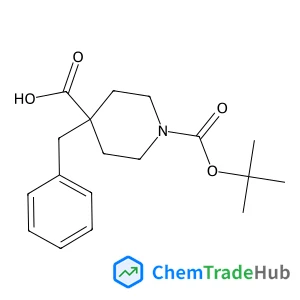
4-Benzyl-1-(tert-butoxycarbonyl)piperidine-4-carboxylic acid
CAS Number:
170838-87-6
Molecular Formula:
C18H25NO4
Recommended Suppliers






Disclaimer
This page provides academic journal information for reference and research purposes only. We are not affiliated with any journal publishers and do not handle publication submissions. For publication-related inquiries, please contact the respective journal publishers directly.
If you notice any inaccuracies in the information displayed, please contact us at support@chemtradehub.com. We will promptly review and address your concerns.